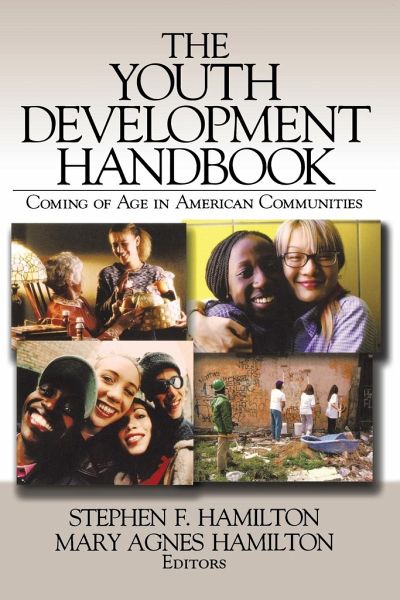
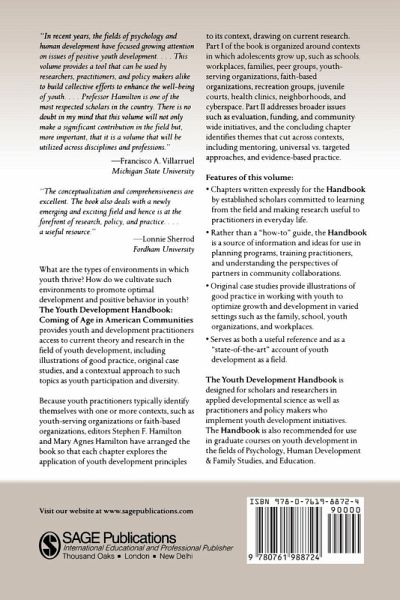
What are the sorts of environments in which youth thrives, and how do we cultivate such environments to promote optimal development and positive behavior in youth? The Youth Development Handbook gives students and practitioners in Development Psychology access to current theory and research along with illustrations of good practice. The main section is organized around the contexts in which adolescents grow up - families and neighbourhoods, peer groups, schools, youth groups and recreation groups, workplaces, religious organizations, health centers, youth courts, cyberspace. Each chapter…mehr
What are the sorts of environments in which youth thrives, and how do we cultivate such environments to promote optimal development and positive behavior in youth? The Youth Development Handbook gives students and practitioners in Development Psychology access to current theory and research along with illustrations of good practice. The main section is organized around the contexts in which adolescents grow up - families and neighbourhoods, peer groups, schools, youth groups and recreation groups, workplaces, religious organizations, health centers, youth courts, cyberspace. Each chapter explores the application of youth development principles to its context, drawing on current research. The next section addresses evaluation, funding, and community-wide initiatives. The concluding chapter identifies multidisciplinary themes, including youth participation, mentoring, universal versus targeted approaches, diversity, and evidence-based practice.
Stephen F. Hamilton is Professor of Human Development and Co-Director of the Family Life Development Center at Cornell University. His research and outreach support youth development, especially through 4-H, the youth component of Cooperative Extension. As a Fulbright Senior Research Fellow, he studied Germany′s apprenticeship system as an institution supporting the transition to adulthood of youth without college degrees. His book, Apprenticeship for Adulthood, and the demonstration project he designed and led with Mary Agnes Hamilton helped to guide the School-to-Work Opportunities Act of 1994. He has also conducted research and contributed to program development related to service-learning and mentoring. He received his M.A.T. and Ed.D. from the Harvard Graduate School of Education and taught for three years in a Washington, D.C., vocational high school. Mary Agnes Hamilton is a Senior Research Associate in Human Development at Cornell and Director of the Cornell Youth and Work Program in the Family Life Development Center. Dr. Hamilton taught for four years in public schools in Richmond, VA, and Montgomery County, Maryland. Dr. Hamilton′s primary interests are education and adolescent development. Her research and program development focus on the quality of learning environments in the community, mentoring relationships between non-related adults and youth, and the transition to adulthood. She seeks to advance educational opportunities and challenges for all youth to gain character and competence. She is especially interested in those young people who do not graduate from four-year colleges. She has an M.A.T. from Duke, C.A.T. from Harvard, and Ph.D. from Cornell.
Inhaltsangabe
Foreword Preface INTRODUCTION: WHAT IS YOUTH DEVELOPMENT? 1. Principles for Youth Development - Stephen F. Hamilton, Mary Agnes Hamilton (both of Cornell University), & Karen Johnson Pittman (Executive Director, The Forum for Youth Investment) SECTION ONE: PROCESSES & PRACTICES IN YOUTH DEVELOPMENT CONTEXTS 2. Youth Organizations: From Principles to Practice - Sarah Deschenes (Stanford University), Morva McDonald (University of Maryland), & Milbrey McLaughlin (Stanford University) 3. Organizations Serving All Ages - Geoffrey L. Ream (Cornell University) & Peter A. Witt (Texas A&M University) 4. Bridging Juvenile Justice & Positive Youth Development - William H. Barton (University of Indiana) 5. Youth Development & Health - Richard Kreipe (University of Rochester), Sheryl A. Ryan (University of Rochester & Rochester General Hospital), & Susan Seibold-Simpson (University of Rochester) 6. Can High Schools Foster Youth Development? - Jerome Ziegler (Cornell University) 7. Designing Work & Service for Learning - Mary Agnes Hamilton & Stephen F. Hamilton (both of Cornell University) 8. Using & Building Family Strengths to Promote Youth Development - Catherine P. Bradshaw & James Garbarino (both of Cornell University) 9. Enlisting Peers in Developmental Interventions: Principles & Practices - Michael J. Karcher (University of Texas at San Antonio), Bradford B. Brown (University of Wisconsin-Madison), & Douglas W. Elliott (Cornell University) 10. How Neighborhoods Matter for Youth Development - Ray Swisher & Janis Whitlock (both of Cornell University) 11. Popular Media Culture & the Promise of Critical Media Literacy - Jane D. Brown, Rebecca Schaffer, Lucila Vargas (all of University of North Carolina at Chapel Hill), & LaHoma S. Romocki (Director of Communication, Family Health International) SECTON TWO: ACTION STEPS 12. Success Factors in Community-wide Initiatives for Youth Development - Kathleen A. Dorgan & Ronald F. Ferguson (Malcolm Wiener Center for Social Policy, JFK School of Government, Harvard University) 13. Understanding & Improving Youth Development Initiatives through Evaluation - Charles V. Izzo, James Connell, Michelle Alberti Gambone, & Catherine P, Bradshaw 14. Understanding the Lay of the Land: Strategies for Funding Youth Development Programs - Glenda Partee (President, American Youth Policy Forum) 15. Implications for Youth Development Practices - Stephen F. Hamilton & Mary Agnes Hamilton (both of Cornell University)
Foreword Preface INTRODUCTION: WHAT IS YOUTH DEVELOPMENT? 1. Principles for Youth Development - Stephen F. Hamilton, Mary Agnes Hamilton (both of Cornell University), & Karen Johnson Pittman (Executive Director, The Forum for Youth Investment) SECTION ONE: PROCESSES & PRACTICES IN YOUTH DEVELOPMENT CONTEXTS 2. Youth Organizations: From Principles to Practice - Sarah Deschenes (Stanford University), Morva McDonald (University of Maryland), & Milbrey McLaughlin (Stanford University) 3. Organizations Serving All Ages - Geoffrey L. Ream (Cornell University) & Peter A. Witt (Texas A&M University) 4. Bridging Juvenile Justice & Positive Youth Development - William H. Barton (University of Indiana) 5. Youth Development & Health - Richard Kreipe (University of Rochester), Sheryl A. Ryan (University of Rochester & Rochester General Hospital), & Susan Seibold-Simpson (University of Rochester) 6. Can High Schools Foster Youth Development? - Jerome Ziegler (Cornell University) 7. Designing Work & Service for Learning - Mary Agnes Hamilton & Stephen F. Hamilton (both of Cornell University) 8. Using & Building Family Strengths to Promote Youth Development - Catherine P. Bradshaw & James Garbarino (both of Cornell University) 9. Enlisting Peers in Developmental Interventions: Principles & Practices - Michael J. Karcher (University of Texas at San Antonio), Bradford B. Brown (University of Wisconsin-Madison), & Douglas W. Elliott (Cornell University) 10. How Neighborhoods Matter for Youth Development - Ray Swisher & Janis Whitlock (both of Cornell University) 11. Popular Media Culture & the Promise of Critical Media Literacy - Jane D. Brown, Rebecca Schaffer, Lucila Vargas (all of University of North Carolina at Chapel Hill), & LaHoma S. Romocki (Director of Communication, Family Health International) SECTON TWO: ACTION STEPS 12. Success Factors in Community-wide Initiatives for Youth Development - Kathleen A. Dorgan & Ronald F. Ferguson (Malcolm Wiener Center for Social Policy, JFK School of Government, Harvard University) 13. Understanding & Improving Youth Development Initiatives through Evaluation - Charles V. Izzo, James Connell, Michelle Alberti Gambone, & Catherine P, Bradshaw 14. Understanding the Lay of the Land: Strategies for Funding Youth Development Programs - Glenda Partee (President, American Youth Policy Forum) 15. Implications for Youth Development Practices - Stephen F. Hamilton & Mary Agnes Hamilton (both of Cornell University)
Es gelten unsere Allgemeinen Geschäftsbedingungen: www.buecher.de/agb
Impressum
www.buecher.de ist ein Internetauftritt der buecher.de internetstores GmbH
Geschäftsführung: Monica Sawhney | Roland Kölbl | Günter Hilger
Sitz der Gesellschaft: Batheyer Straße 115 - 117, 58099 Hagen
Postanschrift: Bürgermeister-Wegele-Str. 12, 86167 Augsburg
Amtsgericht Hagen HRB 13257
Steuernummer: 321/5800/1497
USt-IdNr: DE450055826