

Andere Kunden interessierten sich auch für
 Der Krieg des Yuan-Reiches mit Japan79,90 €
 La guerra dell'Impero Yuan contro il Giappone51,99 €
 A guerra do Império Yuan com o Japão51,99 €
 Marco Polo's fiction about traveling to China82,99 €
 Sword and Scroll: The Duality of Japan's Shogun Era29,99 €
 Sword and Scroll: The Duality of Japan's Shogun Era49,99 €
 Marco Polos Erzählungen über Reisen nach China124,90 €



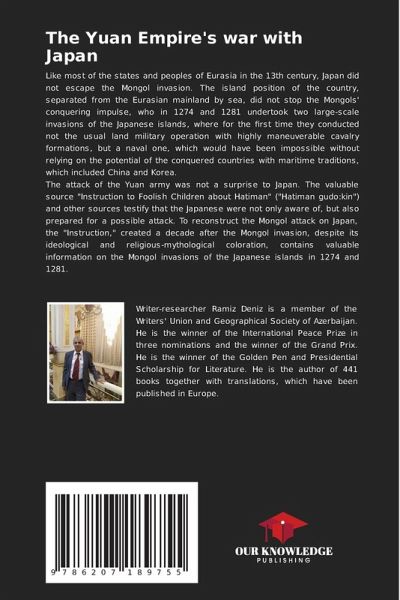
Like most of the states and peoples of Eurasia in the 13th century, Japan did not escape the Mongol invasion. The island position of the country, separated from the Eurasian mainland by sea, did not stop the Mongols' conquering impulse, who in 1274 and 1281 undertook two large-scale invasions of the Japanese islands, where for the first time they conducted not the usual land military operation with highly maneuverable cavalry formations, but a naval one, which would have been impossible without relying on the potential of the conquered countries with maritime traditions, which included China and Korea.The attack of the Yuan army was not a surprise to Japan. The valuable source "Instruction to Foolish Children about Hatiman" ("Hatiman gudo:kin") and other sources testify that the Japanese were not only aware of, but also prepared for a possible attack. To reconstruct the Mongol attack on Japan, the "Instruction," created a decade after the Mongol invasion, despite its ideological and religious-mythological coloration, contains valuable information on the Mongol invasions of the Japanese islands in 1274 and 1281.