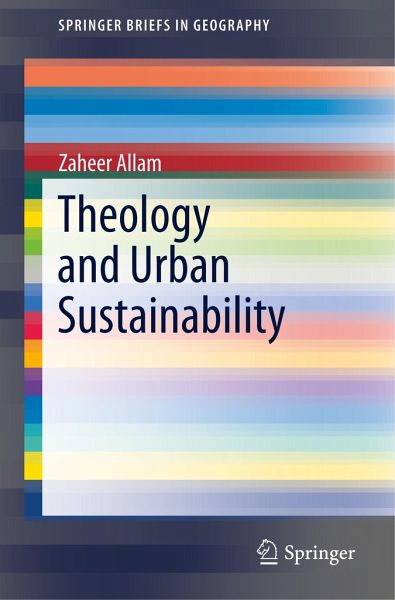
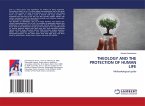
Even though theology does provide interesting and important contributions to ethics that laid the foundation of our modern societies, this book looks at exploring how theology has impacted on urban morphology and has led to questionable unsustainable practices which impacts on both climate and societal living standards. This is seen as being accelerated with the impacts of climate change coupled with increasing urbanisation rates that stresses on contemporary notions and foundations, as initially sparked by religion. Through an argumentative style, the author sets forth to explore the ethics…mehr
Even though theology does provide interesting and important contributions to ethics that laid the foundation of our modern societies, this book looks at exploring how theology has impacted on urban morphology and has led to questionable unsustainable practices which impacts on both climate and societal living standards. This is seen as being accelerated with the impacts of climate change coupled with increasing urbanisation rates that stresses on contemporary notions and foundations, as initially sparked by religion. Through an argumentative style, the author sets forth to explore the ethics of religious dogmas in a rapidly urbanising world that is stressed by increasing consumption from a booming demographic.
Dr. Zaheer Allam holds a PhD in Humanities, a Master of Arts (Res), an MBA, and a Bachelor of Applied Science in Architectural Science from universities in Australia and the United Kingdom. Based in Mauritius, he is the Chairperson of the National Youth Environment Council (NYEC) and a board member of the Mauritius Renewable Energy Agency (MARENA) and works on several projects on the thematic of Smart Cities and on strategies dwelling in the increasing role of technology in Culture and the Society. Zaheer is also the African Representative of the International Society of Biourbanism (ISB), member of the Advisory Circle of the International Federation of Landscape Architects (IFLA), and a member of several other international bodies. He holds several awards and commendations and is the author of over 125 peer reviewed publications and author of 8 books about Smart, Sustainable and Future Cities. Peter Newman is the Professor of Sustainability at Curtin University. Peter has written 23 books and over 400 papers on sustainable cities and decarbonization policy and is one of the most highly cited authors in sustainable urban planning. He created the term automobile dependence in the 1980's which is now standard terminology in urban planning and his book with Jeff Kenworthy has been called 'one of the most influential planning books of all time'. Peter has worked to deliver his ideas in all levels of government having been an elected councillor, seconded to advise three Premiers in Western Australia (1986, 1989, 2001-3) and on the Board of Infrastructure Australia 2008-14. He has been involved in IPCC for ten years and is presently the Co-ordinating Lead Author for the IPCC on Transport. In 2014 he was awarded an Order of Australia for his contributions to urban design and sustainable transport. In 2018/19 he was the Western Australian Scientist of the Year. He is the Editor-in-Chief of the journal Sustainable Earth Reviews.
Inhaltsangabe
Religion and Urban Planning.- Religious Matrimony and Urban Sprawl.- The dichotomy between the living and the dead.- Theology and Governance.- On Faith and Big Data.-Conclusion.
Religion and Urban Planning.- Religious Matrimony and Urban Sprawl.- The dichotomy between the living and the dead.- Theology and Governance.- On Faith and Big Data.-Conclusion.
Es gelten unsere Allgemeinen Geschäftsbedingungen: www.buecher.de/agb
Impressum
www.buecher.de ist ein Internetauftritt der buecher.de internetstores GmbH
Geschäftsführung: Monica Sawhney | Roland Kölbl | Günter Hilger
Sitz der Gesellschaft: Batheyer Straße 115 - 117, 58099 Hagen
Postanschrift: Bürgermeister-Wegele-Str. 12, 86167 Augsburg
Amtsgericht Hagen HRB 13257
Steuernummer: 321/5800/1497
USt-IdNr: DE450055826