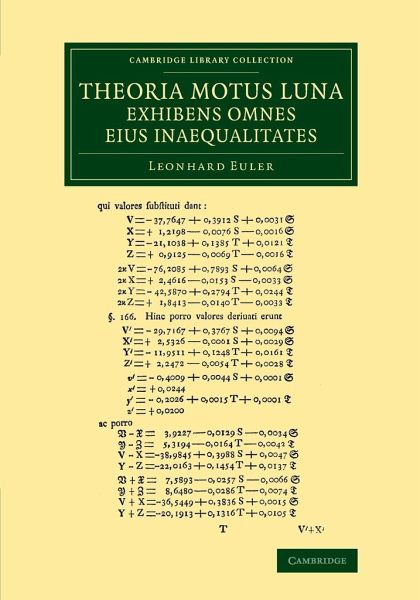
The problem of the moon's orbit was one that Leonhard Euler (1707-83) returned to repeatedly throughout his life. It provided a testing ground for Newton's theory of gravitation. Could the motion of the moon be entirely accounted for by Newton's theory? Or, as Euler initially suspected, did other forces need to be invoked? For practical purposes, if the moon's orbit could be accurately predicted, its motion would provide the universal timekeeper required to solve the longitude problem. In addition to the mathematical 'three-body problem', a topic still under investigation today, Euler was…mehr
The problem of the moon's orbit was one that Leonhard Euler (1707-83) returned to repeatedly throughout his life. It provided a testing ground for Newton's theory of gravitation. Could the motion of the moon be entirely accounted for by Newton's theory? Or, as Euler initially suspected, did other forces need to be invoked? For practical purposes, if the moon's orbit could be accurately predicted, its motion would provide the universal timekeeper required to solve the longitude problem. In addition to the mathematical 'three-body problem', a topic still under investigation today, Euler was faced with the statistical problem of reconciling observations rendered inconsistent by experimental error. The present work, published in Latin in 1753, is Euler's triumphant solution. It may not be the last word on a subject which has occupied mathematicians and astronomers for over three centuries, but it showed that Newton's laws were sufficient to explain lunar motion.
Leonhard Euler (/'??l?r/ OY-l?r;[2] German: ['??l?r] (About this sound listen); 15 April 1707 - 18 September 1783) was a Swiss mathematician, physicist, astronomer, logician and engineer, who made important and influential discoveries in many branches of mathematics, such as infinitesimal calculus and graph theory, while also making pioneering contributions to several branches such as topology and analytic number theory. He also introduced much of the modern mathematical terminology and notation, particularly for mathematical analysis, such as the notion of a mathematical function.[3] He is also known for his work in mechanics, fluid dynamics, optics, astronomy, and music theory.[4] Euler was one of the most eminent mathematicians of the 18th century and is held to be one of the greatest in history. He is also widely considered to be the most prolific mathematician of all time. His collected works fill 60 to 80 quarto volumes,[5] more than anybody in the field. He spent most of his adult life in Saint Petersburg, Russia, and in Berlin, then the capital of Prussia. A statement attributed to Pierre-Simon Laplace expresses Euler's influence on mathematics: ""Read Euler, read Euler, he is the master of us all.""[6][7] Leonhard Euler was born on 15 April 1707, in Basel, Switzerland to Paul III Euler, a pastor of the Reformed Church, and Marguerite née Brucker, a pastor's daughter. He had two younger sisters: Anna Maria and Maria Magdalena, and a younger brother Johann Heinrich.[8] Soon after the birth of Leonhard, the Eulers moved from Basel to the town of Riehen, where Euler spent most of his childhood. Paul Euler was a friend of the Bernoulli family; Johann Bernoulli was then regarded as Europe's foremost mathematician, and would eventually be the most important influence on young Leonhard. Euler's formal education started in Basel, where he was sent to live with his maternal grandmother. In 1720, aged thirteen, he enrolled at the University of Basel, and in 1723, he received a Master of Philosophy with a dissertation that compared the philosophies of Descartes and Newton. During that time, he was receiving Saturday afternoon lessons from Johann Bernoulli, who quickly discovered his new pupil's incredible talent for mathematics.[9] At that time Euler's main studies included theology, Greek, and Hebrew at his father's urging in order to become a pastor, but Bernoulli convinced his father that Leonhard was destined to become a great mathematician. In 1726, Euler completed a dissertation on the propagation of sound with the title De Sono.[10] At that time, he was unsuccessfully attempting to obtain a position at the University of Basel. In 1727, he first entered the Paris Academy Prize Problem competition; the problem that year was to find the best way to place the masts on a ship. Pierre Bouguer, who became known as ""the father of naval architecture"", won and Euler took second place. Euler later won this annual prize twelve times.[11]
Inhaltsangabe
Praefatio Introductio 1. De motu corporis a viribus quibuscunque sollicitati 2. Investigatio virium lunam sollicitantium 3. Introductio anomaliae verae lunae in precedentes aequationes 4. Investigatio inaequalitatis lunae absolutae, quae variatio dicitur 5. Investigatio inaequalitatum lunae ab eius excentricitate simplici solum pendentium 6. Investigatio inaequalitatum lunae a quadrato excentricitatis ipsius ortarum 7. Correctio inaequalitatum lunae hactenus inventarum 8. De motu apogei lunae 9. Investigatio inaequalitatum lunae a sola excentricitate orbitae solis pendentium 10. Investigatio inaequalitatum lunae ab utriusque orbitae excentricitate simul pendentium 11. Investigatio inaequalitatum lunae a parallaxi solis pendentium 12. Investigatio inaequalitatum motum lineae nodorum afficientium 13. Investigatio inclinationis orbitae lunaris as eclipticam cum eius variatione 14. Investigatio inaequalitatum lunae ab eius inclinatione ad eclipticam oriundarum 15. Accuratior investigatio inaequalitatum lunae ab inclinatione eius orbitae pendentium 16. Expositio inaequalitatumlunae hactenus inventarum 17. Investigatio elementorum motus lunae 18. Constitutio elementorum pro tabulis lunaribus Additamentum.