
Andere Kunden interessierten sich auch für
 OVERVIEW AND UNDERSTADING OF OBJECT ORIENTED PROGRAMMING USING JAVA53,99 €
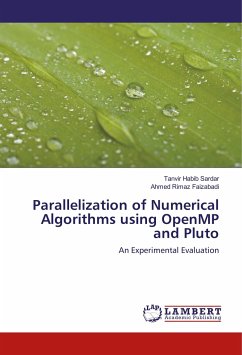
 Parallelization of Numerical Algorithms using OpenMP and Pluto27,99 €
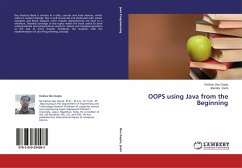
 OOPS using Java from the Beginning58,99 €
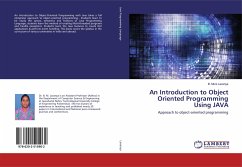
 An Introduction to Object Oriented Programming Using JAVA62,99 €
") Programming for Problem Solving (Using C)51,99 €
Programming for Problem Solving (Using C)51,99 € TensorFlow: A Guide to Build Artificial Neural Networks using Python33,99 €
 Variant Handling using ZAC32,99 €


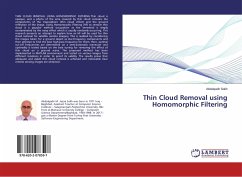
THIN CLOUD REMOVAL USING HOMOMORPHIC FILTERING Thin cloud is opaque, and a photo of the area covered by thin cloud contains the components of the troposphere (thin cloud effect) and the ground reflection of the image. Using Homomorphic Filtering (HF) to remove thin cloud is a popular method occupation as the terrestrial is simply contaminated by the noisy effect which is usually randomly occurring. This research presents an attempt to explain how an HF will be used for thin cloud removal for satellite remote imagery. This is realized by considering the images taken for a ground object as low-frequency components and then attempt to find the best high-pass frequency for them. Here, optimal cut-off frequencies are determined on a semi-automatic maneuver and optimality is tested based on the best tuning for removing the effect of thin cloud on a ground scene. The proposed method has been implemented in MATLAB environment and tested on various images from different locations in orderto proof its validity. The results prove that adequate and viable thin cloud removal is achieved and noticeable clear remote sensing images are obtained.