
Andere Kunden interessierten sich auch für
 'My Share of God's Reward'97,20 €
 Tertullian's Use of the Pastoral Epistles, Hebrews, James, 1 and 2 Peter, and Jude91,55 €
 From John of Apamea to Mark's Gospel83,00 €
 Andrew of Bethsaida and the Johannine Circle91,55 €
 Anti-Cultic Theology in Christian Biblical Interpretation66,95 €
 Reclaiming Divine Wrath64,80 €
 Holiness and Community in 2 Cor 6:14-7:162,95 €
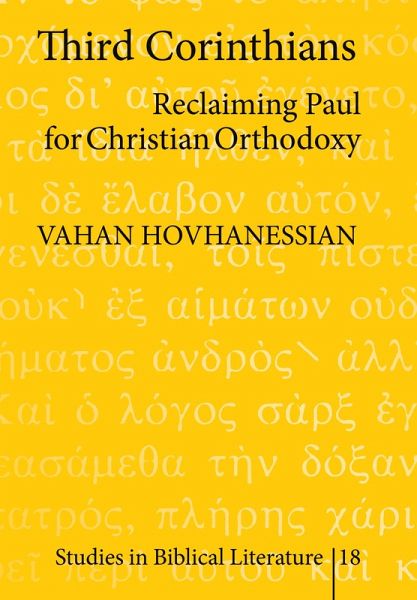
This work is an extensive twentieth-century examination of Third Corinthians, a pseudepigraphon attributed to the apostle Paul. It includes a comprehensive overview of the various manuscripts of Third Corinthians and the textual variations among them. This study carefully examines these variations, securely establishes the original text, and provides a new English translation. Referencing early manuscripts, canon lists, patristic commentaries, and lectionaries, the volume establishes the history of the use of Third Corinthians in the early Church. The study contains an in-depth exploration of the theological implications of early Church controversies, focusing on the resurrection of the dead. The work is a portrayal of the surprisingly diverse Christianity of the second century.
"Father Hovhanessian's work explores an apocryphon to which relatively few scholarly studies have been devoted, particularly in the English language during the past half century. It is also a work that vividly illustrates the second-century struggles between Christian orthodoxy and very powerful heterodox voices over the legacy of St. Paul. Father Hovhanessian engages first in the indispensable reconstruction of the original text, then explores the crucial theological issues at stake in the pseudepigrapher's combat with Paul's 'kidnappers'." (Richard J. Dillon, Professor of Biblical Studies, Fordham University, New York)
"Father Hovhanessian has broached one of the New Testament Apocrypha. In many Armenian manuscript Bibles, Third Corinthians appears alongside the two canonical epistles. What is it? How did it become so closely associated with the New Testament Canon? Why was it written and what was the occasion of its composition? Father Hovhanessian has given clear and insightful answers to these questions, recovering for us another aspect of early Christianity." (Michael E. Stone, Professor of Armenian Studies, Hebrew University of Jerusalem, Jerusalem)
"Utilizing rare important documents from the second century, Father Hovhanessian unfolds a remarkable chapter in the development of the Pauline tradition, one that is seldom addressed in early Christian studies." (Abraham Terian, Academic Dean and Professor of Patristics, St. Nersess Armenian Seminary, New York)
"Father Hovhanessian has broached one of the New Testament Apocrypha. In many Armenian manuscript Bibles, Third Corinthians appears alongside the two canonical epistles. What is it? How did it become so closely associated with the New Testament Canon? Why was it written and what was the occasion of its composition? Father Hovhanessian has given clear and insightful answers to these questions, recovering for us another aspect of early Christianity." (Michael E. Stone, Professor of Armenian Studies, Hebrew University of Jerusalem, Jerusalem)
"Utilizing rare important documents from the second century, Father Hovhanessian unfolds a remarkable chapter in the development of the Pauline tradition, one that is seldom addressed in early Christian studies." (Abraham Terian, Academic Dean and Professor of Patristics, St. Nersess Armenian Seminary, New York)