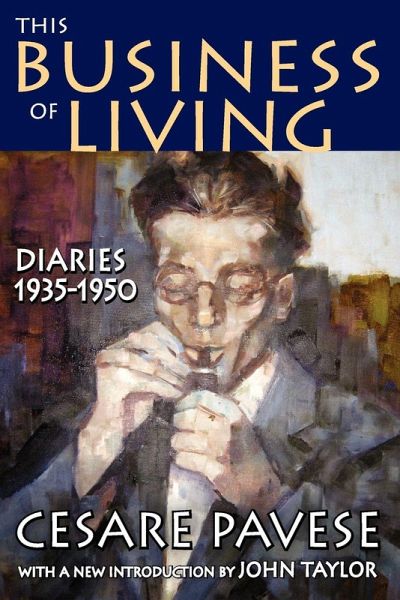
On June 23rd, 1950, Pavese, Italy's greatest modern writer received the coveted Strega Award for his novel Among Women Only. On August 26th, in a small hotel in his home town of Turin, he took his own life. Shortly before his death, he methodically destroyed all his private papers. His diary is all that remains and for this the contemporary reader can be grateful. Contemporary speculation attributed this tragedy to either an unhappy love aff air with the American film star Constance Dawling or his growing disillusionment with the Italian Communist Party. His Diaries, however, reveal a man…mehr
On June 23rd, 1950, Pavese, Italy's greatest modern writer received the coveted Strega Award for his novel Among Women Only. On August 26th, in a small hotel in his home town of Turin, he took his own life. Shortly before his death, he methodically destroyed all his private papers. His diary is all that remains and for this the contemporary reader can be grateful. Contemporary speculation attributed this tragedy to either an unhappy love aff air with the American film star Constance Dawling or his growing disillusionment with the Italian Communist Party. His Diaries, however, reveal a man whose art was his only means of repressing the specter of suicide which had haunted him since childhood: an obsession that finally overwhelmed him. As John Taylor notes, he possessed something much more precious than a political theory: a natural sensitivity to the plight and dignity of common people, be they bums, priests, grape-pickers, gas station attendants, office workers, or anonymous girls picked up on the street (though to women, the author could--as he admitted--be as misogynous as he was affectionate). Bitter and incisive, This Business of Living, is both moving and painful to read and stands with James Joyce's Letters and Andre Gide's Journals as one of the great literary testaments of the twentieth century.
Cesare Pavese was a novelist, poet, translator, editor, and literary critic, considered one of the most influential Italian intellectuals of the twentieth century. Born in 1908 in Santo Stefano Belbo, a small village in the Langhe region of Piedmont, he graduated from the University of Turin with a thesis on the poetry of Walt Whitman. Pavese played a key role in introducing Italian readers to major English and American writers, translating works by authors such as Joyce, Defoe, Melville, and Faulkner. As an editor at the prestigious Einaudi publishing house, Pavese oversaw the publication of novels by Natalia Ginzburg and Italo Calvino. A pioneer of literary neorealism, Pavese's work explores themes of loneliness and alienation, often featuring protagonists struggling to reconnect with a simpler rural past.Pavese battled depression throughout his life. In 1950, two months after winning the Strega Prize, Italy's most prestigious literary award, and following a failed love affair with Hollywood actress Constance Dowling, he tragically ended his life in a hotel room near Turin's railway station.
Es gelten unsere Allgemeinen Geschäftsbedingungen: www.buecher.de/agb
Impressum
www.buecher.de ist ein Internetauftritt der buecher.de internetstores GmbH
Geschäftsführung: Monica Sawhney | Roland Kölbl | Günter Hilger
Sitz der Gesellschaft: Batheyer Straße 115 - 117, 58099 Hagen
Postanschrift: Bürgermeister-Wegele-Str. 12, 86167 Augsburg
Amtsgericht Hagen HRB 13257
Steuernummer: 321/5800/1497
USt-IdNr: DE450055826