
Andere Kunden interessierten sich auch für
 Life and Letters of Thomas Henry Huxley37,99 €
 Life and Letters of Thomas Henry Huxley31,99 €
 Thomas Henry Huxley30,99 €
 The Life And Letters Of Thomas Henry Huxley V.132,99 €
 Life and Letters of Thomas Henry Huxley31,99 €
 Thomas Henry Huxley32,99 €
 Life and Letters of Thomas Henry Huxley32,99 €





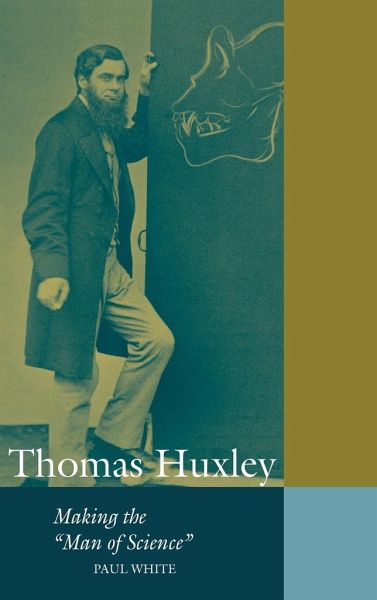
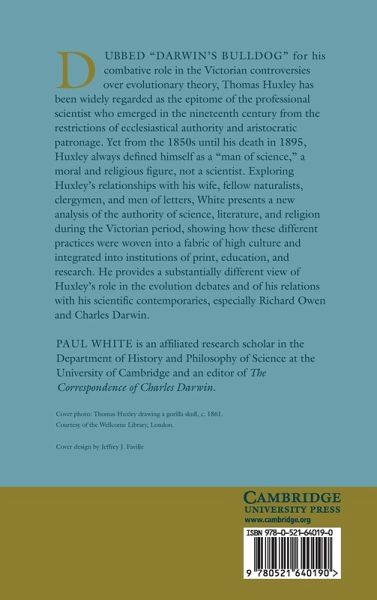
Dubbed 'Darwin's Bulldog' for his combative role in the Victorian controversies over evolutionary theory, Thomas Huxley has been widely regarded as the epitome of the professional scientist who emerged in the nineteenth century from the restrictions of ecclesiastical authority and aristocratic patronage. Yet from the 1850s until his death in 1895, Huxley always defined himself as a 'man of science', a moral and religious figure, not a scientist. Exploring his relationships with his wife, fellow naturalists, clergymen and men of letters, White presents a new analysis of the authority of science, literature, and religion during the Victorian period, showing how these different practices were woven into a fabric of high culture, and integrated into institutions of print, education and research. He provides a substantially different view of Huxley's role in the evolution debates, and of his relations with his scientific contemporaries, especially Richard Owen and Charles Darwin.