
Andere Kunden interessierten sich auch für
 Sky.Pond.Mouth.19,99 €
 Shattered17,99 €
 In the Care of Plenty11,99 €
 Before the Sun Rises15,99 €
 In the Care of Plenty23,99 €
 Master of Distances16,99 €
 Get Well Soon29,99 €
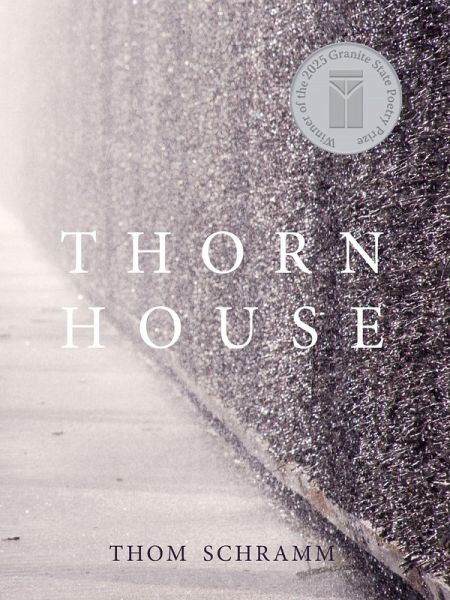
When judging a book contest, every judge hopes for a book that grabs their attention and refuses to let go. Thorn House by Thom Schramm, with its abundance of skillfully wrought music and its wrecked, unruly heart, stood out to me in this way. This is a collection that enthralls the reader from the lyrical hypnosis of the very first poem, weaving a spell that propels us through the book's entirety. As the title suggests, we are both damaged and sheltered by these poems, scratched and bloodied by their barbed circumstances even as we are comforted by their softness. The poems place us inside a New Hampshire wood both sinister and beautiful until Thorn House becomes a book of fairy tales that guide us through to an oven, to a stranger's bed, to a long deep sleep. In Thorn House, the domestic is treacherous and the dangerous is home. An unspoken understanding between reader and speaker exists-we are in the church of the wound or the scratch or the scrape-as clipped, careful moments tug against the chaos at the edge of each poem. Schramm's opening poem shows a speaker seeking to "hatch" and to "heal" from the past. By the book's final piece, the cumulative damage is a literal crack down the center of a poem that finally heals by its end. This is a book thick with New England graveyards, bloodied birch trees, forest pathways lined with the hung bodies of trapped rabbits. At the heart of each line and stanza sits the New Hampshire wilderness, a place of cold and remoteness and wonder, a place that offers refuge from family but also its own dangers. In "Wake: 1978," the arrival of an ice cream truck is juxtaposed with a dead child lying in a living room coffin. In "In Silence," snakes emerge from a concrete set of steps poured badly and in "Yesterday I Wrote a Poem Called 'Yesterday'," "Mother preaches 'her strictures-scriptures that were best obeyed." In several poems, including "Hide and Seek," children disappear into the woods and are unable to be found. The parents in the collection are shadowy figures who are sometimes avoided or escaped. Poems of family and damage in Thorn House are balanced by a quieter series of eight 19-line poems centered around a correspondence with former New Hampshire Poet Laureate Jane Kenyon both before and during her illness. These poems capture moments of intimacy and fear and add to the foreboding sense of the collection, the feeling that we are in a darkness of the woods edged by the comfort of connection. As we read snippets of letters, caring inquiries and sentiments, and the news of her illness and decline, we see how the pain of two people can bond them together. Kenyon's cursive is "small, like nerve endings." Her pain is a "bone pain" suffered for too long. A reaching out across miles and silences becomes clear, as does the urgency of connection. Then finally the news of Kenyon's leukemia breaks, and a postscript to the exchange depicts a reflection at Kenyon's grave in Andover, New Hampshire, in a silence of snow. From the Introduction by Jennifer Militello, New Hampshire Poet Laureate