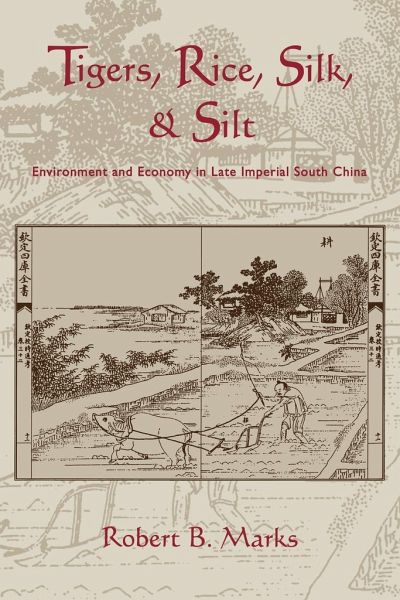
Robert Marks (California Whittier College)Environment and Economy in Late Imperial South China
Tigers, Rice, Silk, and Silt
Environment and Economy in Late Imperial South China
Herausgeber: Worster, Donald; Crosby, Alfred W.
Robert Marks (California Whittier College)Environment and Economy in Late Imperial South China
Tigers, Rice, Silk, and Silt
Environment and Economy in Late Imperial South China
Herausgeber: Worster, Donald; Crosby, Alfred W.
- Broschiertes Buch
- Merkliste
- Auf die Merkliste
- Bewerten Bewerten
- Teilen
- Produkt teilen
- Produkterinnerung
- Produkterinnerung
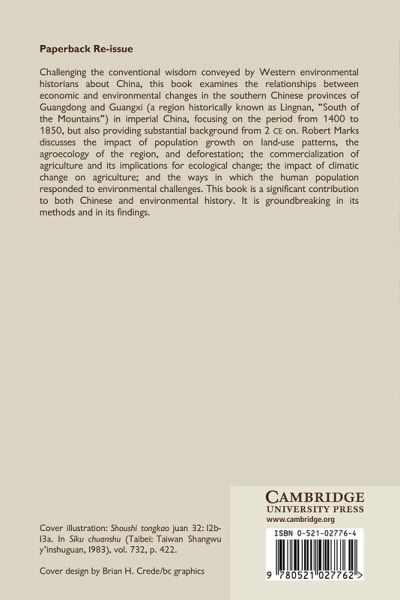
Challenging conventional Western wisdom, Marks examines the relationship between economic and environmental changes in the imperial Chinese provinces of Guangdong and Guangxi (a region historically known as Lingnan, 'South of the Mountains') from 1400 to 1850.
Andere Kunden interessierten sich auch für
Richard H. Grove (Canberra Australian National University)Green Imperialism45,99 €
Ellen F. Arnold (Ohio State University)Medieval Riverscapes37,99 €
Peder Anker (New York University)The Power of the Periphery32,99 €
Margaret Cook (Queensland University of the Sunshine Coast)Cities in a Sunburnt Country38,99 €
Richard C. Hoffmann (Toronto York University)The Catch52,99 €
Richard C. Hoffmann (Toronto York University)The Catch119,99 €
Samuel Dolbee (Tennessee Vanderbilt University)Locusts of Power29,99 €-
-
-
Challenging conventional Western wisdom, Marks examines the relationship between economic and environmental changes in the imperial Chinese provinces of Guangdong and Guangxi (a region historically known as Lingnan, 'South of the Mountains') from 1400 to 1850.
Produktdetails
- Produktdetails
- Studies in Environment and History
- Verlag: Cambridge University Press
- Seitenzahl: 408
- Erscheinungstermin: 25. Juli 2006
- Englisch
- Abmessung: 234mm x 156mm x 22mm
- Gewicht: 628g
- ISBN-13: 9780521027762
- ISBN-10: 0521027764
- Artikelnr.: 21043659
- Herstellerkennzeichnung
- Libri GmbH
- Europaallee 1
- 36244 Bad Hersfeld
- gpsr@libri.de
- Studies in Environment and History
- Verlag: Cambridge University Press
- Seitenzahl: 408
- Erscheinungstermin: 25. Juli 2006
- Englisch
- Abmessung: 234mm x 156mm x 22mm
- Gewicht: 628g
- ISBN-13: 9780521027762
- ISBN-10: 0521027764
- Artikelnr.: 21043659
- Herstellerkennzeichnung
- Libri GmbH
- Europaallee 1
- 36244 Bad Hersfeld
- gpsr@libri.de
List of maps, figures, and tables
Dynasties, Qing dynasty Emperors' reign dates, and weights and measures
Acknowledgments
Introduction
1. 'Firs and pines a hundred spans round': the natural environment of Lingnan
2. 'All deeply forested and wild places are not malarious': human settlement and ecological change in Lingnan, 2-1400 CE
3. 'Agriculture is the foundation': economic recovery and development of Lingnan during the Ming Dynasty, 1368-1644
4. 'All the people have fled': war and the environment in the mid-seventeenth century crisis, 1644-83
5. 'Rich households compete to build ships': overseas trade and economic recovery
6. 'It never used to snow': climate change and agricultural productivity
7. 'There is only a certain amount of grain produced': granaries and the role of the state in the food supply system
8. 'Trade in rice is brisk:' market integration and the environment
9. 'Population increases daily, but the land does not': land clearance in the eighteenth century
10. 'People said that extinction was not possible': the ecological consequences of land clearance
Conclusion
Bibliography
Index.
Dynasties, Qing dynasty Emperors' reign dates, and weights and measures
Acknowledgments
Introduction
1. 'Firs and pines a hundred spans round': the natural environment of Lingnan
2. 'All deeply forested and wild places are not malarious': human settlement and ecological change in Lingnan, 2-1400 CE
3. 'Agriculture is the foundation': economic recovery and development of Lingnan during the Ming Dynasty, 1368-1644
4. 'All the people have fled': war and the environment in the mid-seventeenth century crisis, 1644-83
5. 'Rich households compete to build ships': overseas trade and economic recovery
6. 'It never used to snow': climate change and agricultural productivity
7. 'There is only a certain amount of grain produced': granaries and the role of the state in the food supply system
8. 'Trade in rice is brisk:' market integration and the environment
9. 'Population increases daily, but the land does not': land clearance in the eighteenth century
10. 'People said that extinction was not possible': the ecological consequences of land clearance
Conclusion
Bibliography
Index.
List of maps, figures, and tables
Dynasties, Qing dynasty Emperors' reign dates, and weights and measures
Acknowledgments
Introduction
1. 'Firs and pines a hundred spans round': the natural environment of Lingnan
2. 'All deeply forested and wild places are not malarious': human settlement and ecological change in Lingnan, 2-1400 CE
3. 'Agriculture is the foundation': economic recovery and development of Lingnan during the Ming Dynasty, 1368-1644
4. 'All the people have fled': war and the environment in the mid-seventeenth century crisis, 1644-83
5. 'Rich households compete to build ships': overseas trade and economic recovery
6. 'It never used to snow': climate change and agricultural productivity
7. 'There is only a certain amount of grain produced': granaries and the role of the state in the food supply system
8. 'Trade in rice is brisk:' market integration and the environment
9. 'Population increases daily, but the land does not': land clearance in the eighteenth century
10. 'People said that extinction was not possible': the ecological consequences of land clearance
Conclusion
Bibliography
Index.
Dynasties, Qing dynasty Emperors' reign dates, and weights and measures
Acknowledgments
Introduction
1. 'Firs and pines a hundred spans round': the natural environment of Lingnan
2. 'All deeply forested and wild places are not malarious': human settlement and ecological change in Lingnan, 2-1400 CE
3. 'Agriculture is the foundation': economic recovery and development of Lingnan during the Ming Dynasty, 1368-1644
4. 'All the people have fled': war and the environment in the mid-seventeenth century crisis, 1644-83
5. 'Rich households compete to build ships': overseas trade and economic recovery
6. 'It never used to snow': climate change and agricultural productivity
7. 'There is only a certain amount of grain produced': granaries and the role of the state in the food supply system
8. 'Trade in rice is brisk:' market integration and the environment
9. 'Population increases daily, but the land does not': land clearance in the eighteenth century
10. 'People said that extinction was not possible': the ecological consequences of land clearance
Conclusion
Bibliography
Index.