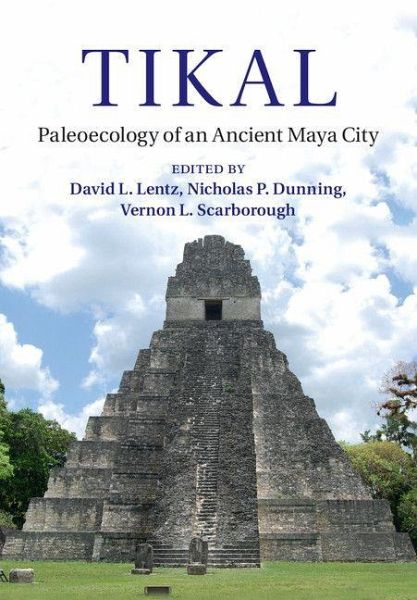
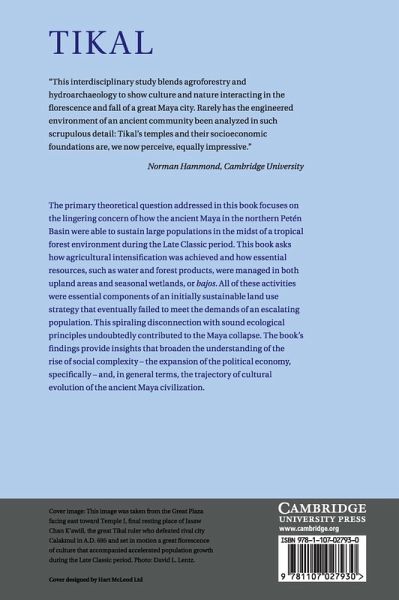
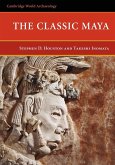
The primary theoretical question addressed in this book focuses on the lingering concern of how the ancient Maya in the northern Petén Basin were able to sustain large populations in the midst of a tropical forest environment during the Late Classic period. This book asks how agricultural intensification was achieved and how essential resources, such as water and forest products, were managed in both upland areas and seasonal wetlands, or bajos. All of these activities were essential components of an initially sustainable land use strategy that eventually failed to meet the demands of an…mehr
The primary theoretical question addressed in this book focuses on the lingering concern of how the ancient Maya in the northern Petén Basin were able to sustain large populations in the midst of a tropical forest environment during the Late Classic period. This book asks how agricultural intensification was achieved and how essential resources, such as water and forest products, were managed in both upland areas and seasonal wetlands, or bajos. All of these activities were essential components of an initially sustainable land use strategy that eventually failed to meet the demands of an escalating population. This spiraling disconnect with sound ecological principles undoubtedly contributed to the Maya collapse. The book's findings provide insights that broaden the understanding of the rise of social complexity - the expansion of the political economy, specifically - and, in general terms, the trajectory of cultural evolution of the ancient Maya civilization.
1. Tikal land water and forest: an introduction Nicholas P. Dunning David L. Lentz and Vernon L. Scarborough; 2. The evolution of an ancient waterworks system at Tikal Vernon L. Scarborough and Liwy Grazioso Sierra; 3. At the core of Tikal: terrestrial sediment sampling and water management Brian Lane Vernon L. Scarborough and Nicholas P. Dunning; 4. Bringing the University of Pennsylvania maps of Tikal into the era of electronic GIS Christopher Carr Eric Weaver Nicholas P. Dunning and Vernon L. Scarborough; 5. Examining landscape modifications for water management at Tikal using three-dimensional modeling with Arcgis .91 Eric Weaver Christopher Carr Nicholas P. Dunning Lee Florea and Vernon L. Scarborough; 6. Life on the edge: Tikal in a bajo landscape Nicholas P. Dunning Robert E. Griffin John G. Jones Richard E. Terry Zachary Larsen and Christopher Carr; 7. Connecting contemporary ecology and ethnobotany to ancient plant use practices of the Maya at Tikal Kim Thompson Angela Hood Dana Cavallaro and David L. Lentz; 8. Agroforestry and agricultural practices of the ancient Maya at Tikal David L. Lentz Kevin Magee Eric Weaver John G. Jones Kenneth B. Tankersley Angela Hood Gerald Islebe Carmen Ramos and Nicholas P. Dunning; 9. Fire and water: the archaeological significance of Tikal's Quaternary sediments Kenneth B. Tankersley Nicholas P. Dunning Vernon L. Scarborough John G. Jones Christopher Carr and David L. Lentz; 10. Fractious farmers at Tikal David Webster and Timothy Murtha; 11. The material culture of Tikal Palma Buttles Carmen Ramos and Fred Valdez Jr; 12. A neighborly view: water and environmental history of the El Zotz region Timothy Beach Sheryl Luzzadder-Beach Jonathan Flood Stephen Houston Thomas Garrison Edwin Román Steve Bozarth and James Doyle; 13. Defining the constructed niche of Tikal: a summary view David L. Lentz Nicholas P. Dunning and Vernon L. Scarborough.
1. Tikal land water and forest: an introduction Nicholas P. Dunning David L. Lentz and Vernon L. Scarborough; 2. The evolution of an ancient waterworks system at Tikal Vernon L. Scarborough and Liwy Grazioso Sierra; 3. At the core of Tikal: terrestrial sediment sampling and water management Brian Lane Vernon L. Scarborough and Nicholas P. Dunning; 4. Bringing the University of Pennsylvania maps of Tikal into the era of electronic GIS Christopher Carr Eric Weaver Nicholas P. Dunning and Vernon L. Scarborough; 5. Examining landscape modifications for water management at Tikal using three-dimensional modeling with Arcgis .91 Eric Weaver Christopher Carr Nicholas P. Dunning Lee Florea and Vernon L. Scarborough; 6. Life on the edge: Tikal in a bajo landscape Nicholas P. Dunning Robert E. Griffin John G. Jones Richard E. Terry Zachary Larsen and Christopher Carr; 7. Connecting contemporary ecology and ethnobotany to ancient plant use practices of the Maya at Tikal Kim Thompson Angela Hood Dana Cavallaro and David L. Lentz; 8. Agroforestry and agricultural practices of the ancient Maya at Tikal David L. Lentz Kevin Magee Eric Weaver John G. Jones Kenneth B. Tankersley Angela Hood Gerald Islebe Carmen Ramos and Nicholas P. Dunning; 9. Fire and water: the archaeological significance of Tikal's Quaternary sediments Kenneth B. Tankersley Nicholas P. Dunning Vernon L. Scarborough John G. Jones Christopher Carr and David L. Lentz; 10. Fractious farmers at Tikal David Webster and Timothy Murtha; 11. The material culture of Tikal Palma Buttles Carmen Ramos and Fred Valdez Jr; 12. A neighborly view: water and environmental history of the El Zotz region Timothy Beach Sheryl Luzzadder-Beach Jonathan Flood Stephen Houston Thomas Garrison Edwin Román Steve Bozarth and James Doyle; 13. Defining the constructed niche of Tikal: a summary view David L. Lentz Nicholas P. Dunning and Vernon L. Scarborough.
Es gelten unsere Allgemeinen Geschäftsbedingungen: www.buecher.de/agb
Impressum
www.buecher.de ist ein Internetauftritt der buecher.de internetstores GmbH
Geschäftsführung: Monica Sawhney | Roland Kölbl | Günter Hilger
Sitz der Gesellschaft: Batheyer Straße 115 - 117, 58099 Hagen
Postanschrift: Bürgermeister-Wegele-Str. 12, 86167 Augsburg
Amtsgericht Hagen HRB 13257
Steuernummer: 321/5800/1497
USt-IdNr: DE450055826