
Andere Kunden interessierten sich auch für
 Tissue Culture and Phytochemical Studies on Solanum surattense Burm. f46,99 €
 GRAIN LEGUME") TISSUE CULTURE STUDIES IN CHICK PEA (CICER ARIETINUM.L.) GRAIN LEGUME45,99 €
TISSUE CULTURE STUDIES IN CHICK PEA (CICER ARIETINUM.L.) GRAIN LEGUME45,99 €, LÉGUMINEUSE À GRAINS") ÉTUDES DE CULTURE DE TISSUS CHEZ LE POIS CHICHE(CICER ARIETINUM.L.), LÉGUMINEUSE À GRAINS44,99 €
ÉTUDES DE CULTURE DE TISSUS CHEZ LE POIS CHICHE(CICER ARIETINUM.L.), LÉGUMINEUSE À GRAINS44,99 €") ESTUDOS DE CULTURA DE TECIDOS EM GRÃO DE ERVILHA(CICER ARIETINUM.L.)44,99 €
ESTUDOS DE CULTURA DE TECIDOS EM GRÃO DE ERVILHA(CICER ARIETINUM.L.)44,99 €") STUDIEN ZUR GEWEBEKULTUR BEI DER KÖRNERLEGUMINOSE KICHERERBSE(CICER ARIETINUM.L.)68,90 €
STUDIEN ZUR GEWEBEKULTUR BEI DER KÖRNERLEGUMINOSE KICHERERBSE(CICER ARIETINUM.L.)68,90 €") STUDI DI COLTURA TISSUTALE IN LEGUMI DA GRANELLA DI CECI(CICER ARIETINUM.L.)44,99 €
STUDI DI COLTURA TISSUTALE IN LEGUMI DA GRANELLA DI CECI(CICER ARIETINUM.L.)44,99 € Tissue Culture and Genetic Transformation Studies on Cucumis melo.L47,99 €
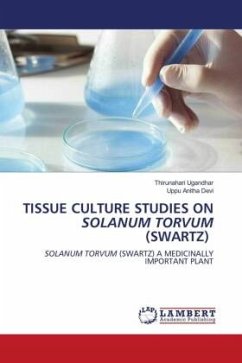
Solanum torvum (Swartz) plants were tested for callus induction, callus-mediated regeneration, direct regeneration, micropropagation, somatic embryogenesis, and protoplast isolation. Below are the work's principal results. To create a callusing protocol for hypocotyl, cotyledon, and leaf explants on a growth regulator-containing medium. Standardize callus-mediated regeneration on varied growth regulator concentrations and combinations. To examine the influence of growth ingredient concentrations and combinations on in vitro plantlet regeneration in leaf and cotyledon explants. Shoo the tip and nodal explants from 30-day-old seedlings induced numerous shoots. Solanum torvum leaf explants somatic embryogenesis and plantlet development. Explants from 30-day-old seedlings planted in glass bottles generated more numerous shoots (8.0/explant) than those grown in glass tubes. In vitro shoots rooted in MS medium with 2.0 mg/L IAA/IBA. After greenhouse hardening, 95% of tissue-culture plantlets survived. Rooted shoots survived (92%) greenhouse hardening and matured (100%) in the field. Leaf explants isolate high amounts of protoplast.