
Andere Kunden interessierten sich auch für
 To Have and to Hold27,90 €
 To Have and To Hold26,99 €
 To Have and to Hold28,99 €
 To Have and to Hold79,90 €
 To Have and to Hold59,90 €
 To Have and to Hold16,99 €
 To Have and to Hold79,90 €
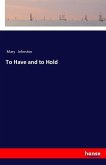

Mary Johnston (November 21, 1870 - May 9, 1936) was an American novelist and women's rights advocate from Virginia. She was one of America's best selling authors during her writing career and had three silent films adapted from her novels. Mary Johnston was born in the small town of Buchanan, Virginia, the eldest child of John William Johnston, an American Civil War veteran, and Elizabeth Dixon Alexander Johnston. Due to frequent illness, she was educated at home by family and tutors. She grew up with a love of books and was financially independent enough to devote herself to writing. Johnston wrote historical books and novels that often combined romance with history. Her first book, Prisoners of Hope (1898), dealt with colonial times in Virginia as did her second novel, To Have and to Hold (1900), and later, Sir Mortimer (1904). The Goddess of Reason (1907) uses the theme of the French Revolution, and in Lewis Rand (1908) the author portrayed political life at the dawn of the 19th century. To Have and to Hold was serialized in The Atlantic Monthly in 1899 and published in book form 1900, by Houghton Mifflin. The book proved enormously popular and was the bestselling novel in the United States in 1900. Johnston's next work, titled Audrey, was the fifth bestselling book in the U.S. in 1902, and Sir Mortimer, serialized in Harper's Monthly magazine from November 1903 through April 1904, was published in 1904. Her best-selling 1911 novel on the American Civil War, The Long Roll, brought Johnston into open conflict with Stonewall Jackson's widow, Mary Anna Jackson. Beyond her native America, Johnston's novels were also very popular in Canada and in England. During her long career Johnston wrote, in addition to 23 novels, numerous short stories, two long narrative poems, and one play. She used her fame to advocate for women's rights and strongly supported the women's suffrage movement. Three of Johnston's books were adapted to film. Audrey was made into a 1916 silent film of the same name, and her blockbuster work To Have and to Hold was made into silent films both in 1916 and in 1922. Pioneers of the Old South was adapted as the film Jamestown (1923).