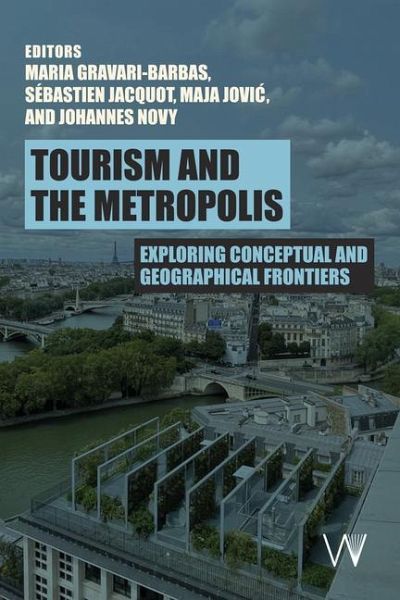
The growing role and relevance of tourism in cities - and of cities in tourism - has in recent decades emerged as a topic of great interest to scholars across many social sciences disciplines. Yet, while urban tourism research has flourished, various issues relating to tourism in metropolitan contexts are in need of greater scholarly engagement. What forms does tourism take in today's metropolises and metropolitan regions? How do these forms differ from tourism in other urban contexts? Are these differences significant enough to warrant the classification of 'metropolitan tourism' as a…mehr
The growing role and relevance of tourism in cities - and of cities in tourism - has in recent decades emerged as a topic of great interest to scholars across many social sciences disciplines. Yet, while urban tourism research has flourished, various issues relating to tourism in metropolitan contexts are in need of greater scholarly engagement. What forms does tourism take in today's metropolises and metropolitan regions? How do these forms differ from tourism in other urban contexts? Are these differences significant enough to warrant the classification of 'metropolitan tourism' as a distinct type of urban tourism? What are their implications for policy and planning processes? How do policy and planning processes in different metropolises and metropolitan regions differ from each other, and what can they learn from each other? And finally, how could tourism in metropolises and metropolitan regions be made more sustainable, resilient, and inclusive? Given the importance widely attributed to major metropolises and metropolitan regions as contemporary engines of economic development, innovation, and change, the widespread portrayal of tourism as a leading economic and social force of the 21st century, and the fact that the world's large metropolitan areas are key recipients of tourism flows, it is surprising how little systematic attention is paid to tourism in metropolitan contexts. This book aims to fill these gaps.
Maria Gravari-Barbas is a professor of Geography at Paris 1 Panthéon-Sorbonne University, France. Trained as an architect and social geographer, her research focuses on urban and metropolitan transformations in relation to heritagization, gentrification, and tourism. She is the Director of EIREST, a multidisciplinary research team dedicated to tourism studies. Since 2009, she has been the director of the UNESCO Chair at Paris 1 Panthéon-Sorbonne University and the coordinator of the UNITWIN network Tourism, Culture, Development. Maria is also the Head of the PhD programme in Cultural Heritage at the European University Alliance Una Europa. Sébastien Jacquot is a lecturer in geography at the University of Paris 1 Panthéon Sorbonne at the Institute for Research and Studies in Tourism (IREST). Since 2020 he is the director of IREST. He is a member of the EA EIREST interdisciplinary research team in tourism, and an associate member of the UMR PRODIG. He is co-responsible for the Heritage Working Group of the Labex Dynamite, member of the UNITWIN network attached to the UNESCO Chair Culture, Tourism, Development. His research is in line with social and urban geography, and focuses on heritage policies, World Heritage and intangible heritage, tourism and digital social networks, tourism observation, metropolitan tourism, heritage from below, globalization and circulations. Maja Jovic is Assistant Head of School of Architecture + Cities at the University of Westminster and Director of Interdisciplinarity and Collaboration. With a background in architecture, her work spans architecture, heritage, tourism, and critical urban studies. She co-founded and co-leads the MA Architecture and Sustainable Heritage programme. Her recent research explores tourism's role in metropolitan transformation, diasporic communities in metropolises, heritage safeguarding in (post)conflict environments, and the preservation of urban creative capital. Beyond academia, she advises cultural consultancies and branding agencies on urban and tourism development, adaptive reuse of heritage sites, and heritage policies. She contributes as a critic to architecture studios and international competitions, serves on scientific committees and editorial boards, curates exhibitions, and organises workshops and conferences. Johannes Novy is a senior lecturer at the University of Westminster, where he leads the MA Urban and Regional Planning program. His research focuses on urban planning theory, politics, tourism, and leisure consumption. He has (co-)authored or edited numerous scholarly publications, but also writes for non-academic audiences, and engages in various professional activities beyond academia, e.g. as consultant or advisor in the realms of urban and tourism development, planning, and policy. He serves on the Curatorial board of the Internationale Bauausstellung Stuttgart-Region 2027 and is part of the European Commission's New European Bauhaus Facility expert group.
Es gelten unsere Allgemeinen Geschäftsbedingungen: www.buecher.de/agb
Impressum
www.buecher.de ist ein Internetauftritt der buecher.de internetstores GmbH
Geschäftsführung: Monica Sawhney | Roland Kölbl | Günter Hilger
Sitz der Gesellschaft: Batheyer Straße 115 - 117, 58099 Hagen
Postanschrift: Bürgermeister-Wegele-Str. 12, 86167 Augsburg
Amtsgericht Hagen HRB 13257
Steuernummer: 321/5800/1497
USt-IdNr: DE450055826