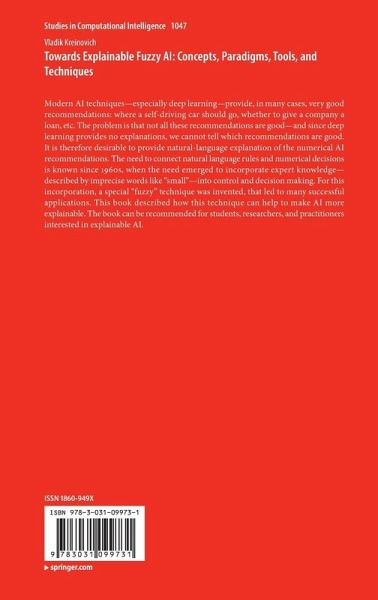
Modern AI techniques -- especially deep learning -- provide, in many cases, very good recommendations: where a self-driving car should go, whether to give a company a loan, etc. The problem is that not all these recommendations are good -- and since deep learning provides no explanations, we cannot tell which recommendations are good. It is therefore desirable to provide natural-language explanation of the numerical AI recommendations. The need to connect natural language rules and numerical decisions is known since 1960s, when the need emerged to incorporate expert knowledge -- described by…mehr
Modern AI techniques -- especially deep learning -- provide, in many cases, very good recommendations: where a self-driving car should go, whether to give a company a loan, etc. The problem is that not all these recommendations are good -- and since deep learning provides no explanations, we cannot tell which recommendations are good. It is therefore desirable to provide natural-language explanation of the numerical AI recommendations. The need to connect natural language rules and numerical decisions is known since 1960s, when the need emerged to incorporate expert knowledge -- described by imprecise words like "small" -- into control and decision making. For this incorporation, a special "fuzzy" technique was invented, that led to many successful applications. This book described how this technique can help to make AI more explainable.The book can be recommended for students, researchers, and practitioners interested in explainable AI.
Vladik Kreinovich is Professor of Computer Science at the University of Texas at El Paso. His main interests are representation and processing of uncertainty, especially interval computations and intelligent control. He has published 13 books, 39 edited books, and more than 1,800 papers. Vladik is Vice-President of the International Fuzzy Systems Association (IFSA), Vice-President of the European Society for Fuzzy Logic and Technology (EUSFLAT), Fellow of International Fuzzy Systems Association (IFSA), Fellow of Mexican Society for Artificial Intelligence (SMIA), and Fellow of the Russian Association for Fuzzy Systems and Soft Computing. Graçaliz Dimuro received the M.Sc. (1991) and Ph.D. (1998) degrees from the Institute of Informatics of Universidade Federal do Rio Grande¿do Sul, Brazil. In 2015, she was POS-DOC of the Brazilian Research Funding Agency CNPq at Universidad Pública de Navarra (UPNA), Spain, and, in 2017, she had a talent grantwith the Institute of Smart Cities of UPNA. She was Visitant Professor at UPNA during 2020-2022. Currently, she is Full Professor with Universidade Federal do Rio Grande, Brazil, and Researcher of level 1 of CNPq. She Member of the council of the Brazilian Society of Computational and Applied Mathematics and Associate Editor of Computational and Applied Mathematics journal (Springer). She was Invited Editor of several journals, e.g., fuzzy sets and systems, applied soft computing, and natural computing. She has reviewed papers for important journals and is Member of several program committees of international conferences. Her H-index (scopus) is 32 (August 2022), having over 2707 citations among 181 published papers. She has been awarded with best paper nominations in important conferences, e.g., NAFIPS 2018 and 2019, and FUZZ-IEEE 2022. Antônio Carlos da Rocha Costa, Ph.D. in Computer Science (UFRGS, 1993), is Retired Associate Professor (FURG, 2015). He publisheda book: A Variational Basis for the Regulation and Structuration Mechanisms of Agent Societies (Springer, 2019).
Inhaltsangabe
Why Explainable AI? Why Fuzzy Explainable AI? What Is Fuzzy?.- Defuzzification.- Which Fuzzy Techniques?.- So How Can We Design Explainable Fuzzy AI: Ideas.- How to Make Machine Learning Itself More Explainable.- Final Self-Test.
Why Explainable AI? Why Fuzzy Explainable AI? What Is Fuzzy?.- Defuzzification.- Which Fuzzy Techniques?.- So How Can We Design Explainable Fuzzy AI: Ideas.- How to Make Machine Learning Itself More Explainable.- Final Self-Test.
Es gelten unsere Allgemeinen Geschäftsbedingungen: www.buecher.de/agb
Impressum
www.buecher.de ist ein Internetauftritt der buecher.de internetstores GmbH
Geschäftsführung: Monica Sawhney | Roland Kölbl | Günter Hilger
Sitz der Gesellschaft: Batheyer Straße 115 - 117, 58099 Hagen
Postanschrift: Bürgermeister-Wegele-Str. 12, 86167 Augsburg
Amtsgericht Hagen HRB 13257
Steuernummer: 321/5800/1497
USt-IdNr: DE450055826