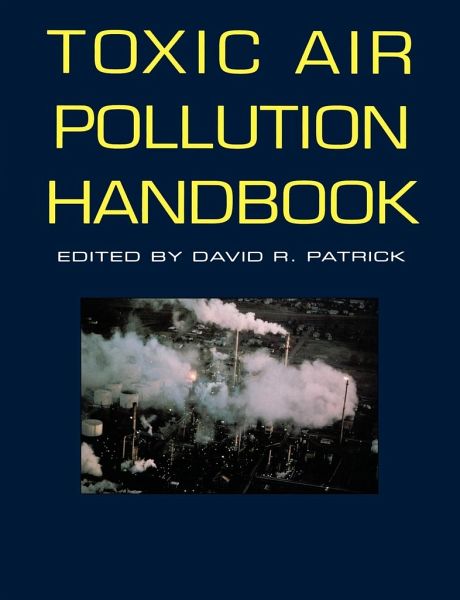
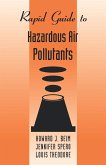
Toxic Air Pollution Handbook Edited by David R. Patrick The 1990 Amendments to the Clean Air Act created an entirely new program for the regulation of toxic air pollutants. As a result, the sources of these pollutants have been required to upgrade their control measures or install new ones. Here is the first comprehensive reference on how to assess, regulate, and control these pollutants in order to comply with the new regulations. The Toxic Air Pollution Handbook lists 189 toxic air pollutants subject to regulation and their sources. It covers the latest acceptable control methods and…mehr
Toxic Air Pollution Handbook Edited by David R. Patrick The 1990 Amendments to the Clean Air Act created an entirely new program for the regulation of toxic air pollutants. As a result, the sources of these pollutants have been required to upgrade their control measures or install new ones. Here is the first comprehensive reference on how to assess, regulate, and control these pollutants in order to comply with the new regulations. The Toxic Air Pollution Handbook lists 189 toxic air pollutants subject to regulation and their sources. It covers the latest acceptable control methods and identifies safe and/or acceptable levels of exposure for these pollutants as mandated by the Environmental Protection Agency [EPA]. The author clarifies the requirements of the 1990 amendments, describes how the toxicity of air pollutants is evaluated, and provides EPA-accepted health criteria for dealing with these pollutants. Also included are discussions of * Methods for assessing/quantifying human exposure to toxic air pollutants * Technologies and operating procedures used to control emissions * Fugitive emissions (an important but little understood source of air pollution) * Air sampling methods and emission estimation * How to communicate with the public, press, and regulators about risks associated with air toxics Throughout, emphasis is on the reduction of toxic emissions. The author discuses the new science of ecological assessment, as well as current state and local toxic air pollutant regulatory programs. He addresses air dispersion and deposition models, how to include population activity in an exposure assessment, how to derive and use ambient concentration limits, and how to use risk assessment with air toxics. Other key subjects addressed include air toxic from mobile sources, the effects of various regulatory programs, and international controls. Plant managers, environmental managers, environmental consultants, regulators, and teachers will find the Toxic Air Pollution Handbook to be a vital resource.
About the Editor David R. Patrick is a nationally known expert on air pollution and has over 20 years' experience as a Professional Engineer. Currently he directs air pollution services for both public and private sector clients in his position as Vice President of ICF Kaiser International in Fairfax, Virginia. While working for the EPA for 15 years, Mr. Patrick managed programs and directed studies involving all aspects of evaluation, measurement, regulation, and control of air pollution. He serves as an expert air pollution witness for the U.S. Department of Justice, has written extensively on air pollution topics, and speaks frequently at technical meetings and seminars.
Inhaltsangabe
Acknowledgment Preface Contributor List Background 3 Title III of the 1990 Clean Air Act Amendments 25 Toxic Air Pollutants and Their Sources 33 Assessment and Control of Toxic Air Pollutants 50 Evaluation of Toxicological Data 57 Quantitative Methods for Cancer Risk Assessment 79 Noncancer Toxicity of Inhaled Toxic Air Pollutants: Available Approaches for Risk Assessment and Risk Management 100 Exposure Assessment Principles 133 Source Sampling and Analysis 166 Emissions Estimation 217 Air Dispersion and Deposition Models 226 Atmospheric Transformation and Removal of Air Toxics 241 Human Intake 249 Population and Activity Analysis 264 Ecological Risk Assessment 280 Legislative and Legal Considerations 291 Ambient Concentration Limits 313 Technology Standards 325 Risk Assessment and Risk Management 341 Cost-Benefit Approaches 362 Gaseous Toxic Air Pollutant Control Technologies 373 Fugitive Emissions Controls 398 Pollution Prevention 440 Special Sources of Toxic Air Pollutants 461 Mobile Sources and Air Toxics 469 Other Programs That Control Toxic Air Pollutants 489 Control of Air Toxics in Other Countries 505 Risk Communication on Toxic Air Pollutants 514 Ap A Noncancer Toxicity of Inhaled Air Pollutants: Available Approaches for Risk Assessment and Risk Management 529 Ap B Supplementary Procedures for Obtaining Fugitive Emission Estimates 542 Ap C Response Factors 550 Ap D Vacuum Bagging 552 Ap E Blow-Through Bagging 555 Ap F Recirculation Bagging 558 Ap G Exposure and Risk Models 559 Acronyms and Abbreviations 567 Bibliography 573 Index 579
Acknowledgment Preface Contributor List Background 3 Title III of the 1990 Clean Air Act Amendments 25 Toxic Air Pollutants and Their Sources 33 Assessment and Control of Toxic Air Pollutants 50 Evaluation of Toxicological Data 57 Quantitative Methods for Cancer Risk Assessment 79 Noncancer Toxicity of Inhaled Toxic Air Pollutants: Available Approaches for Risk Assessment and Risk Management 100 Exposure Assessment Principles 133 Source Sampling and Analysis 166 Emissions Estimation 217 Air Dispersion and Deposition Models 226 Atmospheric Transformation and Removal of Air Toxics 241 Human Intake 249 Population and Activity Analysis 264 Ecological Risk Assessment 280 Legislative and Legal Considerations 291 Ambient Concentration Limits 313 Technology Standards 325 Risk Assessment and Risk Management 341 Cost-Benefit Approaches 362 Gaseous Toxic Air Pollutant Control Technologies 373 Fugitive Emissions Controls 398 Pollution Prevention 440 Special Sources of Toxic Air Pollutants 461 Mobile Sources and Air Toxics 469 Other Programs That Control Toxic Air Pollutants 489 Control of Air Toxics in Other Countries 505 Risk Communication on Toxic Air Pollutants 514 Ap A Noncancer Toxicity of Inhaled Air Pollutants: Available Approaches for Risk Assessment and Risk Management 529 Ap B Supplementary Procedures for Obtaining Fugitive Emission Estimates 542 Ap C Response Factors 550 Ap D Vacuum Bagging 552 Ap E Blow-Through Bagging 555 Ap F Recirculation Bagging 558 Ap G Exposure and Risk Models 559 Acronyms and Abbreviations 567 Bibliography 573 Index 579
Es gelten unsere Allgemeinen Geschäftsbedingungen: www.buecher.de/agb
Impressum
www.buecher.de ist ein Internetauftritt der buecher.de internetstores GmbH
Geschäftsführung: Monica Sawhney | Roland Kölbl | Günter Hilger
Sitz der Gesellschaft: Batheyer Straße 115 - 117, 58099 Hagen
Postanschrift: Bürgermeister-Wegele-Str. 12, 86167 Augsburg
Amtsgericht Hagen HRB 13257
Steuernummer: 321/5800/1497
USt-IdNr: DE450055826