
Andere Kunden interessierten sich auch für
 The Veterinary Obstetrical Compendium: for the Farmer and Breeder of Livestock22,99 €
 Keeping Livestock Healthy17,99 €
 The Practical Horseshoer: Being a Collection of Articles on Horseshoeing in All Its Branches Which Have Appeared From Time to Time in the Column22,99 €
![Register of the Members of the Royal College of Veterinary Surgeons From January, 1794, to May, 1874, Inclusive [electronic Resource]]( "Register of the Members of the Royal College of Veterinary Surgeons From January, 1794, to May, 1874, Inclusive [electronic Resource]") Register of the Members of the Royal College of Veterinary Surgeons From January, 1794, to May, 1874, Inclusive [electronic Resource]15,99 €
Register of the Members of the Royal College of Veterinary Surgeons From January, 1794, to May, 1874, Inclusive [electronic Resource]15,99 € Directions for the Dissection and Study of the Cranial Nerves and Blood Vessels of the Horse ..15,99 €
 Observations on the Air, and Epidemic Diseases,: From the Beginning of the Year 1738, to the End of the Year 1748: Vol. II.23,99 €
![Fleming's Vest-pocket Veterinary Adviser [microform]: Veterinary Science, as It Applies to the More Prevalent Ailments of Horses and Cattle, Condensed]( "Fleming's Vest-pocket Veterinary Adviser [microform]: Veterinary Science, as It Applies to the More Prevalent Ailments of Horses and Cattle, Condensed") Fleming's Vest-pocket Veterinary Adviser [microform]: Veterinary Science, as It Applies to the More Prevalent Ailments of Horses and Cattle, Condensed17,99 €
Fleming's Vest-pocket Veterinary Adviser [microform]: Veterinary Science, as It Applies to the More Prevalent Ailments of Horses and Cattle, Condensed17,99 €
![Register of the Members of the Royal College of Veterinary Surgeons From January, 1794, to May, 1874, Inclusive [electronic Resource]](https://bilder.buecher.de/produkte/66/66188/66188702m.jpg "Register of the Members of the Royal College of Veterinary Surgeons From January, 1794, to May, 1874, Inclusive [electronic Resource]")

![Fleming's Vest-pocket Veterinary Adviser [microform]: Veterinary Science, as It Applies to the More Prevalent Ailments of Horses and Cattle, Condensed](https://bilder.buecher.de/produkte/66/66167/66167230m.jpg "Fleming's Vest-pocket Veterinary Adviser [microform]: Veterinary Science, as It Applies to the More Prevalent Ailments of Horses and Cattle, Condensed")
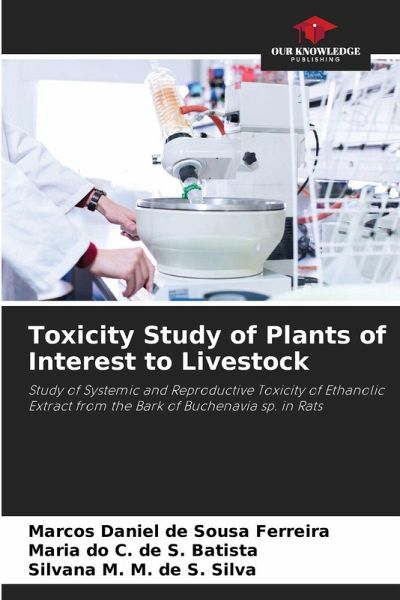
Currently, more than a hundred plants known to be toxic to livestock are known in Brazil, with at least 42 known in the Northeast region. Some species of the genus Buchenavia are reported as toxic by producers in the northern region of the state of Piauí, causing abortion, but this has not yet been scientifically proven. Considering the need to investigate this aspect, the general objective of this research was to investigate the possible adverse effects induced by the ethanolic extract formulated from the bark of the Buchenavia sp. stem in rats. In this sense, this book is aimed at students, educators, researchers, and health professionals committed to animal health and reproduction, helping them to understand the pharmacology and toxicology studies of the species studied, and serving as a basis for new research in the area.