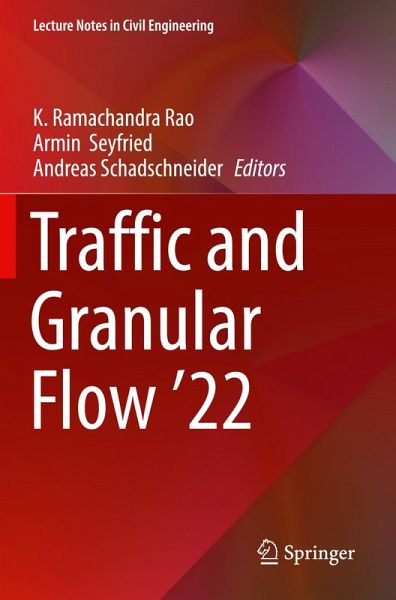
This book gathers contributions on a variety of flowing collective systems. While primarily focusing on pedestrian dynamics, it also reflects the latest developments in areas such as vehicular traffic and granular flows and addresses related emerging topics such as self-propelled particles, data transport, swarm behaviour, intercellular transport, and individual interactions to complex systems. Combining fundamental research and practical applications in the various fields discussed, the book offers a valuable asset for researchers and professionals in areas such as civil and transportation…mehr
This book gathers contributions on a variety of flowing collective systems. While primarily focusing on pedestrian dynamics, it also reflects the latest developments in areas such as vehicular traffic and granular flows and addresses related emerging topics such as self-propelled particles, data transport, swarm behaviour, intercellular transport, and individual interactions to complex systems. Combining fundamental research and practical applications in the various fields discussed, the book offers a valuable asset for researchers and professionals in areas such as civil and transportation engineering, mechanical engineering, electrical engineering, physics, computer science, and mathematics.
K. Ramachandra Rao is currently Professor and MoUD Chair in the Department of Civil Engineering at the Indian Institute of Technology Delhi, India. He is presently the Head of Transportation Research and Injury Prevention Centre (TRIP Centre), IIT Delhi. He holds a Ph.D. in Civil Engineering (Transportation Engineering) from IIT Kharagpur. He has a masters' degree in Transportation Engineering from NIT Warangal and a bachelor's degree in civil engineering from Andhra University (GITAM, Visakhapatnam). His research interests are in traffic dynamics, pedestrian dynamics, public transportation systems planning, road safety, and urban freight logistics. He is widely published in peer-reviewed journals and conferences. He has co-authored the book (Highway Material Testing and Quality Control, I.K. Publishers, 2017). He has advised many Ph.D. and master's students at IIT Delhi. He is involved in projects and consulting related to pedestrian evacuations, traffic dynamics, and road safety. He is on the scientific committee of the international conference series traffic and granular flow and pedestrian and evacuation dynamics. Andreas Schadschneider is currently Professor in Theoretical Physics at University of Cologne, Germany, since 2006. He has a diploma and Ph.D. in Physics from University of Cologne. His research interests are pedestrian dynamics, nonequilibrium physics, vehicular traffic, biological transport, physics education. He is very widely published (more than 150 journal articles) and is currently Member of Editorial Board: Int. J. Mod. Physics C, J. Stat. Mech., Physica A (Main Editor), Collective Dynamics (Editor-in-Chief). He is Member of the steering committee of the international conference series 'Pedestrian and Evacuation Dynamics' and 'Traffic and Granular Flow'. Besides editing several conference procedia, he has authored A. Schadschneider, D. Chowdhury and K. Nishinari: Stochastic Transport in Complex Systems: From Molecules to Vehicles, Elsevier (2010). He has advised many Ph.D. and master's students besides engaging in several research projects. Armin Seyfried is currently Director of the Institute of Advanced Simulation: Civil Safety Research (IAS-7), Forschungszentrum Jülich. In the same time, he holds Chair of 'Computer Simulations for Fire Safety and Pedestrian Traffic', University of Wuppertal, Germany. His research interests are in the fields of pedestrian dynamics, nonequilibrium systems, traffic engineering, and fire safety engineering. He is widely known for his seminal work in the field of pedestrian dynamics and is on the Editorial Board Collective Dynamics (Founder Editor-in-Chief). He has offered a full course on 'Pedestrian Dynamics: Empirics and modelling' at IIT Delhi under the GIAN programme. He is Member of the steering committee of the conference series 'Pedestrian and Evacuation Dynamics' and 'Traffic and Granular Flow' and has been Co-editor of theproceedings, Traffic and Granular Flow '13, Springer (2015). He has advised many Ph.D. and master's students at University of Wuppertal besides engaging in several research projects.
Inhaltsangabe
Collective traffic of agents that remember. "Nudging" crowds: When it works, when it doesn't and why. Revisiting the theoretical basis of agent based models for pedestrian dynamics. An emergency evacuation model for avoiding high nuclide concentration areas in nuclear accident. Shoulder rotation measurement in camera and 3D motion capturing data. Methods of density estimation for pedestrians moving in small groups without a spatial boundary. A review of entropy based studies on crowd behavior and risk analysis. Understanding the difference in social group behaviour of a spiritually motivated crowd and a general crowd. Mass evacuation planning based on mean field games theory. Experimental study of bidirectional pedestrian flow in a corridor with certain height constraint. Crowd Dynamics of a Rural Group in a Mass Religious Gathering: A Case Study of Kumbh Mela 2016, India. Modeling of obstacle avoidance by a dense crowd as a Mean Field Game. Two types of bottlenecks in leisure facilities: bottlenecks caused by attractiveness and structural layout. Face validation of a route choice module in a crowd simulator for confined indoor spaces in context of the COVID 19 pandemic. On the Influence of Group Social Interaction on Intrusive Behaviours. Sound Guidance on Evacuation under Limited Visibility: an Experimental Study. Pedestrian Kernel Density Estimates: the Individual Approach. Density dependence of stripe formation in a cross flow. Estimation of pedestrian crossing intentions in in vehicle video.
Collective traffic of agents that remember. "Nudging" crowds: When it works, when it doesn't and why. Revisiting the theoretical basis of agent based models for pedestrian dynamics. An emergency evacuation model for avoiding high nuclide concentration areas in nuclear accident. Shoulder rotation measurement in camera and 3D motion capturing data. Methods of density estimation for pedestrians moving in small groups without a spatial boundary. A review of entropy based studies on crowd behavior and risk analysis. Understanding the difference in social group behaviour of a spiritually motivated crowd and a general crowd. Mass evacuation planning based on mean field games theory. Experimental study of bidirectional pedestrian flow in a corridor with certain height constraint. Crowd Dynamics of a Rural Group in a Mass Religious Gathering: A Case Study of Kumbh Mela 2016, India. Modeling of obstacle avoidance by a dense crowd as a Mean Field Game. Two types of bottlenecks in leisure facilities: bottlenecks caused by attractiveness and structural layout. Face validation of a route choice module in a crowd simulator for confined indoor spaces in context of the COVID 19 pandemic. On the Influence of Group Social Interaction on Intrusive Behaviours. Sound Guidance on Evacuation under Limited Visibility: an Experimental Study. Pedestrian Kernel Density Estimates: the Individual Approach. Density dependence of stripe formation in a cross flow. Estimation of pedestrian crossing intentions in in vehicle video.
Es gelten unsere Allgemeinen Geschäftsbedingungen: www.buecher.de/agb
Impressum
www.buecher.de ist ein Internetauftritt der buecher.de internetstores GmbH
Geschäftsführung: Monica Sawhney | Roland Kölbl | Günter Hilger
Sitz der Gesellschaft: Batheyer Straße 115 - 117, 58099 Hagen
Postanschrift: Bürgermeister-Wegele-Str. 12, 86167 Augsburg
Amtsgericht Hagen HRB 13257
Steuernummer: 321/5800/1497
USt-IdNr: DE450055826