
Andere Kunden interessierten sich auch für
 Transcendence in Heidegger's Early Thought91,99 €
 Meaning Takes Time to Unfold: Towards a Heideggerian Ontology of Temporal Differentiation91,99 €
 Welt und Selbst beim frühen Heidegger129,95 €
 Karl Jaspers' Theory of Irrationality101,99 €
 Wittgenstein's Pre-Tractatus Writings113,99 €
 Studien zur Neuen Ontologie und Anthropologie39,95 €
") Heidegger and Future Presencing (The Black Pages)57,99 €
Heidegger and Future Presencing (The Black Pages)57,99 €





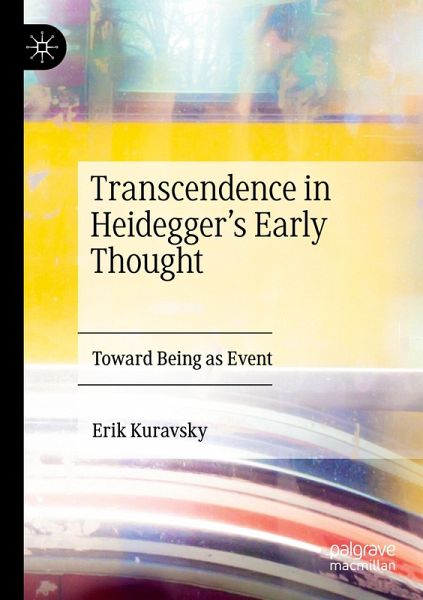
This book demonstrates how Heidegger's departure from ontotheology occurs initially as a preparation for the concept of Dasein's transcendence and subsequently as its explicit development and overcoming. Dasein's transcendence is revealed as the foundation for the subsequent concept of Beyng as an Event, which stands in contrast to all ontotheological perspectives that assert a singular a priori foundation of the universe attributed to beings, God, consciousness, or even an independent "process" of Being that doesn't rely on Dasein. The book illustrates that transcendence is not an attribute of human consciousness or a connection to something external to it. Instead, as a "primal act," transcendence paves the way for a non-representational dwelling in the essence of a historically unfolding Being, a contemplative recollection of the truth of Beyng. Throughout the book, there is a gradual progression towards an understanding of transcendence as an active engagement, wherein we"do" transcendence. This process involves a reconstruction of the ontological significance of action, emphasizing its performative embeddedness in existence and its inseparability from Beyng.
Kuravsky s book is clearly written and provides a coherent argument that Heidegger s philosophy should be understood as a unitary unfolding, albeit with evolutionary shifts in emphasis. ... Kuravsky s Transcendence in Heidegger s Early Thought provides us with a more solid footing as to how to navigate this terrain, and I therefore highly recommend this work for anyone interested in thinking through the unity of Heidegger s early and later philosophy. (Casey Rentmeester, Human Studies, Vol. 48 (3), 2025)