
Andere Kunden interessierten sich auch für
 U.S. Power and the Social State in Brazil167,99 €
 Localism and the Design of Political Systems167,99 €
 The Politics of Bureaucracy222,99 €
 Egypt63,99 €
 Contemporary European Politics56,99 €
 Industrialization and Development114,99 €
 Civil-Military Relations in Post-Conflict Societies185,99 €

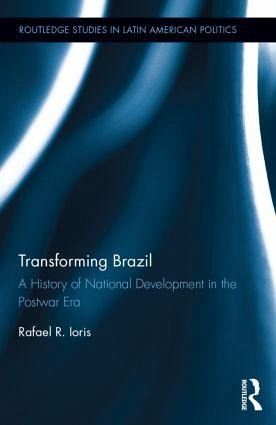
Innovating in its multidimensional analytical scope and interdisciplinary focus, Transforming Brazil provides a rich political, cultural, and intellectual examination of a historical period characterized by rapid socio-economic changes amidst significant political instability and the heightened ideological polarization shaping the political scenario of Brazil and much of Latin America in the Cold War era.
'This well-researched and engaging study makes a provocative case that Brazilian developmentalism had heretofore unidentified political consequences that shaped the nation throughout the second half of the twentieth century and beyond. Ioris turns the conventional wisdom on its head by locating the origins of the 1964 military coup in the developmentalism of the 1950s. This innovative argument will no doubt spark debate on twentieth-century Brazilian and Latin American political economy.'
-Joel Wolfe, University of Massachusetts
"Rafael Ioris properly dispels the notion of late 1950s Brazil as embodied in the image of a smiling Juscelino Kubitschek overseeing the construction of Brasília and a dispute-free march towards national development. Ioris delves into the era's ideological debates and the lives of working-class people to provide us with a more realistic view of the challenges inherent in transformative human endeavors. Ultimately, Ioris sheds critical light on the years leading up to one of the most intriguing yet tragic developments of modern Latin America: the overthrow of Brazil's democratically elected government in 1964. Ioris's work is a must-read for anybody wishing to comprehend Brazil's subsequent efforts to further project itself globally."
-Kenneth P. Serbin, University of San Diego
'Drawing on a vast array of published and archival sources, Rafael Ioris has produced a sophisticated analysis of the debates about national development in postwar Brazil. This study offers fresh insights into the hopes and dreams of an impressive array of interest groups-including politicians, technocrats, labor leaders and many others-who sought to make the 'country of the future' into a developed nation.'
-Marshall C. Eakin, Vanderbilt University
'This well-researched book offers a rich picture of the trajectory of development in the JK years and will serve as a valuable reference.'
-Thomas D. Rogers, Varia Historia, Belo Horizonte
'The historical material contributed here is rich and adds value to the work ... he brought aspects of Brazilian foreign policy into the national debate on developmentalism, unknown to non-specialists in the field, as is my case, as well as dimensions of the mass culture-advertising and consumption-conceptions that are little associated with the theme. He was quite successful in his intention, making his work recommendable, especially to new students of the subject.'
-Maria Rita Loureiro, Brazilian Political Science Review
'Though scholars have long debated the conceptual significance of postwar developmental policies in Latin America, Transforming Brazil innovates in examining how concrete historical actors thought of and acted to advance their own, at times divergent positions about the ever more divisive and influential theme of national development. The analysis is based on a diverse and largely unexamined collection of materials, including official government documents, intellectual works, business publications, and labor newspapers, brought together under the overarching goal of reconstructing, from several different angles, the rich socio-cultural mosaic that defined the 1950s in Brazil.'
-Brasil Wire
-Joel Wolfe, University of Massachusetts
"Rafael Ioris properly dispels the notion of late 1950s Brazil as embodied in the image of a smiling Juscelino Kubitschek overseeing the construction of Brasília and a dispute-free march towards national development. Ioris delves into the era's ideological debates and the lives of working-class people to provide us with a more realistic view of the challenges inherent in transformative human endeavors. Ultimately, Ioris sheds critical light on the years leading up to one of the most intriguing yet tragic developments of modern Latin America: the overthrow of Brazil's democratically elected government in 1964. Ioris's work is a must-read for anybody wishing to comprehend Brazil's subsequent efforts to further project itself globally."
-Kenneth P. Serbin, University of San Diego
'Drawing on a vast array of published and archival sources, Rafael Ioris has produced a sophisticated analysis of the debates about national development in postwar Brazil. This study offers fresh insights into the hopes and dreams of an impressive array of interest groups-including politicians, technocrats, labor leaders and many others-who sought to make the 'country of the future' into a developed nation.'
-Marshall C. Eakin, Vanderbilt University
'This well-researched book offers a rich picture of the trajectory of development in the JK years and will serve as a valuable reference.'
-Thomas D. Rogers, Varia Historia, Belo Horizonte
'The historical material contributed here is rich and adds value to the work ... he brought aspects of Brazilian foreign policy into the national debate on developmentalism, unknown to non-specialists in the field, as is my case, as well as dimensions of the mass culture-advertising and consumption-conceptions that are little associated with the theme. He was quite successful in his intention, making his work recommendable, especially to new students of the subject.'
-Maria Rita Loureiro, Brazilian Political Science Review
'Though scholars have long debated the conceptual significance of postwar developmental policies in Latin America, Transforming Brazil innovates in examining how concrete historical actors thought of and acted to advance their own, at times divergent positions about the ever more divisive and influential theme of national development. The analysis is based on a diverse and largely unexamined collection of materials, including official government documents, intellectual works, business publications, and labor newspapers, brought together under the overarching goal of reconstructing, from several different angles, the rich socio-cultural mosaic that defined the 1950s in Brazil.'
-Brasil Wire