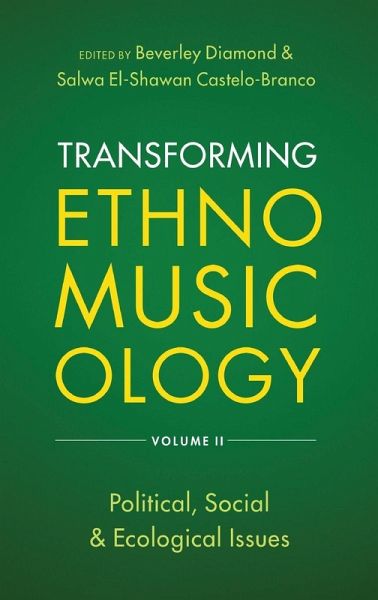
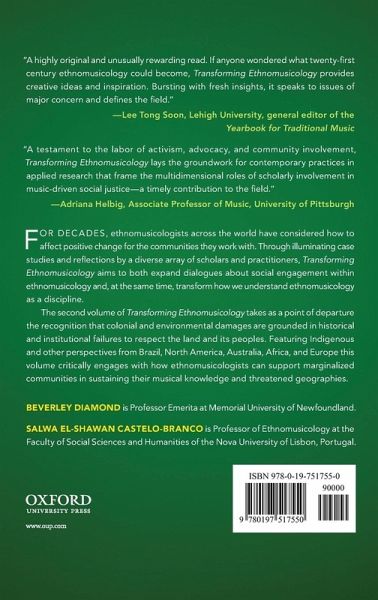
For decades, ethnomusicologists across the world have considered how to affect positive change for the communities they work with. Through illuminating case studies and reflections by a diverse array of scholars and practitioners, Transforming Ethnomusicology aims to both expand dialogues about social engagement within ethnomusicology and, at the same time, transform how we understand ethnomusicology as a discipline. The second volume of Transforming Ethnomusicology takes as a point of departure the recognition that colonial and environmental damages are grounded in historical and…mehr
For decades, ethnomusicologists across the world have considered how to affect positive change for the communities they work with. Through illuminating case studies and reflections by a diverse array of scholars and practitioners, Transforming Ethnomusicology aims to both expand dialogues about social engagement within ethnomusicology and, at the same time, transform how we understand ethnomusicology as a discipline. The second volume of Transforming Ethnomusicology takes as a point of departure the recognition that colonial and environmental damages are grounded in historical and institutional failures to respect the land and its peoples. Featuring Indigenous and other perspectives from Brazil, North America, Australia, Africa, and Europe this volume critically engages with how ethnomusicologists can support marginalized communities in sustaining their musical knowledge and threatened geographies.
Beverley Diamond is Professor Emerita at Memorial University of Newfoundland where she served as the first Canada Research Chair in Ethnomusicology and founded and directed the Research Centre for the Study of Music, Media, and Place (MMaP) from 2003-15. Diamond is known for her feminist music research and her work on Canadian cultural historiography and Indigenous music cultures in North America and Scandinavia. Salwa El-Shawan Castelo-Branco is Professor of Ethnomusicology at the Faculty of Social Sciences and Humanities of the Nova University of Lisbon, Portugal, where she founded and directs the Ethnomusicology Institute - Center for the Study of Music and Dance (INET-md). Her publications focus on cultural politics, musical nationalism, identity, music media, modernity, heritagization, and music and conflict in Portugal, Egypt, and Oman.
Inhaltsangabe
* Ethnomusicological Praxis: An Introduction * Beverley Diamond and Salwa El-Shawan Castelo-Branco * Chapter 1: A Sound Economy * Jeff Todd Titon * Chapter 2: Music for Global Human Development * Michael Frishkopf * Chapter 3: Reengaging Sound Praxis in the Real World: Politico-Epistemological Dimensions of Dialogue and Participation in Knowledge Production * Samuel Araujo * Chapter 4: Silenced Registers of Ethnomusicological Academic Labor under Neoliberalism * Ana Hofman * Chapter 5: Sonic Mapping and Critical Citizenship: Reflections on LimerickSoundscapes * Aileen Dillane and Tony Langlois * Chapter 6: The Earth Is (Still) Our Mother: Traversing Indigenous Landscapes through Sacred Geographies of Song * Chad Hamill * Chapter 7: The Modernity of the Songlines * Rhoda Roberts * Chapter 8: Music Endangerment, Repatriation and Intercultural Collaboration in an Australian Discomfort Zone * Sally Treloyn and Rona Goonginda Charles * Chapter 9: Dancing Domba: Intersections of Ethnomusicology, Music Education, and Research with Children and Young People * Andrea Emberly and Mudzunga Junniah Davhula * Chapter 10: Ethical Friction: IRBs, Ethnolmusicological Ethics, and Music in an American Jail * Andy McGraw * Chapter 11: Ethnomusicology and the Meeting of Knowledges in Music: The Inclusion of Masters of Traditional Musics as Lecturers in Higher Education Institutions * José Jorge de Carvalho
* Ethnomusicological Praxis: An Introduction * Beverley Diamond and Salwa El-Shawan Castelo-Branco * Chapter 1: A Sound Economy * Jeff Todd Titon * Chapter 2: Music for Global Human Development * Michael Frishkopf * Chapter 3: Reengaging Sound Praxis in the Real World: Politico-Epistemological Dimensions of Dialogue and Participation in Knowledge Production * Samuel Araujo * Chapter 4: Silenced Registers of Ethnomusicological Academic Labor under Neoliberalism * Ana Hofman * Chapter 5: Sonic Mapping and Critical Citizenship: Reflections on LimerickSoundscapes * Aileen Dillane and Tony Langlois * Chapter 6: The Earth Is (Still) Our Mother: Traversing Indigenous Landscapes through Sacred Geographies of Song * Chad Hamill * Chapter 7: The Modernity of the Songlines * Rhoda Roberts * Chapter 8: Music Endangerment, Repatriation and Intercultural Collaboration in an Australian Discomfort Zone * Sally Treloyn and Rona Goonginda Charles * Chapter 9: Dancing Domba: Intersections of Ethnomusicology, Music Education, and Research with Children and Young People * Andrea Emberly and Mudzunga Junniah Davhula * Chapter 10: Ethical Friction: IRBs, Ethnolmusicological Ethics, and Music in an American Jail * Andy McGraw * Chapter 11: Ethnomusicology and the Meeting of Knowledges in Music: The Inclusion of Masters of Traditional Musics as Lecturers in Higher Education Institutions * José Jorge de Carvalho
Es gelten unsere Allgemeinen Geschäftsbedingungen: www.buecher.de/agb
Impressum
www.buecher.de ist ein Internetauftritt der buecher.de internetstores GmbH
Geschäftsführung: Monica Sawhney | Roland Kölbl | Günter Hilger
Sitz der Gesellschaft: Batheyer Straße 115 - 117, 58099 Hagen
Postanschrift: Bürgermeister-Wegele-Str. 12, 86167 Augsburg
Amtsgericht Hagen HRB 13257
Steuernummer: 321/5800/1497
USt-IdNr: DE450055826