
This book critically examines the ways in which translation studies can offer a conceptual framework for understanding and researching international affairs, drawing on examples from China's Belt and Road Initiative. The volume encourages new conceptualisations of our understanding of culture and communication through the lens of translation, re-envisioning translation beyond the scope of the global circulation of cultural products. Tian explores the case study of the Belt and Road Initiative to show how nation branding and soft power can be understood through a translational lens if we…mehr
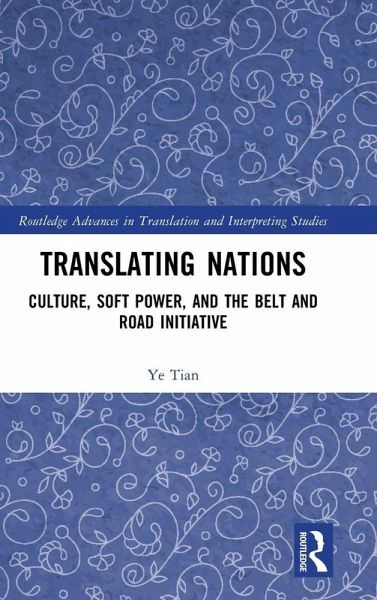
This book critically examines the ways in which translation studies can offer a conceptual framework for understanding and researching international affairs, drawing on examples from China's Belt and Road Initiative.
The volume encourages new conceptualisations of our understanding of culture and communication through the lens of translation, re-envisioning translation beyond the scope of the global circulation of cultural products. Tian explores the case study of the Belt and Road Initiative to show how nation branding and soft power can be understood through a translational lens if we rethink of translation as the means by which cultures communicate and build relationships with each other while retaining their distinct dimensions. In focusing on intertwining concepts across translation studies, cultural studies, and international relations - universalism, power, identity, and development - the book showcases how it is a useful framework for understanding how translation studies can serve as a platform for multidisciplinary dialogue on a global scale.
This book will be of interest to scholars in translation studies, cultural studies, international relations, and Asian studies.
Produktdetails
Produktdetails
Routledge Advances in Translation and Interpreting Studies
Ye Tian is a scholar in translation studies. He taught and worked at the University of Manchester before becoming a visiting scholar at Durham University.
Inhaltsangabe
Contents Acknowledgements Introduction 0.1 Purpose 0.2 Main thesis of the book 0.3 Chapter overview Chapter 1 Map-Sketching as an Interdisciplinary Method: Against Map, Linearity, and Mastery 1.1 Map and power: Inspirations from critical cartography 1.1.1 Critical cartography, maps, and power 1.1.2 The map of TS and its problems 1.2 Sketch map as a method: Line, meshwork, and rhizomatic epistemology 1.2.1 Sketch map and lines of a meshwork 1.2.2 Rhizome 1.2.3 Serendipity and translation 1.3 Conclusion Part I: Culture as Defined by Translation Chapter 2 Culture as Meaning Making 2.1 Culture as a lifestyle 2.2 Culture as a system 2.3 Culture as signs and meanings Chapter 3 Culture function and translation 3.1 Culture differentiates 3.1.1 An anthropological account 3.1.2 A sociological account 3.2 Culture assimilates 3.2.1 Cultural assimilation 3.2.2 Deculturation and acculturation 3.2.3 Cultural fusion 3.3 Overview of culture function: Re-examining globalisation, deculturation, and glocalisation 3.3.1 Globalisation as cosmopolitanism 3.3.2 Globalisation as deculturation Entanglement 1: Culture and Translation Part II: Soft Power, Nation Branding, and Translation Chapter 4 Power and Translation 4.1 Defining power 4.2 Soft power and translation 4.2.l Culture as the resource for soft power 4.2.2. Instruments of soft power 4.2.3 Overview: soft power and translation Chapter 5 Nation Branding as Translation 5.1 Constructability of national identity 5.2 Branding 5.3 Nation branding 5.3.1 Nation branding compared with commercial branding 5.3.2 Nation branding conveying national identity: Nation branding as touching 5.3.3 Soft power as a resource for nation branding: Nation branding as communication and development Entanglement 2: Translation, Power, and Branding Part III: China's Nation Branding as Translation Chapter 6 Introduction to the BRI: A Geo-Economic, Geo-Political, Geo-Cultural, or Interconnective Initiative? 6.1 The BRI as a geo-economic initiative 6.2 The BRI as a geo-political initiative 6.3 The BRI as a geo-cultural initiative 6.3.1 The BRI and the concept of He: The peace-building and interconnectivity outlook of the BRI 6.3.2 The BRI as eco-translation Chapter 7 The "What" Question: Framing, Reframing, and Stereotypes 7.1 Translation as framing 7.2 Framing in nation branding 7.2.1 Framing as stereotyping 7.2.2 Framing as selecting information 7.2.3 Framing in the BRI: Framing history as an example 7.3 Conclusion: Framing the Silk Road as translatio studii et imperii Chapter 8 The "Who" Question: Translation and Identity in China's Nation Branding 8.1 Self and otherness 8.2 The self and otherness in TS 8.3 The self and otherness for China 8.3.1 A philosophical exploration 8.3.2 An anthropological exploration 8.4 The self and otherness in BRI branding 8.4.1 From the periphery to the centre 8.4.2 Who is allowed to translate? 8.5 Conclusion: Choose translators with otherness in mind Chapter 9 The "How" Question: How do Nations Communicate their Brands to Others? 9.1 Development communication: An overview 9.1.1 Empowerment 9.1.2 Participatory development 9.2 Development communication and nation branding 9.3 Development communication in the BRI 9.3.1 China's communication for development: The case of Confucius Institute 9.3.2 China's communication about development 9.3.3 China's communication of development 9.4 Conclusion: Development translation Entanglement 3: Who, what, and how to brand a nation from a translational perspective Chapter 10 Translation Studies as Knowledge, Method, and Meta-Discipline 10.1 Revisiting research questions 10.1.1 Translation as connection 10.1.2 Translation as differentiation and assimilation 10.1.3 Translation as criticism of authority 10.1.4 Translation as a process rather than a product 10.2 Implications 10.2.1 Translation knowledge 10.2.2 Translation as a method 10.2.3 TS as a meta-discipline 10.3 Potential for future research Bibliography Index
Es gelten unsere Allgemeinen Geschäftsbedingungen: www.buecher.de/agb
Impressum
www.buecher.de ist ein Internetauftritt der buecher.de internetstores GmbH
Geschäftsführung: Monica Sawhney | Roland Kölbl | Günter Hilger
Sitz der Gesellschaft: Batheyer Straße 115 - 117, 58099 Hagen
Postanschrift: Bürgermeister-Wegele-Str. 12, 86167 Augsburg
Amtsgericht Hagen HRB 13257
Steuernummer: 321/5800/1497
USt-IdNr: DE450055826