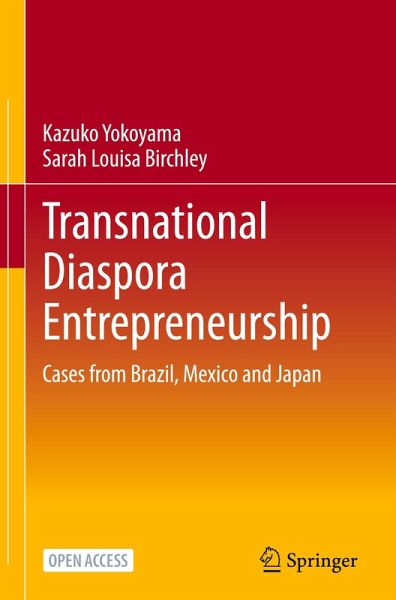
This Open Access book is the first book to share in-depth narratives outlining the lived experiences of Japanese and Latin American Diaspora Entrepreneurs in Brazil, Mexico and Japan. It focuses in on the career paths of forty-seven entrepreneurs exploring how they negotiate their identity, culture, and heritage as they set-up businesses in a country outside their country of origin. In our previous book we explored Japanese Self-Initiated Expatriate Entrepreneurs (SIEE) in Southeast Asia, yet we see a significant difference between self-initiated expatriate entrepreneurs and second and third…mehr
This Open Access book is the first book to share in-depth narratives outlining the lived experiences of Japanese and Latin American Diaspora Entrepreneurs in Brazil, Mexico and Japan. It focuses in on the career paths of forty-seven entrepreneurs exploring how they negotiate their identity, culture, and heritage as they set-up businesses in a country outside their country of origin. In our previous book we explored Japanese Self-Initiated Expatriate Entrepreneurs (SIEE) in Southeast Asia, yet we see a significant difference between self-initiated expatriate entrepreneurs and second and third generation diaspora Japanese Latin American entrepreneurs. This book represents the entrepreneurs, their journeys, their successes, and their struggles. It provides a framework for better understanding diaspora ethnic entrepreneurship in cases where multiple identities and cultures are intertwined. This research exposes the political, sociological, economic, and cultural complexities of diaspora entrepreneurship as a means to support oneself in a foreign , yet somewhat familiar, country of destination. This book thus creates a new understanding of what it is to be a diaspora entrepreneur of Japanese heritage in a variety of contexts.
This groundbreaking book delves into the compelling narratives of Japanese and Latin American diaspora entrepreneurs in Japan, Mexico, and Brazil. It highlights the career paths of 47 entrepreneurs, revealing how they navigate their identities, cultures, and heritage while establishing businesses far from their countries of origin. Unlike our previous book on Japanese Self-Initiated Expatriate Entrepreneurs (SIEE), this edition also uncovers the unique experiences of second and third-generation Japanese Latin American entrepreneurs. Through their stories of triumph and struggle, this book provides a deeper understanding of diaspora ethnic entrepreneurship, where multiple identities and cultures intersect. It also sheds light on the political, sociological, economic, and cultural complexities faced by these entrepreneurs as they build their lives in 'foreign' yet familiar lands. Discover a new perspective on what it means to be a diaspora entrepreneur of Japanese heritage in diverse contexts.
Artikelnr. des Verlages: 89561579, 978-981-96-9380-1
Seitenzahl: 212
Erscheinungstermin: 2. Oktober 2025
Englisch
Abmessung: 241mm x 160mm x 18mm
Gewicht: 487g
ISBN-13: 9789819693801
ISBN-10: 9819693802
Artikelnr.: 74340770
Herstellerkennzeichnung
Springer-Verlag KG
Sachsenplatz 4-6
1201 Wien, AT
ProductSafety@springernature.com
Autorenporträt
Professor Yokoyama is the Dean of the Graduate School of Business Administration, Toyo Gakuen University, Tokyo, Japan, where she supervises research in the field of human resource management in Japanese companies by drawing comparisons between Japanese-style employment management and the merit-based systems. Her recent research is concerned with Japanese self-initiated expatriate entrepreneurs working in Southeast Asia, where she conducted researches, visiting Hong Kong, Thailand, Cambodia, Myanmar, Indonesia, China, Vietnam and the Philippines. Her recent publications include Working in South-east Asia, Pelican Publishing Co., 2017 and Yokoyama K. & S. L. Birchley (2018). Mindset and Social Entrepreneurship, Journal of Entrepreneurship and Innovation in Emerging Economies, Vol 4, Issue 1, pp1-21, SAGE Publications. In her early career, Yokoyama worked a total of nine years in the UN Organizations, for Employment Department in ILO, Geneva, African Bureau of UNHCR, Geneva and Personnel Division of FAO, Rome. Professor Birchley works in the Faculty of Business Administration and the Graduate School of Business Administration, Toyo Gakuen University, Tokyo, Japan. Her research interests include diaspora entrepreneurship, tourism entrepreneurship and entrepreneurship education. She has recently completed a sabbatical as a Visiting Scholar at the IC2 Institute at the University of Texas at Austin and at Cardiff University, Wales. Her recent publications include Birchley, S.L. (2018). Heritage Tourism and Entrepreneurship: Cases from the Welsh Context. Proceedings of the International Tourism Congress 2018, Quito, Ecuador and Yokoyama K. & Birchley, S.L. (2018). Mindset and Social Entrepreneurship, Journal of Entrepreneurship and Innovation in Emerging Economies, Vol 4, Issue 1, pp1-21, SAGE. From Wales, Sarah Louisa has been an expatriate in Japan since 2001 and is working to harness the energy and potentialof the Welsh diaspora in Asia and encourage business and entrepreneurs Transnational Entrepreneurship in South East Asia: Japanese Self-Initiated Expatriate Entrepreneurs Chapter One: Perspectives on Transnational Entrepreneurship 1.1 Introduction 1.2. Positioning the Research 1.3. What is it exactly that are we exploring? 1.3.1. Entrepreneurship 1.3.2. Defining Transnational Entrepreneurship 1.4. Who is the Entrepreneur in this book? 1.4.1. Self-Initiated Expatriate Entrepreneurs 1.5. When and why is this a pertinent study? 1.6. How are we approaching transnational entrepreneurship? 1.7. The Study Chapter Two: Entrepreneurship in the Japanese Context 2.1. Demographic Changes in Japan2.2. Globalization and Internationalization in Japan 2.3. Government Strategy 2.4. Human Resource Management Practices in Japan 2.5. Women in Japanese Society 2.6. Entrepreneurship in Japan 2.7. Career Education in Japan 2.8. Entrepreneurship Education in Japan 2.9. Japan, Culture and Entrepreneurship Chapter Three: Japanese Self-Initiated Expatriate Entrepreneurs in South East Asia 3.1. The Context of South East Asia 3.2. Cambodia 3.2.1. Country Context 3.2.2. Cases 3.3. Vietnam3.3.1. Country Context 3.3.2. Cases 3.4. Myanmar 3.4.1. Country Context 3.4.2. Cases 3.5. Indonesia 3.5.1. Country Context 3.5.2. Cases 3.6. China 3.6.1. Country Context 3.6.2. Cases 3.7. Hong Kong 3.7.1. Country Context 3.7.2. Cases 3.8. Thailand 3.8.1. Country Context 3.8.2. Cases 3.9. The Philippines 3.9.1. Country Context 3.9.2. Cases Chapter Four: Country Comparisons 4.1. General Findings 4.2. ConceptualizingJapanese Transnational Entrepreneurs in Asia. 4.2.1. Experience 4.2.1.1 Education 4.2.1.2. Workplace 4.2.1.3. Life 4.2.2. Motivation 4.2.3. Networks and Brokers 4.2.4. Knowledge 4.2.5. Mindset 4.2.6. Opportunity Recognition 4.2.7. Innovation and Creativity 4.2.8. Venture Creation and Financing 4.2.9. Identity4.3. Self-determination theory (SDT) 4.4. Summary of Chapter Four &n
Inhaltsangabe
Perspectives on Nikkei Diaspora and Japanese Transnational Entrepreneurship.- Defining Transnational, Diaspora and Ethnic Entrepreneurship.- Country Study: Brazil.- Country Study: Mexico.- Country Study: Japan.- Country Comparisons.- Key Learnings and the Future of Japanese-Latin American Diaspora Entrepreneurship.
Perspectives on Nikkei Diaspora and Japanese Transnational Entrepreneurship.- Defining Transnational, Diaspora and Ethnic Entrepreneurship.- Country Study: Brazil.- Country Study: Mexico.- Country Study: Japan.- Country Comparisons.- Key Learnings and the Future of Japanese-Latin American Diaspora Entrepreneurship.
Es gelten unsere Allgemeinen Geschäftsbedingungen: www.buecher.de/agb
Impressum
www.buecher.de ist ein Internetauftritt der buecher.de internetstores GmbH
Geschäftsführung: Monica Sawhney | Roland Kölbl | Günter Hilger
Sitz der Gesellschaft: Batheyer Straße 115 - 117, 58099 Hagen
Postanschrift: Bürgermeister-Wegele-Str. 12, 86167 Augsburg
Amtsgericht Hagen HRB 13257
Steuernummer: 321/5800/1497
USt-IdNr: DE450055826