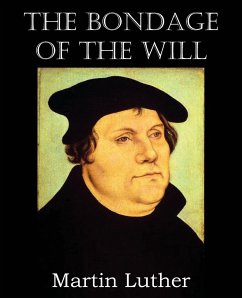
Miikka Ruokanen reveals the powerfully Trinitarian and participatory nature of Martin Luther's conception of divine grace in his magnum opus The Bondage of the Will. The study establishes a genuinely new understanding of Luther's major treatise opening up its ecumenical potential. Luther's debate with Erasmus signifies not only a disagreement concerning free will, but the dispute reveals two contrasting understandings of the very core idea of the Christian faith. For Erasmus, the relationship of the human being with God is based on the rationally and morally acceptable principles of fair play.…mehr
Miikka Ruokanen reveals the powerfully Trinitarian and participatory nature of Martin Luther's conception of divine grace in his magnum opus The Bondage of the Will. The study establishes a genuinely new understanding of Luther's major treatise opening up its ecumenical potential. Luther's debate with Erasmus signifies not only a disagreement concerning free will, but the dispute reveals two contrasting understandings of the very core idea of the Christian faith. For Erasmus, the relationship of the human being with God is based on the rationally and morally acceptable principles of fair play. For Luther, the human being is captivated by the overwhelming power of unfaith and transcendental evil, Satan; only the monergistic grace of the Triune God and the power of the Holy Spirit can liberate him/her. Ruokanen verifies the Trinitarian vision of salvation "by grace alone" as the center of Luther's theology. This doctrine has three dimensions. Firstly, the conversion of the sinner and the birth of faith in Christ are effected by prevenient divine grace; justification "through faith alone," is the sole work of God's Spirit, comparable to creation ex nihilo. Secondly, participation in the person, life, and divine properties of Christ, as well as participation in his salvific work, his cross and resurrection, are possible solely because of the presence of the Holy Spirit in the believer. Justification means simultaneously the forensic declaration of the guilty non-guilty on the basis of the atonement by Jesus' cross, as well as a union with Christ in the Holy Spirit. Thirdly, sanctification means the gradual growth of love for God and neighbor enabled by the believer's participation in divine love in the Holy Spirit. Ruokanen's work offers a crucial modification and advance to the world-renowned Finnish school of Luther interpretation: Luther's classic use of Pneumatological language avoids the problems caused by using an ontological language.
Miikka Ruokanen is Professor Emeritus of Dogmatics at the University of Helsinki, Finland, and Professor of Systematic Theology at Nanjing Union Theological Seminary, China. He is also Guest Professor at the Renmin University of China, Beijing, and Advisory Professor at Fudan University, Shanghai. His publications include include The Catholic Doctrine of Non-Christian Religions: According to the Second Vatican Council (Brill, 1992), Theology of Social Life in Augustine's De civitate Dei (Vandenhoeck & Ruprecht, 1993), and Christianity and Chinese Culture (co-edited with Paulos Huang; Eerdmans, 2010).
Inhaltsangabe
List of Abbreviation 1: Introduction 2: Erasmus and Luther: Two Different Paradigms of the Christian Faith 3: Luther's Theological Method of Conflict and Distinction 4: The Enslavement of the Human Being 5: Pneumatological Emphasis in the Doctrine of Grace 6: The Trinitarian Nature of the Pneumatological Grace 7: A Theology of Paradoxes 8: A Comprehensive View of Luther's Doctrine of Grace 9: Is there Any Possibility of Reconciliation between Erasmus and Luther? 10: Conclusion Bibliography Index of Personal Names Index of Subjects
List of Abbreviation 1: Introduction 2: Erasmus and Luther: Two Different Paradigms of the Christian Faith 3: Luther's Theological Method of Conflict and Distinction 4: The Enslavement of the Human Being 5: Pneumatological Emphasis in the Doctrine of Grace 6: The Trinitarian Nature of the Pneumatological Grace 7: A Theology of Paradoxes 8: A Comprehensive View of Luther's Doctrine of Grace 9: Is there Any Possibility of Reconciliation between Erasmus and Luther? 10: Conclusion Bibliography Index of Personal Names Index of Subjects
Es gelten unsere Allgemeinen Geschäftsbedingungen: www.buecher.de/agb
Impressum
www.buecher.de ist ein Internetauftritt der buecher.de internetstores GmbH
Geschäftsführung: Monica Sawhney | Roland Kölbl | Günter Hilger
Sitz der Gesellschaft: Batheyer Straße 115 - 117, 58099 Hagen
Postanschrift: Bürgermeister-Wegele-Str. 12, 86167 Augsburg
Amtsgericht Hagen HRB 13257
Steuernummer: 321/5800/1497
USt-IdNr: DE450055826