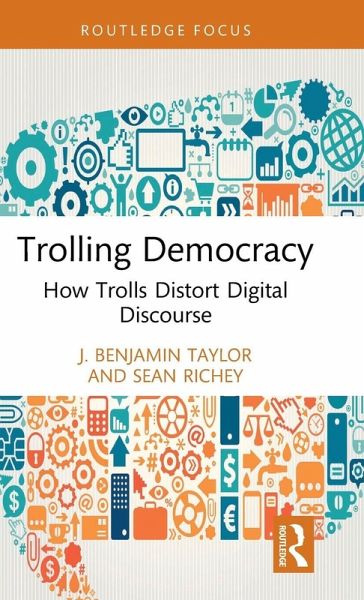
Trolling Democracy offers both academic and practical insights into one of the most pressing challenges of the digital age, offering a comprehensive understanding of trolling's effect on the public sphere, its implications for democratic processes, the spread of misinformation and the exacerbation of political polarization.
Trolling Democracy offers both academic and practical insights into one of the most pressing challenges of the digital age, offering a comprehensive understanding of trolling's effect on the public sphere, its implications for democratic processes, the spread of misinformation and the exacerbation of political polarization.
J. Benjamin Taylor is Associate Professor of Political Science at Kennesaw State University. He researches and teaches courses on American political behavior. He has published several books and academic journal articles in Political Communication, State Politics & Policy Quarterly, American Politics Research, Politics & Religion, and Presidential Studies Quarterly . Sean Richey is Professor of Political Science at Georgia State University. He was a Fulbright Fellow from 2013 to 2014 at the University of Tokyo. He was a Japan Society for the Promotion of Science Post-Doctoral Fellow at the University of Tokyo between 2004 and 2006. He researches American politics, specializing in elections, voting behavior, public opinion, and quantitative methodology. His research has appeared in two peer-reviewed books and academic journal articles, including in Political Research Quarterly, the British Journal of Political Science, Political Communication, Political Behavior, International Studies Quarterly, and others.
Inhaltsangabe
1. The Impact of Trolling on Democracy 2. Deliberative Democratic Theory and Trolling 3. Who are the Victims of Online Harassment and Trolling? 4. Need for Chaos Scale: Psychological Determinants of Internet Trolling 5. Nonpsychological Predictors of Trolling 6. Identifying Trolling and Trolls Online 7. The Effect of Trolling on Down-the-Line Behaviors 8. Conclusion: Trolling, Deliberative Democracy, and the Path Forward. Appendix
1. The Impact of Trolling on Democracy 2. Deliberative Democratic Theory and Trolling 3. Who are the Victims of Online Harassment and Trolling? 4. Need for Chaos Scale: Psychological Determinants of Internet Trolling 5. Nonpsychological Predictors of Trolling 6. Identifying Trolling and Trolls Online 7. The Effect of Trolling on Down-the-Line Behaviors 8. Conclusion: Trolling, Deliberative Democracy, and the Path Forward. Appendix
Es gelten unsere Allgemeinen Geschäftsbedingungen: www.buecher.de/agb
Impressum
www.buecher.de ist ein Internetauftritt der buecher.de internetstores GmbH
Geschäftsführung: Monica Sawhney | Roland Kölbl | Günter Hilger
Sitz der Gesellschaft: Batheyer Straße 115 - 117, 58099 Hagen
Postanschrift: Bürgermeister-Wegele-Str. 12, 86167 Augsburg
Amtsgericht Hagen HRB 13257
Steuernummer: 321/5800/1497
USt-IdNr: DE450055826