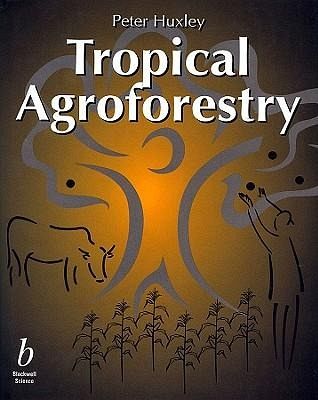
Agroforestry is the cultivation, by farmers, of trees or other woody plants with crops or pasture. Its scientific study is attracting great interest and increasing funding because of its potential to produce sustainable agricultural systems and agroforestry is now included in most university and college courses covering land use subjects. Tropical Agroforestry is the first book that provides an analytical account of the principles, as well as the practices, of agroforestry within the context of the needs of land occupiers and, in so doing, describes the various specialist aspects that are now…mehr
Agroforestry is the cultivation, by farmers, of trees or other woody plants with crops or pasture. Its scientific study is attracting great interest and increasing funding because of its potential to produce sustainable agricultural systems and agroforestry is now included in most university and college courses covering land use subjects. Tropical Agroforestry is the first book that provides an analytical account of the principles, as well as the practices, of agroforestry within the context of the needs of land occupiers and, in so doing, describes the various specialist aspects that are now emerging as part of this discipline. The main objective throughout the book is to present, in a readable way, the underlying functional basis of woody/non-woody plant mixtures and to give a balanced account of how agroforestry can contribute to sustainable production from land. Understanding the biology of multipurpose trees is a key to this.
Peter Huxley is the author of Tropical Agroforestry, published by Wiley.
Inhaltsangabe
Preface. Acknowledgements. Section I. 1 Introduction. 2 The Nature of Agroforestry. 3 A Need for Agroforestry? 4 Agroforestry and the Farmer: Why Use Woody Plants? 5 Animal Agroforestry. 6 Agroforestry and Soil and Water Conservation. Section II. 7 The Pros and Cons of 'Woodiness'. 8 Learning from Growing Crops. 9 Agroforestry and the Use of Environmental Resources: the 'Promise' of Agroforestry. 10 Plant Spacing and Arrangement: an Essential Management Tool. 11 Resource Allocation in Plants. Section III. 12 The Tree-Crop Interface: a Key to Biological Success or Failure in Agroforestry. 13 Competition and Complementarity. 14 Measuring the Efficiency of Agroforestry Systems. Section IV. 15 Trees in Support of Agriculture: More About Trees. 16 Classifying Multipurpose Trees: What Are Functional Types? 17 Phenology: Understanding Plant Behaviour. 18 The Form and Nature of Root Systems. 19 Pruning and Tree Management: Some Practical Aspects. 20 Helpful Associations: Soil Biota, Nitrogen Fixing Organisms and Mycorrhizas. 21 Propagation, Planting Out and Tree Protection. Section V. 22 'Patchiness': Living in the Real World. 23 Trees and their Environment. 24 Agroforestry and Site Modification: Nutrient Recycling and Soil Organic Matter. 25 Agroforestry and Sustainability. Section VI. 26 Introducing the Philosophy and Practice of Agroforestry Research. 27 Agroforestry Field Experimentation: a First Approach. Appendix 1 Some Characteristics of Trees (and Other Woody Perennials) for Consideration in Agroforestry. Appendix 2 Some Equipment Used in Agroforestry Research. References. Index.
Es gelten unsere Allgemeinen Geschäftsbedingungen: www.buecher.de/agb
Impressum
www.buecher.de ist ein Internetauftritt der buecher.de internetstores GmbH
Geschäftsführung: Monica Sawhney | Roland Kölbl | Günter Hilger
Sitz der Gesellschaft: Batheyer Straße 115 - 117, 58099 Hagen
Postanschrift: Bürgermeister-Wegele-Str. 12, 86167 Augsburg
Amtsgericht Hagen HRB 13257
Steuernummer: 321/5800/1497
USt-IdNr: DE450055826