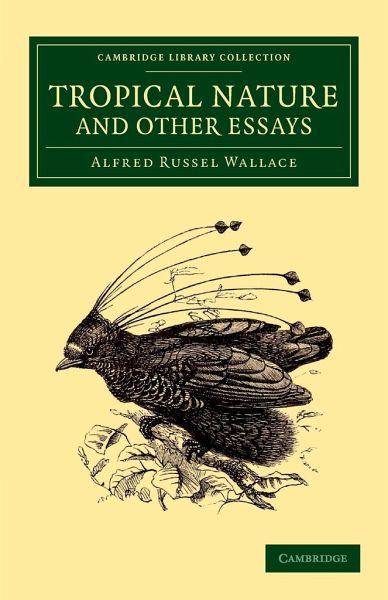
Sometimes referred to as 'the grand old man of science', Alfred Russel Wallace (1823-1913) was a naturalist, evolutionary theorist, and friend of Charles Darwin. In this study of tropical flora and fauna, he takes the reader on a tour of the equatorial forest belt - the almost continuous band of forest that stretches around the world between the tropics. There, chameleon-like caterpillars alter the colours of their cocoons, parasitical trees override their hosts with spectacular aerial root systems, and some of the most pressing questions of Victorian evolutionary science arise: how do animals…mehr
Sometimes referred to as 'the grand old man of science', Alfred Russel Wallace (1823-1913) was a naturalist, evolutionary theorist, and friend of Charles Darwin. In this study of tropical flora and fauna, he takes the reader on a tour of the equatorial forest belt - the almost continuous band of forest that stretches around the world between the tropics. There, chameleon-like caterpillars alter the colours of their cocoons, parasitical trees override their hosts with spectacular aerial root systems, and some of the most pressing questions of Victorian evolutionary science arise: how do animals and plants come to be brightly coloured? Can their adaptations provide clues about past geological eras? And was Darwin wholly correct in his theory of sexual selection? First published in 1878, Wallace's book is a skilfully written reflection of contemporary naturalism, still highly readable and relevant to students in the history of science.
Alfred Russel Wallace was an English naturalist, explorer, geographer, anthropologist, biologist, and illustrator who lived from 8 January 1823 to 7 November 1913. His own development of the theory of evolution through natural selection is what made him most famous. Charles Darwin's earlier papers on the subject were also excerpted in his 1858 paper, which was published in the same year. In response, Darwin rapidly wrote an abstract of the "great species book" he was composing, which he then published in 1859 as "On the Origin of Species. Beginning in the Amazon River basin, Wallace conducted considerable fieldwork. The Wallace Line, which divides the Indonesian archipelago into two distinct parts and is now known as the Wallace Line, was discovered by him while conducting fieldwork in the Malay Archipelago. In the western portion, where the animals are large and of Asian origin, and in the eastern portion, where the fauna reflects Australasia. He is frequently referred to as the "father of biogeography," or more specifically, of zoogeography, and was thought to be the foremost authority on the geographic distribution of animal species in the 19th century.
Inhaltsangabe
Preface 1. The climate and physical aspects of the equatorial zone 2. Equatorial vegetation 3. Animal life in the tropical forests 4. Humming-birds: as illustrating the luxuriance of tropical nature 5. The colours of animals and sexual selection 6. The colours of plants and the origin of the colour-sense 7. By-paths in the domain of biology 8. The distribution of animals as indicating geographical changes Index.
Preface 1. The climate and physical aspects of the equatorial zone 2. Equatorial vegetation 3. Animal life in the tropical forests 4. Humming-birds: as illustrating the luxuriance of tropical nature 5. The colours of animals and sexual selection 6. The colours of plants and the origin of the colour-sense 7. By-paths in the domain of biology 8. The distribution of animals as indicating geographical changes Index.
Es gelten unsere Allgemeinen Geschäftsbedingungen: www.buecher.de/agb
Impressum
www.buecher.de ist ein Internetauftritt der buecher.de internetstores GmbH
Geschäftsführung: Monica Sawhney | Roland Kölbl | Günter Hilger
Sitz der Gesellschaft: Batheyer Straße 115 - 117, 58099 Hagen
Postanschrift: Bürgermeister-Wegele-Str. 12, 86167 Augsburg
Amtsgericht Hagen HRB 13257
Steuernummer: 321/5800/1497
USt-IdNr: DE450055826