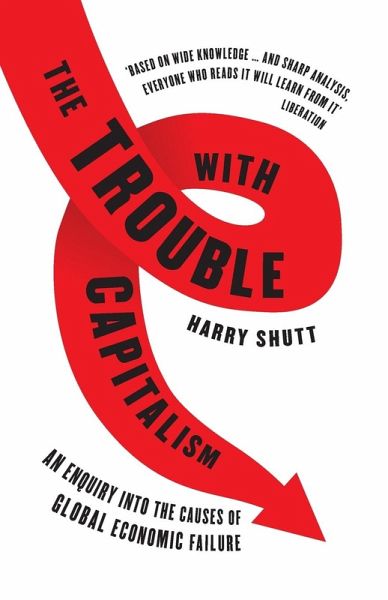
The recent collapse of the banking system and instability in the financial markets has dramatically shaken confidence in the global economic order. Is the current variant of 'free market' capitalism really sustainable? The Trouble With Capitalism - originally written, with remarkable prescience, in 1998 - anticipates such a development and explains the underlying economic fragility it has revealed. Rather than being merely a temporary blip in the march of capitalism, Shutt argues forcefully that the on-going crisis has arisen as a result of fundamental economic problems, stemming from the…mehr
The recent collapse of the banking system and instability in the financial markets has dramatically shaken confidence in the global economic order. Is the current variant of 'free market' capitalism really sustainable? The Trouble With Capitalism - originally written, with remarkable prescience, in 1998 - anticipates such a development and explains the underlying economic fragility it has revealed. Rather than being merely a temporary blip in the march of capitalism, Shutt argues forcefully that the on-going crisis has arisen as a result of fundamental economic problems, stemming from the growing redundancy of both labour and capital since the 1970s. In doing so, he exposes the sham of the laissez faire prospectus, showing that state power and capital are increasingly being used to prop up capital while pretending that the aim is to roll back the frontiers of the state. The implications of the author's startling conclusion (re-examined in a new foreword) - that the maximisation of profit must cease to be the main basis for allocating resources - are profound.
Harry Shutt was educated at Oxford and Warwick Universities. He worked for six years in the Development and Planning Division of the Economist Intelligence Unit (EIU). He then moved to the Research Department of the General and Municipal Workers' Union (1973-76) and subsequently became Chief Economist at the Fund for Research and Investment for the Development of Africa (1977-79). Since then he has been an independent economic consultant. His books include 'The Myth of Free Trade: Patterns of Protectionism Since 1945', (Basil Blackwell/The Economist, 1985), 'The Trouble with Capitalism: An Inquiry into the Causes of Global Economic Failure', (Zed Books, 1999), 'A New Democracy: Alternatives to a Bankrupt World Order' (Zed Books, 2001) and 'The Decline of Capitalism: Can a Self-Regulated Profits System Survive (Zed Books, 2004).
Inhaltsangabe
Foreword: Apocalypse now? Introduction 1. The Origins of Modern Capitalism: A Brief History to World War II 2. The Post-1945 Economic Dispensation in the West 3. The End of the Boom and the Neo-classical Reaction 4. The Illusion of Orthodoxy 5. Incurable Addiction to State Support 6. Globalisation and the Power Vacuum 7. Technological Nemesis 8. Coping with the Capital Glut 9. Wider Symptoms of Disintegration: I - The Wreckage of Soviet Communism 10. Wider Symptoms of Disintegration: II - Third World Catastrophe 11. A Crisis of Legitimacy 12. Can the Profits System be Saved? 13. Political Paralysis 14. Essential Features of a Sustainable World Order Index
Foreword: Apocalypse now? Introduction 1. The Origins of Modern Capitalism: A Brief History to World War II 2. The Post-1945 Economic Dispensation in the West 3. The End of the Boom and the Neo-classical Reaction 4. The Illusion of Orthodoxy 5. Incurable Addiction to State Support 6. Globalisation and the Power Vacuum 7. Technological Nemesis 8. Coping with the Capital Glut 9. Wider Symptoms of Disintegration: I - The Wreckage of Soviet Communism 10. Wider Symptoms of Disintegration: II - Third World Catastrophe 11. A Crisis of Legitimacy 12. Can the Profits System be Saved? 13. Political Paralysis 14. Essential Features of a Sustainable World Order Index
Es gelten unsere Allgemeinen Geschäftsbedingungen: www.buecher.de/agb
Impressum
www.buecher.de ist ein Internetauftritt der buecher.de internetstores GmbH
Geschäftsführung: Monica Sawhney | Roland Kölbl | Günter Hilger
Sitz der Gesellschaft: Batheyer Straße 115 - 117, 58099 Hagen
Postanschrift: Bürgermeister-Wegele-Str. 12, 86167 Augsburg
Amtsgericht Hagen HRB 13257
Steuernummer: 321/5800/1497
USt-IdNr: DE450055826