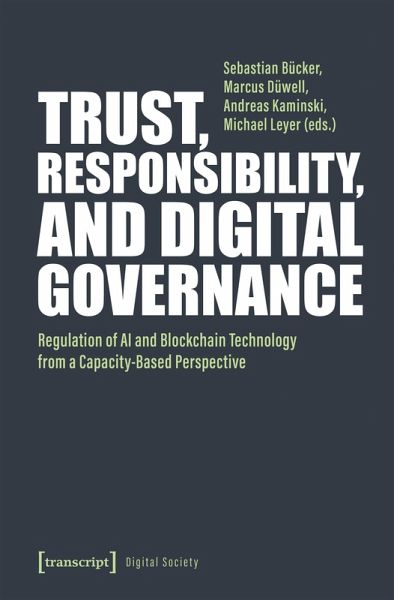
Regulation of AI and Blockchain Technology from a Capacity-Based Perspective Herausgegeben:Bücker, Sebastian; Düwell, Marcus; Kaminski, Andreas; Leyer, Michael
Regulation of AI and Blockchain Technology from a Capacity-Based Perspective Herausgegeben:Bücker, Sebastian; Düwell, Marcus; Kaminski, Andreas; Leyer, Michael
Numerous ethical guidelines and regulatory frameworks have been developed to assess and shape digital systems. However, these efforts often rest on the dubious assumption that individuals and organisations possess the necessary capacities to assess such systems in terms of justice, reliability, and other normative standards - especially given the growing complexity and corresponding opacity of many digital models. This issue is therefore of central importance to both legal and ethical debates surrounding AI and digital systems in general. The contributors to this volume propose a new approach…mehr
Numerous ethical guidelines and regulatory frameworks have been developed to assess and shape digital systems. However, these efforts often rest on the dubious assumption that individuals and organisations possess the necessary capacities to assess such systems in terms of justice, reliability, and other normative standards - especially given the growing complexity and corresponding opacity of many digital models. This issue is therefore of central importance to both legal and ethical debates surrounding AI and digital systems in general. The contributors to this volume propose a new approach to digital governance to enhance the capacity to evaluate and shape digital systems.
Andreas Kaminski (Edited by) Andreas Kaminski (M.A.) is a professor of philosophy of science and technology at Technische Universität Darmstadt. His research areas include social epistemology (philosophy of trust and testimony), technical epistemology (the role of technology in science) and politics of technology. He is a senior scientist at the High-Performance Computing Center of the Universität Stuttgart (HLRS). Michael Leyer (Edited by) Michael Leyer (PhD) is a professor of business administration and chair of Digitalization and Process Management at Universität Marburg. He is also an adjunct professor at Queensland University of Technology. The main focus of his research is the sociotechnical consideration of future technologies in organizations. Sebastian Bücker (Edited by) Sebastian Bücker, born in 1989, works as a scientific researcher at the Institute of Philosophy at Technische Universität Darmstadt. Using both his backgrounds in computer science and philosophy of technology, his research focuses on how current developments in AI can be connected to philosophy, especially regarding the ascription of capabilities associated with autonomy. Marcus Düwell (Edited by) Marcus Düwell is a professor of philosophy at the Institute for Philosophy at Technische Universität Darmstadt. His research interests include foundational questions of moral and political philosophy, philosophical anthropology, and applied ethics.
Es gelten unsere Allgemeinen Geschäftsbedingungen: www.buecher.de/agb
Impressum
www.buecher.de ist ein Internetauftritt der buecher.de internetstores GmbH
Geschäftsführung: Monica Sawhney | Roland Kölbl | Günter Hilger
Sitz der Gesellschaft: Batheyer Straße 115 - 117, 58099 Hagen
Postanschrift: Bürgermeister-Wegele-Str. 12, 86167 Augsburg
Amtsgericht Hagen HRB 13257
Steuernummer: 321/5800/1497
USt-IdNr: DE450055826