
Andere Kunden interessierten sich auch für
 Children's Attitudes towards Investigative Methods in Science Classes27,99 €
 Parental participation in children's education: A Samoan case24,99 €
 A CASE STUDY: BILINGUAL CHILDREN'S CODE-SWITCHING MECHANISMS29,99 €
 Parents' Involvement and Their Children's Mathematics Achievement39,99 €
 Taiwanese Young Children's Play in ECE Settings45,99 €
 Road Blocks of Education in Nomadic Pastoral Communities in Turkana37,99 €
 Elementary Teachers of Cameroon and Children's Literacy Achievement47,99 €

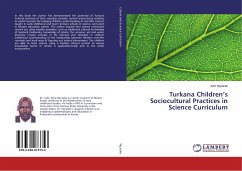
In this book the author has demonstrated the potential of Turkana Cultural practices of their everyday nomadic survival socioculutral activities as useful concepts for bridging children understanding of scientific content taught in early childhood and lower primary schools in science curriculum in Kenyan education system. The author argued that science instruction carried out using familiar examples, such as traditional cultural knowledge of livestock husbandry, knowledge of plants, the universe, soil and water discovery creates curiosity in the learners and stimulate in children intellectual understanding of the relationship between Western scientific concepts and local ways of figuring out natural phenomena. The children are able to learn science using a familiar cultural context to ensure knowledge learnt in school is applicable locally and to the wider environment.