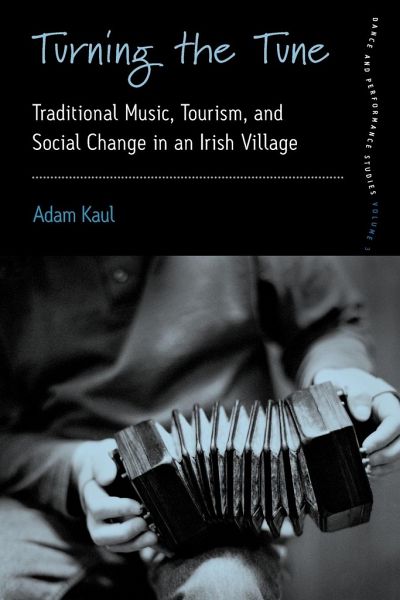
Argues traditional Irish music represents an increasingly important identity marker both in Ireland and abroad. Focuses on a small village in County Clare, a pilgrimage site for those interested in experiencing traditional music. Explores the commercialization of music and culture, consumption of "place," and offers a critique of the trope of "authenticity"
Argues traditional Irish music represents an increasingly important identity marker both in Ireland and abroad. Focuses on a small village in County Clare, a pilgrimage site for those interested in experiencing traditional music. Explores the commercialization of music and culture, consumption of "place," and offers a critique of the trope of "authenticity"
Adam Kaul is a Professor of Anthropology at Augustana College in Rock Island, Illinois. He has written extensively on traditional music, tourism, and the economics of musical performance in Ireland. He is also the co-editor of Leisure and Death (University Press of Colorado 2018) and co-editor of the 3rd edition of Tourists and Tourism (Waveland 2018).
Inhaltsangabe
Chapter 1. Introduction * Conceptual Orientation * Conceptual Organization * Doolin PART I: REMEMBERED HISTORY Chapter 2. The Old Days * Ethnography, History and Memory * Subsistence and Seasonality * Argonauts of the Eastern Atlantic * Seasonality Tourism in Clare in 1859 * (On the Origins of a New Species) * Traditional Irish Music of the "Old Days" * The Céilí and the Crossroads Dance * The Country House Dance * The Dance Halls and The Céilí Bands * Early Collections and Early Sessions * Conclusions Chapter 3. The Revival * A Changing Economy * The Folk Revival * Internal Changes in Irish Music * The Revival Arrives * Turning the Tune * Conclusions PART II: MOVING IN AND MOVING THROUGH Chapter 4. The Celtic Tiger * Celtic Tourism * Mass Tourists * Coach Tours * "Travelers", Working Tourists, and Visitors * Conclusions Chapter 5. Locals and Blow-ins * Locals * Blow-ins * Negotiations of Belonging * Conclusions PART III: CHANGE AND CONTINUITY Chapter 6. Consolidation and Globalization * Traditional Music of the Celtic Tiger * Doolin's Celtic Music Industry * Bands and Sessions, Performing and Playing * Paying to Play * Conclusions Chapter 7. Adoption and Approriation * Appropriation * Adoption * Complementary Discourses * Phenomenology of the Session * Premeditated Spontaneity * Music as a Conversation * Perfect Embodiment and Good Craic * Conclusions Chapter 8. Conclusions * History, Globalization, and Tourism * Appropriation, Tradition, and Cosmopolitanism * The Trope of Authenticity * Credibility * One's Relationship to the Locale * One's Epistemological Relationship to the Music * Immediate Context * Seasonality * The Interaction of Personalities * Good Man, Yourself Bibliography Index
Chapter 1. Introduction * Conceptual Orientation * Conceptual Organization * Doolin PART I: REMEMBERED HISTORY Chapter 2. The Old Days * Ethnography, History and Memory * Subsistence and Seasonality * Argonauts of the Eastern Atlantic * Seasonality Tourism in Clare in 1859 * (On the Origins of a New Species) * Traditional Irish Music of the "Old Days" * The Céilí and the Crossroads Dance * The Country House Dance * The Dance Halls and The Céilí Bands * Early Collections and Early Sessions * Conclusions Chapter 3. The Revival * A Changing Economy * The Folk Revival * Internal Changes in Irish Music * The Revival Arrives * Turning the Tune * Conclusions PART II: MOVING IN AND MOVING THROUGH Chapter 4. The Celtic Tiger * Celtic Tourism * Mass Tourists * Coach Tours * "Travelers", Working Tourists, and Visitors * Conclusions Chapter 5. Locals and Blow-ins * Locals * Blow-ins * Negotiations of Belonging * Conclusions PART III: CHANGE AND CONTINUITY Chapter 6. Consolidation and Globalization * Traditional Music of the Celtic Tiger * Doolin's Celtic Music Industry * Bands and Sessions, Performing and Playing * Paying to Play * Conclusions Chapter 7. Adoption and Approriation * Appropriation * Adoption * Complementary Discourses * Phenomenology of the Session * Premeditated Spontaneity * Music as a Conversation * Perfect Embodiment and Good Craic * Conclusions Chapter 8. Conclusions * History, Globalization, and Tourism * Appropriation, Tradition, and Cosmopolitanism * The Trope of Authenticity * Credibility * One's Relationship to the Locale * One's Epistemological Relationship to the Music * Immediate Context * Seasonality * The Interaction of Personalities * Good Man, Yourself Bibliography Index
Es gelten unsere Allgemeinen Geschäftsbedingungen: www.buecher.de/agb
Impressum
www.buecher.de ist ein Internetauftritt der buecher.de internetstores GmbH
Geschäftsführung: Monica Sawhney | Roland Kölbl | Günter Hilger
Sitz der Gesellschaft: Batheyer Straße 115 - 117, 58099 Hagen
Postanschrift: Bürgermeister-Wegele-Str. 12, 86167 Augsburg
Amtsgericht Hagen HRB 13257
Steuernummer: 321/5800/1497
USt-IdNr: DE450055826