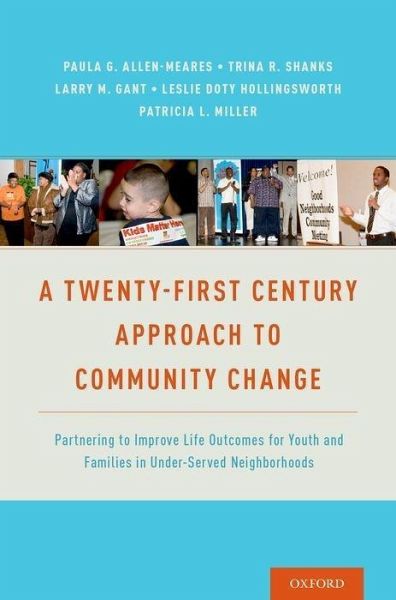
Urban renewal has been the dominant approach to revitalizing industrialized communities that fall into decline. A national, community-based organization, the Skillman Foundation sought to engage in a joint effort with the University of Michigan's School of Social Work to bring six neighborhoods in one such declining urban center, Detroit, back to positions of strength and national leadership. A Twenty-First Century Approach to Community Change introduces readers to the basis for the Foundation's solicitation of social work expertise and the social context within which the work of technical…mehr
Urban renewal has been the dominant approach to revitalizing industrialized communities that fall into decline. A national, community-based organization, the Skillman Foundation sought to engage in a joint effort with the University of Michigan's School of Social Work to bring six neighborhoods in one such declining urban center, Detroit, back to positions of strength and national leadership. A Twenty-First Century Approach to Community Change introduces readers to the basis for the Foundation's solicitation of social work expertise and the social context within which the work of technical assistance began. Building on research, the authors introduce the theory and practice knowledge of earlier scholars, including the conduct of needs assessments at multiple levels, engagement of community members in identifying problem-solving strategies, assistance in developing community goals, and implementation of social work field instruction opportunities. Lessons learned and challenges are described as they played out in the process of creating partnerships for the Foundation with community leaders, engaging and maintaining youth involvement, managing roles and relationships with multiple partners recruited by the Foundation for their specialized expertise, and ultimately conducting the work of technical assistance within a context of increasing influence of the city's surrounding systems (political, economic, educational, and social). Readers will especially note the role of technical assistance in an evolving theory of change.
Paula G. Allen-Meares, PhD, MSW, Chancellor Emerita, John Corbally Presidential Professor, Professor of Medicine, University of Illinois at Chicago; Executive Director, Office of Health Literacy, University of Illinois at Chicago; Dean and Professor Emerita/Norma Radin Collegiate Professor, School of Social Work, University of Michigan Trina R. Shanks, PhD, MSW, MPh, Associate Professor, School of Social Work, University of Michigan Larry M. Gant, PhD, MA, MSW, Professor, School of Social Work; Professor, Penny W. Stamps School of Art and Design, University of Michigan Leslie D. Hollingsworth, PhD, MSW, Associate Professor Emerita, School of Social Work, University of Michigan Patricia L. Miller, MSW, Past Project Director, School of Social Work Technical Assistance Center, University of Michigan
Inhaltsangabe
* Foreword * Carol Goss * Acknowledgements * Contributor List * Chapter 1: Introduction to Good Neighborhoods * Paula Allen-Meares * Chapter 2: Detroit: The Emergence, Decline and Possible Revitalization of a Great City * Reynolds Farley * Chapter 3: Community Development and Place-Based Neighborhood Change * Larry M. Gant * Chapter 4: Introducing the Six Good Neighborhoods Communities * Trina R. Shanks * Chapter 5: Theories of Change: Creating and Going Forward * Leslie Hollingsworth, Larry M. Gant * Chapter 6: Community Change Process: The Planning Phase * Leslie Hollingsworth, Larry M. Gant, Patricia Miller * Chapter 7: Building and Maintaining Community Capacity: How the TAC Supported Neighborhood Organizations * Trina R. Shanks, Leslie Hollingsworth, Patricia Miller * Chapter 8: Building and Maintaining Community Capacity: How the TAC Supported Neighborhood Residents * Trina R. Shanks, Patricia Miller * Chapter 9: Helping Communities Design Governance Structures: The Technical Assistance Center Approach * Larry M. Gant * Chapter 10: Innovative Approaches in Field Instruction and Educational Practice Innovations for Training Social Work Student Interns * Larry M. Gant * Chapter 11: Measurable Results of Good Neighborhoods: What Was Accomplished? * Trina R. Shanks, Sonia Harb, Sue Ann Savas * Chapter 12: Lessons Learned: Stream of Thought * Paula Allen-Meares, Leslie Hollingsworth, Patricia Milleru * Epilogue * Tonya Allen * Appendix A * Appendix B * Appendix C * Appendix D * Appendix E * Appendix F * Appendix G * Appendix H * Appendix I * Index
* Foreword * Carol Goss * Acknowledgements * Contributor List * Chapter 1: Introduction to Good Neighborhoods * Paula Allen-Meares * Chapter 2: Detroit: The Emergence, Decline and Possible Revitalization of a Great City * Reynolds Farley * Chapter 3: Community Development and Place-Based Neighborhood Change * Larry M. Gant * Chapter 4: Introducing the Six Good Neighborhoods Communities * Trina R. Shanks * Chapter 5: Theories of Change: Creating and Going Forward * Leslie Hollingsworth, Larry M. Gant * Chapter 6: Community Change Process: The Planning Phase * Leslie Hollingsworth, Larry M. Gant, Patricia Miller * Chapter 7: Building and Maintaining Community Capacity: How the TAC Supported Neighborhood Organizations * Trina R. Shanks, Leslie Hollingsworth, Patricia Miller * Chapter 8: Building and Maintaining Community Capacity: How the TAC Supported Neighborhood Residents * Trina R. Shanks, Patricia Miller * Chapter 9: Helping Communities Design Governance Structures: The Technical Assistance Center Approach * Larry M. Gant * Chapter 10: Innovative Approaches in Field Instruction and Educational Practice Innovations for Training Social Work Student Interns * Larry M. Gant * Chapter 11: Measurable Results of Good Neighborhoods: What Was Accomplished? * Trina R. Shanks, Sonia Harb, Sue Ann Savas * Chapter 12: Lessons Learned: Stream of Thought * Paula Allen-Meares, Leslie Hollingsworth, Patricia Milleru * Epilogue * Tonya Allen * Appendix A * Appendix B * Appendix C * Appendix D * Appendix E * Appendix F * Appendix G * Appendix H * Appendix I * Index
Es gelten unsere Allgemeinen Geschäftsbedingungen: www.buecher.de/agb
Impressum
www.buecher.de ist ein Internetauftritt der buecher.de internetstores GmbH
Geschäftsführung: Monica Sawhney | Roland Kölbl | Günter Hilger
Sitz der Gesellschaft: Batheyer Straße 115 - 117, 58099 Hagen
Postanschrift: Bürgermeister-Wegele-Str. 12, 86167 Augsburg
Amtsgericht Hagen HRB 13257
Steuernummer: 321/5800/1497
USt-IdNr: DE450055826