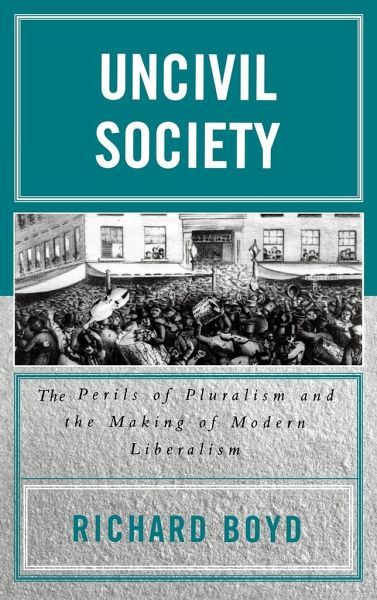
In Uncivil Society, Richard Boyd argues contrarily that contemporary political theorist and social scientists have unduly neglected the "uncivil" properties of groups. Through a careful reading of such exemplary figures as Hobbes, Locke, the Scottish Moralist, Edmund Burke, John Stuart Mill, Alexis de Tocqueville, and Michael Oakeshott in the classical liberal tradition - and their defense of the virtue of civility - this work calls into question many contemporary assumptions about the nature and origins of civil society.
1 Introduction: Civic Associations and the Liberal Tradition 2 Chapter One: Thomas Hobbes and the Perils of Pluralism 3 Chapter Two: John Locke, Toleration, and Sectarianism 4 Chapter Three: Reappraising the Scottish Moralists and Civil Society 5 Chapter Four: Edmund Burke's Defense of Civil Society 6 Chapter Five: John Stuart Mill and the Modern Liberal Ambivalence to Groups 7 Chapter Six: Alexis de Tocqueville and the Perils of Pluralism Revisited 8 Chapter Seven: Michael Oakeshott and the Transformational (Im)possibilities of the Liberal State 9 Chapter Eight: F. A. Hayek and the Limits of Liberal Constitutionalism 10 Conclusion: Liberal Neutrality, Purposive Community, and the Logic of Contemporary Pluralism
Es gelten unsere Allgemeinen Geschäftsbedingungen: www.buecher.de/agb
Impressum
www.buecher.de ist ein Internetauftritt der buecher.de internetstores GmbH
Geschäftsführung: Monica Sawhney | Roland Kölbl | Günter Hilger
Sitz der Gesellschaft: Batheyer Straße 115 - 117, 58099 Hagen
Postanschrift: Bürgermeister-Wegele-Str. 12, 86167 Augsburg
Amtsgericht Hagen HRB 13257
Steuernummer: 321/5800/1497
USt-IdNr: DE450055826