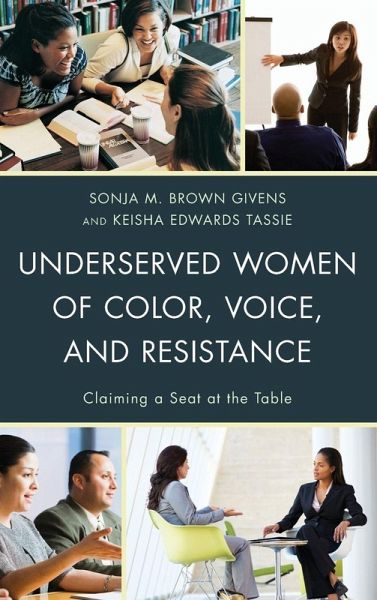
This book argues that contemporary research on the lives and experiences of women of color tends to neglect the influence of women’s perceived access to voice on how they manage tensions related to race, class, and gender. This book explores the politics of pursuing voice by women of color across various social contexts.
This book argues that contemporary research on the lives and experiences of women of color tends to neglect the influence of women’s perceived access to voice on how they manage tensions related to race, class, and gender. This book explores the politics of pursuing voice by women of color across various social contexts.
Sonja Brown Givens is associate dean for the Niagara Frontier Region at SUNY Empire State College. Keisha Edwards Tassie is associate professor of communication at Morehouse College.
Inhaltsangabe
Table of Contents Foreword Olga I. Davis Acknowledgments Part I: Finding Voice in silencing environments Chapter 1: Finding our voices: Connecting across time, space, age, race, and profession Atika Chaudhary and Gary L. Lemons Chapter 2: My name is not Maria/Samira: On the interchangeability of Brownness in U.S. pedagogical contexts Fatima Z. Chrifi Alaoui, Raquel Moreira, Krishna Pattisapu, Salma Shukri and Bernadette M. Calafell Chapter 3: Current perspectives on the intersectionality of military women Christie Burton Chapter 4: Writing for ourselves: Voicing as therapy in and outside of the classroom Cantice Greene Chapter 5: "You speak Ebonics right?!": My struggle to come to Voice within the academy Tangela Serls and Yakini Kemp Part II: Using Voice to resist silencing Chapter 6: A resistance story: Negotiating the institutional and material through collectivity Manoucheka Celeste, Sara P. Diaz, Angela B. Ginorio and Ralina L. Joseph Chapter 7: Black Atlantic heretics of Empire 1919-1965: The Caribbean intersectionality of Amy Jacques Garvey, Elma Francois and Claudia Jones Reynaldo Anderson Chapter 8: Teaching autocritiography by women of color feminists: Writing to save our own lives Gary L. Lemons Chapter 9: I came with resistance in mind: Teaching and learning as a Black woman at a predominately White institution / Aiming at Solidarity: Teaching and learning as a White woman at a predominately White Institution Rondrea Mathis and Diane Price-Herndl
Table of Contents Foreword Olga I. Davis Acknowledgments Part I: Finding Voice in silencing environments Chapter 1: Finding our voices: Connecting across time, space, age, race, and profession Atika Chaudhary and Gary L. Lemons Chapter 2: My name is not Maria/Samira: On the interchangeability of Brownness in U.S. pedagogical contexts Fatima Z. Chrifi Alaoui, Raquel Moreira, Krishna Pattisapu, Salma Shukri and Bernadette M. Calafell Chapter 3: Current perspectives on the intersectionality of military women Christie Burton Chapter 4: Writing for ourselves: Voicing as therapy in and outside of the classroom Cantice Greene Chapter 5: "You speak Ebonics right?!": My struggle to come to Voice within the academy Tangela Serls and Yakini Kemp Part II: Using Voice to resist silencing Chapter 6: A resistance story: Negotiating the institutional and material through collectivity Manoucheka Celeste, Sara P. Diaz, Angela B. Ginorio and Ralina L. Joseph Chapter 7: Black Atlantic heretics of Empire 1919-1965: The Caribbean intersectionality of Amy Jacques Garvey, Elma Francois and Claudia Jones Reynaldo Anderson Chapter 8: Teaching autocritiography by women of color feminists: Writing to save our own lives Gary L. Lemons Chapter 9: I came with resistance in mind: Teaching and learning as a Black woman at a predominately White institution / Aiming at Solidarity: Teaching and learning as a White woman at a predominately White Institution Rondrea Mathis and Diane Price-Herndl
Es gelten unsere Allgemeinen Geschäftsbedingungen: www.buecher.de/agb
Impressum
www.buecher.de ist ein Internetauftritt der buecher.de internetstores GmbH
Geschäftsführung: Monica Sawhney | Roland Kölbl | Günter Hilger
Sitz der Gesellschaft: Batheyer Straße 115 - 117, 58099 Hagen
Postanschrift: Bürgermeister-Wegele-Str. 12, 86167 Augsburg
Amtsgericht Hagen HRB 13257
Steuernummer: 321/5800/1497
USt-IdNr: DE450055826