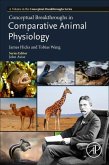
Understanding Animal Intelligence: Practical Behavior Theory for Biology, Psychology, and Cognitive Science synthesizes theories and practice to comprehend animal cognition. Using the framework of reinforcement learning, this book combines current knowledge of animal intelligence, focusing on decision-making, memory retrieval, associative learning, training, and more. It evaluates how evolutionary and environmental factors influence cognition and behavior. Additionally, the book explores motivational states and how these fulfill different goals, such as seeking food and water. Moreover, this…mehr
Understanding Animal Intelligence: Practical Behavior Theory for Biology, Psychology, and Cognitive Science synthesizes theories and practice to comprehend animal cognition. Using the framework of reinforcement learning, this book combines current knowledge of animal intelligence, focusing on decision-making, memory retrieval, associative learning, training, and more. It evaluates how evolutionary and environmental factors influence cognition and behavior. Additionally, the book explores motivational states and how these fulfill different goals, such as seeking food and water. Moreover, this book is a valuable reference and essential reading for courses in animal behavior, animal physiology, and ethology. It provides a comprehensive analysis of animal intelligence by examining decision-making processes, memory retrieval, and associative learning. The book also delves into the interplay between evolutionary and environmental influences on cognition and behavior and demonstrates how learning can align with genetic predispositions.
Dr. Stefano Ghirlanda is a Full Professor in the Department of Psychology at Brooklyn College. He received his PhD in zoology, with a concentration in ethology, from Stockholm University. He is also a founder and fellow of the Stockholm University Centre for the Study of Cultural Evolution. He considers himself a "behavior theorist" - he is interested in data-driven, theoretical accounts of all aspects of human and non-human behavior, including their neural underpinnings, and in particular learning and generalization, the architecture of behavior, and cultural evolution.
Inhaltsangabe
Part I: Fundamental questions 1. What does it mean to understand animal intelligence? 2. Different purposes of mechanistic, developmental, and evolutionary explanations 3. Describing behavior - responses to stimuli, individual history, evolutionary history 4. Modeling animal intelligence - decision-making, learning, and evolution Part II: Decision-making 5. Using available information to select the best action - external stimuli, memories, and motivational states 6. Evaluation of current stimuli - perception, generalization, relationship with deep learning 7. Memory retrieval - selecting which information to use 8. Motivational systems - selecting which goal to pursue 9. Inborn contributions to decision-making strategies Part III: Learning and development 10. Associative learning - a modern perspective on reinforcement learning 11. Specialized memory systems - purposes and algorithms 12. Genetic guidance of learning 13. Learned information 14. Maturation - changing behavioral mechanisms with age and experience 15. Training - teaching animals beyond their inherent scope Part IV: Evolution of behavior 16. Evolution’s effect on learning and decision-making 17. Innate value landscapes 18. Co-evolution of animal intelligence with environmental demands
Es gelten unsere Allgemeinen Geschäftsbedingungen: www.buecher.de/agb
Impressum
www.buecher.de ist ein Internetauftritt der buecher.de internetstores GmbH
Geschäftsführung: Monica Sawhney | Roland Kölbl | Günter Hilger
Sitz der Gesellschaft: Batheyer Straße 115 - 117, 58099 Hagen
Postanschrift: Bürgermeister-Wegele-Str. 12, 86167 Augsburg
Amtsgericht Hagen HRB 13257
Steuernummer: 321/5800/1497
USt-IdNr: DE450055826