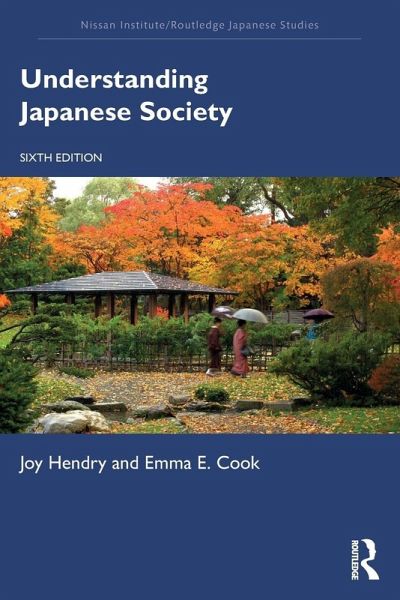
In this welcome new sixth edition of the bestselling textbook Understanding Japanese Society, Joy Hendry and Emma E. Cook take the reader into the heart of Japanese life. Providing a clear and accessible introduction to Japanese ways of thinking, which does not require any previous knowledge of the country, this book explores Japanese society through the worlds of home, work, play, health, religion, and ritual, covering a full range of life experiences, from childhood to old age. Fully updated, revised, and expanded with a brand new chapter on health and ageing, the sixth edition contains…mehr
In this welcome new sixth edition of the bestselling textbook Understanding Japanese Society, Joy Hendry and Emma E. Cook take the reader into the heart of Japanese life.
Providing a clear and accessible introduction to Japanese ways of thinking, which does not require any previous knowledge of the country, this book explores Japanese society through the worlds of home, work, play, health, religion, and ritual, covering a full range of life experiences, from childhood to old age. Fully updated, revised, and expanded with a brand new chapter on health and ageing, the sixth edition contains new material on: Experiences of the COVID-19 pandemicChanges in the family and LGBTQ experiencesIncreased interest in rural areas, the problems and opportunities of empty housesUse of technology and AI in different areas of lifeDiscussion of new kinds of criminal activity and an increase in elderly offenders Each chapter in this new edition also includes an exciting insert from scholars in the field, based on new and emerging research. This book will be invaluable to all students studying Japan. It will also enlighten tourists, travellers, and business people wishing to gain an understanding of Japanese people.
Joy Hendry was born in Birmingham, brought up within a Scottish community in Warwickshire, travelling back to the home country every summer to visit relatives and enjoy the wonderful opportunities for hiking and camping. She was also sometimes sent, alone from quite an early age, to visit her mother's relatives in Yorkshire, where her aunt introduced her to beachcombing and coastal walks and encouraged her ambition to become a writer. From the age of nine, Joy attended Penrhos College, a girls' boarding school by the sea in North Wales, advised (correctly) by the family doctor to help her recover from a long and quite debilitating attack of sinusitis. Travel, adventure and new experiences were thus woven into her upbringing, and possibly underpinned her eventual choice of social anthropology as a career. Joy went back to university to study social anthropology at Lady Margaret Hall, Oxford, in the autumn of that same year, and began the story that this volume recounts during that period of training. She went on to teach for many years at Oxford Brookes University and after retirement was made an emeritus professor. She also held a readership in the Scottish Centre for Japanese Studies at the University of Stirling from 1989-92, when she established a home in Tillicoultry, Clackmannanshire, where she would return most summers to write. Now released from teaching, this same activity has enabled her to spend the 2020 lockdown period in relative peace and comfort. Joy also founded a global professional organisation called the Japan Anthropology Workshop and another, the Europe Japan Research Centre, largely based at Oxford Brookes, where she helped to found one of the most successful departments of Japanese in the UK. She has been president of the British Association for Japanese Studies, vice president of the European Association for Japanese Studies, and in 2017, the Government of Japan bestowed on her the Order of the Rising Sun, Gold Rays with Rosette, "in recognition of her outstanding contribution to the promotion of Japanese Studies in the UK and thus to deeper mutual understanding between Japan and the United Kingdom".
Inhaltsangabe
Introduction 1. Sources of Japanese identity: Historical and mythological foundations of Japan 2. The house and family system 3. Socialisation and classification 4. Community and neighborhood 5. The education system 6. Status, hierarchy, and ethnic diversity 7. Healthcare and ageing 8. Religious influences 9. Ritual and the life cycle 10. Opportunities for working life 11. Arts, entertainment, and leisure 12. Government and the craft of politics 13. The legal system and social control Conclusion
Introduction 1. Sources of Japanese Identity 2. The House and Family System 3. Socialisation and Classification 4. Community and Neighbourhood 5. The Education System 6. Status, Hierarchy and Ethnic Diversity 7. Religious In uences 8. Ritual and the Life Cycle 9. Opportunities for Working Life 10. Arts, Entertainment and Leisure 11. Government and the Craft of Politics 12. The Legal System and Social Control in a Global World Conclusion
Introduction 1. Sources of Japanese identity: Historical and mythological foundations of Japan 2. The house and family system 3. Socialisation and classification 4. Community and neighborhood 5. The education system 6. Status, hierarchy, and ethnic diversity 7. Healthcare and ageing 8. Religious influences 9. Ritual and the life cycle 10. Opportunities for working life 11. Arts, entertainment, and leisure 12. Government and the craft of politics 13. The legal system and social control Conclusion
Introduction 1. Sources of Japanese Identity 2. The House and Family System 3. Socialisation and Classification 4. Community and Neighbourhood 5. The Education System 6. Status, Hierarchy and Ethnic Diversity 7. Religious In uences 8. Ritual and the Life Cycle 9. Opportunities for Working Life 10. Arts, Entertainment and Leisure 11. Government and the Craft of Politics 12. The Legal System and Social Control in a Global World Conclusion
Es gelten unsere Allgemeinen Geschäftsbedingungen: www.buecher.de/agb
Impressum
www.buecher.de ist ein Internetauftritt der buecher.de internetstores GmbH
Geschäftsführung: Monica Sawhney | Roland Kölbl | Günter Hilger
Sitz der Gesellschaft: Batheyer Straße 115 - 117, 58099 Hagen
Postanschrift: Bürgermeister-Wegele-Str. 12, 86167 Augsburg
Amtsgericht Hagen HRB 13257
Steuernummer: 321/5800/1497
USt-IdNr: DE450055826