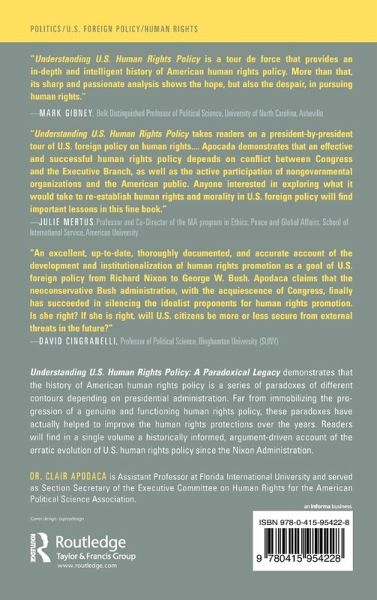
This book provides a comprehensive historical overview and analysis of the complex and often vexing problem of understanding the formation of US human rights policy over the past thirty-five years.
This book provides a comprehensive historical overview and analysis of the complex and often vexing problem of understanding the formation of US human rights policy over the past thirty-five years.
Clair Apodaca is Assistant Professor in the Department of International Relations at Florida International University.
Inhaltsangabe
Introduction: The Paradoxes of U.S. Human Rights Policy 1. The United States System of Foreign Policy Making 1.1 Theories of Foreign Policy 1.2 Foreign Policy Actors 1.3 Tools of United States Human Rights Foreign Policy 1.4 What is Foreign Aid? 1.5 Foreign Aid and Human Rights 1.6 Conclusion 2. Human Rights, the Unintended Consequence: The Nixon and Ford Administrations 2.1 Realpolitik 2.2 Congress and the Imperial President 2.3 The Helsinki Conference 2.4 The Executive Branch Rebuff 2.5 The Public, NGOs and the Media and the Human Rights Agenda 2.6 Conclusion 3. Human Rights Policy, the Unintended Victim: The Carter Administration 3.1 Idealism 3.2 The Implementation of U.S. Human Rights Policy 3.3 Human Rights as an Unintended Victim 3.4 Idealism in a Realist World 3.5 Congress as a Continued Force for Human Rights 3.6 Conclusion 4. The Contradictions of U.S. Human Rights Policy: The Reagan Administration 4.1 Conservative Realism 4.2 The Renewed Cold War Warrior 4.3 United States Foreign Aid 4.4 The Bureau of Human Rights and Humanitarian Affairs 4.5 Congress' Continued Role 4.6 Institutionalizing Human Rights 4.7 Conclusion 5. Human Rights in the New World Order: The George H.W. Bush Administration 5.1 A Pragmatic Conservative Realist 5.2 Bush's Leadership Style and Relationship with Congress 5.3 Political Expediency in International Crises 5.4 The War on Drugs and Human Rights Abuses 5.5 A Kinder, Gentler Central America Policy 5.6. Foreign Aid 5.7. Conclusion 6. Selling Off Human Rights: The Clinton Administration 6.1 Liberal Internationalism 6.2 Repudiated Idealism: The Selling Off of Human Rights 6.3 Assertive Multilateralism 6.4 Foreign Aid 6.5 Congressional Human Rights Initiatives 6.6 Conclusion 7. U.S. Human Rights Policy, the Calculated Victim: The George W. Bush Administration 7.1 Neoconservativism 7.2 The New Imperial Presidency: Bush's Grab of Power 7.3 Democracy at the Point of a Gun 7.4 Foreign Aid 7.5 A Stain on Our Country's Honor 7.6 Conclusion 8. Conclusion: Paradox Lost?
Introduction: The Paradoxes of U.S. Human Rights Policy 1. The United States System of Foreign Policy Making 1.1 Theories of Foreign Policy 1.2 Foreign Policy Actors 1.3 Tools of United States Human Rights Foreign Policy 1.4 What is Foreign Aid? 1.5 Foreign Aid and Human Rights 1.6 Conclusion 2. Human Rights, the Unintended Consequence: The Nixon and Ford Administrations 2.1 Realpolitik 2.2 Congress and the Imperial President 2.3 The Helsinki Conference 2.4 The Executive Branch Rebuff 2.5 The Public, NGOs and the Media and the Human Rights Agenda 2.6 Conclusion 3. Human Rights Policy, the Unintended Victim: The Carter Administration 3.1 Idealism 3.2 The Implementation of U.S. Human Rights Policy 3.3 Human Rights as an Unintended Victim 3.4 Idealism in a Realist World 3.5 Congress as a Continued Force for Human Rights 3.6 Conclusion 4. The Contradictions of U.S. Human Rights Policy: The Reagan Administration 4.1 Conservative Realism 4.2 The Renewed Cold War Warrior 4.3 United States Foreign Aid 4.4 The Bureau of Human Rights and Humanitarian Affairs 4.5 Congress' Continued Role 4.6 Institutionalizing Human Rights 4.7 Conclusion 5. Human Rights in the New World Order: The George H.W. Bush Administration 5.1 A Pragmatic Conservative Realist 5.2 Bush's Leadership Style and Relationship with Congress 5.3 Political Expediency in International Crises 5.4 The War on Drugs and Human Rights Abuses 5.5 A Kinder, Gentler Central America Policy 5.6. Foreign Aid 5.7. Conclusion 6. Selling Off Human Rights: The Clinton Administration 6.1 Liberal Internationalism 6.2 Repudiated Idealism: The Selling Off of Human Rights 6.3 Assertive Multilateralism 6.4 Foreign Aid 6.5 Congressional Human Rights Initiatives 6.6 Conclusion 7. U.S. Human Rights Policy, the Calculated Victim: The George W. Bush Administration 7.1 Neoconservativism 7.2 The New Imperial Presidency: Bush's Grab of Power 7.3 Democracy at the Point of a Gun 7.4 Foreign Aid 7.5 A Stain on Our Country's Honor 7.6 Conclusion 8. Conclusion: Paradox Lost?
Es gelten unsere Allgemeinen Geschäftsbedingungen: www.buecher.de/agb
Impressum
www.buecher.de ist ein Internetauftritt der buecher.de internetstores GmbH
Geschäftsführung: Monica Sawhney | Roland Kölbl | Günter Hilger
Sitz der Gesellschaft: Batheyer Straße 115 - 117, 58099 Hagen
Postanschrift: Bürgermeister-Wegele-Str. 12, 86167 Augsburg
Amtsgericht Hagen HRB 13257
Steuernummer: 321/5800/1497
USt-IdNr: DE450055826