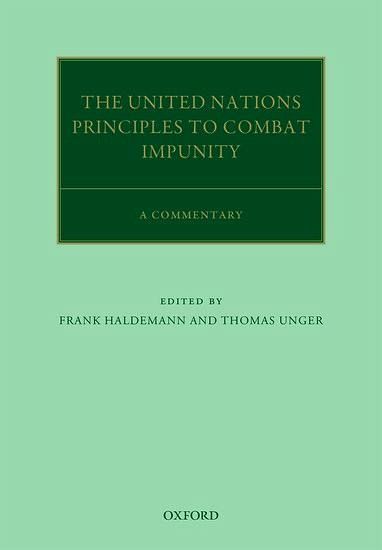
The fight against impunity has become a growing concern of the international community. Updated in 2005, the UN Set of Principles for the Protection and Promotion of Human Rights Through Action to Combat Impunity is the fruit of several years of study, developed under the aegis of the UN Commission on Human Rights and then affirmed by the Human Rights Council. These Principles are today widely accepted as constituting an authoritative reference point for efforts in the fight against impunity for gross human rights abuses and serious violations of international humanitarian law. As a…mehr
The fight against impunity has become a growing concern of the international community. Updated in 2005, the UN Set of Principles for the Protection and Promotion of Human Rights Through Action to Combat Impunity is the fruit of several years of study, developed under the aegis of the UN Commission on Human Rights and then affirmed by the Human Rights Council. These Principles are today widely accepted as constituting an authoritative reference point for efforts in the fight against impunity for gross human rights abuses and serious violations of international humanitarian law. As a comprehensive attempt to codify universal accountability norms, the UN Set of Principles marks a significant step forward in the debate on the obligation of states to combat impunity in its various forms. Bringing together leading experts in the field, this volume provides comprehensive academic commentary of the 38 principles. The book is a perfect companion to the document, setting out the text of the Principles alongside detailed analysis, as well as a full introduction and a guide to the relevant literature and case law. The commentary advances debates and clarifies complex legal issues, making it an essential resource for legal academics, students, and practitioners working in fields such as human rights, international criminal law, and transitional justice.
Frank Haldemann is the Co-Director of the Master of Advanced Studies in Transitional Justice, Human Rights and the Rule of Law at the Geneva Academy of International Humanitarian Law and Human Rights. Since 2010 he has been teaching Transitional Justice within the Geneva Academys various programmes. From June 2011 to July 2017, he was Assistant Professor at the Law Faculty, University of Geneva. In 2011 he was awarded a Swiss National Science Foundation Professorship, enabling him to direct a five-year research project on Historical Injustices, Reparations and International Law. Thomas Unger is a researcher on transitional justice at the Geneva Academy and Co-Director of the Master of Advanced Studies in Transitional Justice, Human Rights and the Rule of Law. He is the former Senior Adviser to the UN Special Rapporteur on the promotion of truth, justice, reparation and guarantees of non-recurrence.
Inhaltsangabe
* Prologue * Introduction * I. * Preamble * II. Definitions * III. * Combating Imputiny: General Obligation * IV. * The Right to Know * A. General Principles * Principle 2: The inalienable right to the truth * Principle 3: The duty to preserve memoryPrinciple 4: The victimsâ right to know * Principle 5: Guarantees to give effect to the right to know * B. Commissions of Inquiry * Principle 6: The establishment and role of truth commissions * Principle 7: Guarantees of independence, impartiality and competence * Principle 8: Definition of a commissionâs terms of reference * Principle 9: Guarantees for persons implicated * Principle 10: Guarantees for victims and witnesses testifying on their behalf * Principle 11: Adequate resources for commissions * Principle 12: Advisory functions of the commissionsPrinciple 13: Publicizing the commissionâs reports * C. Preservation of and Access to Archives Bearing Witness to Violations * Principle 14: Measures for the preservation of archivesPrinciple 15: Measures for facilitating access to archives * Principle 16: Cooperation between archive departments and the courts and non-judicial commissions of inquiry * Principle 17: Specific measures relating to archives containing names * Principle 18: Specific measures related to the restoration of or transition to democracy and/or peace * V. The Right to Justice * A. General Principles * Principle 19: Duties of States with regard to the administration of justice * B. Distribution of Jurisdiction Between National, Foreign, International and Internationalized Courts * Principle 20: Jurisdiction of international and internationalized criminal tribunals * Principle 21: Measures for strengthening the effectiveness of international legal Principles concerning universal and international jurisdiction * C. Restrictions on Rules of Law Justified by Action to Combat Impunity * Principle 22: Nature of restrictive measures * Principle 23: Restrictions on prescription * Principle 24: Restrictions and other measures relating to amnesty * Principle 25: Restrictions on the right of asylum * Principle 26: Restrictions on extradition/non bis in idem * Principle 27: Restrictions on justifications related to due obedience, superior responsibility, and official status * Principle 28: Restrictions on the effects of legislation on disclosure or repentance * Principle 29: Restrictions on the jurisdiction of military courts * Principle 30: Restrictions on the Principle of the irremovability of judges * VI. * The Right to Reparation/Guarantees of Non-Recurrence A. The Right to Reparation * Principle 31: Rights and duties arising out of the obligation to make reparation * Principle 32: Reparation procedures * Principle 33: Publicizing reparation procedures * Principle 34: Scope of the right to reparation * B. * Guarantees of non-recurrence of violations * Principle 35: General Principles * Principle 36: Reform of State institutions * Principle 37: Disbandment of parastatal armed forces/demobilization and social reintegration of children * Principle 38: Reform of laws and institutions contributing to impunity
* Prologue * Introduction * I. * Preamble * II. Definitions * III. * Combating Imputiny: General Obligation * IV. * The Right to Know * A. General Principles * Principle 2: The inalienable right to the truth * Principle 3: The duty to preserve memoryPrinciple 4: The victimsâ right to know * Principle 5: Guarantees to give effect to the right to know * B. Commissions of Inquiry * Principle 6: The establishment and role of truth commissions * Principle 7: Guarantees of independence, impartiality and competence * Principle 8: Definition of a commissionâs terms of reference * Principle 9: Guarantees for persons implicated * Principle 10: Guarantees for victims and witnesses testifying on their behalf * Principle 11: Adequate resources for commissions * Principle 12: Advisory functions of the commissionsPrinciple 13: Publicizing the commissionâs reports * C. Preservation of and Access to Archives Bearing Witness to Violations * Principle 14: Measures for the preservation of archivesPrinciple 15: Measures for facilitating access to archives * Principle 16: Cooperation between archive departments and the courts and non-judicial commissions of inquiry * Principle 17: Specific measures relating to archives containing names * Principle 18: Specific measures related to the restoration of or transition to democracy and/or peace * V. The Right to Justice * A. General Principles * Principle 19: Duties of States with regard to the administration of justice * B. Distribution of Jurisdiction Between National, Foreign, International and Internationalized Courts * Principle 20: Jurisdiction of international and internationalized criminal tribunals * Principle 21: Measures for strengthening the effectiveness of international legal Principles concerning universal and international jurisdiction * C. Restrictions on Rules of Law Justified by Action to Combat Impunity * Principle 22: Nature of restrictive measures * Principle 23: Restrictions on prescription * Principle 24: Restrictions and other measures relating to amnesty * Principle 25: Restrictions on the right of asylum * Principle 26: Restrictions on extradition/non bis in idem * Principle 27: Restrictions on justifications related to due obedience, superior responsibility, and official status * Principle 28: Restrictions on the effects of legislation on disclosure or repentance * Principle 29: Restrictions on the jurisdiction of military courts * Principle 30: Restrictions on the Principle of the irremovability of judges * VI. * The Right to Reparation/Guarantees of Non-Recurrence A. The Right to Reparation * Principle 31: Rights and duties arising out of the obligation to make reparation * Principle 32: Reparation procedures * Principle 33: Publicizing reparation procedures * Principle 34: Scope of the right to reparation * B. * Guarantees of non-recurrence of violations * Principle 35: General Principles * Principle 36: Reform of State institutions * Principle 37: Disbandment of parastatal armed forces/demobilization and social reintegration of children * Principle 38: Reform of laws and institutions contributing to impunity
Es gelten unsere Allgemeinen Geschäftsbedingungen: www.buecher.de/agb
Impressum
www.buecher.de ist ein Internetauftritt der buecher.de internetstores GmbH
Geschäftsführung: Monica Sawhney | Roland Kölbl | Günter Hilger
Sitz der Gesellschaft: Batheyer Straße 115 - 117, 58099 Hagen
Postanschrift: Bürgermeister-Wegele-Str. 12, 86167 Augsburg
Amtsgericht Hagen HRB 13257
Steuernummer: 321/5800/1497
USt-IdNr: DE450055826