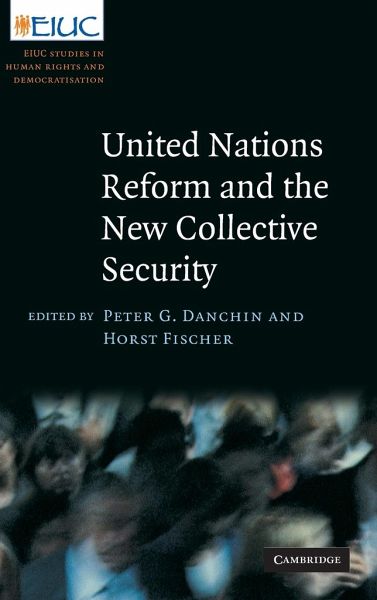
United Nations Reform and the New Collective Security
Herausgeber: Danchin, Peter G.; Fischer, Horst
United Nations Reform and the New Collective Security
Herausgeber: Danchin, Peter G.; Fischer, Horst
- Gebundenes Buch
- Merkliste
- Auf die Merkliste
- Bewerten Bewerten
- Teilen
- Produkt teilen
- Produkterinnerung
- Produkterinnerung
An examination of the concept of collective security in international law and international relations from normative and institutional perspectives.
Andere Kunden interessierten sich auch für
Danesh SarooshiThe United Nations and the Development of Collective Security284,99 €
The United Nations Security Council in the Age of Human Rights138,99 €
Accountability for Collective Wrongdoing63,99 €
Gary WilsonThe United Nations and Collective Security177,99 €
Víctor Hugo Ramírez LavalleEvolution of the Collective Security System58,99 €
The United Nations and Freedom of Expression and Information106,99 €
Ralph ZacklinThe United Nations Secretariat and the Use of Force in a Unipolar World64,99 €-
-
-
An examination of the concept of collective security in international law and international relations from normative and institutional perspectives.
Produktdetails
- Produktdetails
- Verlag: Cambridge University Press
- Seitenzahl: 450
- Erscheinungstermin: 28. Januar 2010
- Englisch
- Abmessung: 235mm x 157mm x 29mm
- Gewicht: 798g
- ISBN-13: 9780521515436
- ISBN-10: 0521515432
- Artikelnr.: 28112396
- Herstellerkennzeichnung
- Libri GmbH
- Europaallee 1
- 36244 Bad Hersfeld
- gpsr@libri.de
- Verlag: Cambridge University Press
- Seitenzahl: 450
- Erscheinungstermin: 28. Januar 2010
- Englisch
- Abmessung: 235mm x 157mm x 29mm
- Gewicht: 798g
- ISBN-13: 9780521515436
- ISBN-10: 0521515432
- Artikelnr.: 28112396
- Herstellerkennzeichnung
- Libri GmbH
- Europaallee 1
- 36244 Bad Hersfeld
- gpsr@libri.de
Introduction: the new collective security Peter G. Danchin and Horst
Fischer; Part I. Law and Politics in United Nations Reform: 1. Things fall
apart: the concept of collective security in international law Peter G.
Danchin; 2. Reflections on the politics of institutional reform Jan
Klabbers; 3. Great powers then and now: security council reform and
responses to threats to peace and security Lauri Mälksoo; Part II. Defining
'Threats' to Collective Security: 4. Assessing the high-level panel report:
rethinking the causes and consequences of threats to collective security
Maxwell O. Chibundu; 5. Collective security and the responsibility to
protect George Andreopoulos; 6. Responses to non-military threats:
environment, disease and technology Joachim Wolf; Part III. Prevention and
Responses: 7. On the far side of conflict: the UN Peacebuilding Commission
as optical illusion Dirk Salomons; 8. The new peacebuilding architecture:
an institutional innovation of the United Nations Ejeviome Oloho Otobo; 9.
The world summit process and UN sanctions reform: between rhetoric and
force Jeremy Farrall; 10. The UN response to the evolving threat of global
terrorism: institutional reform, rivalry, or renewal? Eric Rosand; 11.
International justice and collective security: between pragmatism and
principle Carmen Márquez Carrasco; Part IV. Perspectives on the Ground: 12.
Developing security in the eastern DRC: MONUC as a practical example of
(failing) collective security Dennis Dijkzeul; 13. Indirect power: a
critical look at civil society in the new human rights council Elizabeth
Salmón; 14. Collective security: a village eye-view J. Paul Martin and
Benedicto Q. Sánchez.
Fischer; Part I. Law and Politics in United Nations Reform: 1. Things fall
apart: the concept of collective security in international law Peter G.
Danchin; 2. Reflections on the politics of institutional reform Jan
Klabbers; 3. Great powers then and now: security council reform and
responses to threats to peace and security Lauri Mälksoo; Part II. Defining
'Threats' to Collective Security: 4. Assessing the high-level panel report:
rethinking the causes and consequences of threats to collective security
Maxwell O. Chibundu; 5. Collective security and the responsibility to
protect George Andreopoulos; 6. Responses to non-military threats:
environment, disease and technology Joachim Wolf; Part III. Prevention and
Responses: 7. On the far side of conflict: the UN Peacebuilding Commission
as optical illusion Dirk Salomons; 8. The new peacebuilding architecture:
an institutional innovation of the United Nations Ejeviome Oloho Otobo; 9.
The world summit process and UN sanctions reform: between rhetoric and
force Jeremy Farrall; 10. The UN response to the evolving threat of global
terrorism: institutional reform, rivalry, or renewal? Eric Rosand; 11.
International justice and collective security: between pragmatism and
principle Carmen Márquez Carrasco; Part IV. Perspectives on the Ground: 12.
Developing security in the eastern DRC: MONUC as a practical example of
(failing) collective security Dennis Dijkzeul; 13. Indirect power: a
critical look at civil society in the new human rights council Elizabeth
Salmón; 14. Collective security: a village eye-view J. Paul Martin and
Benedicto Q. Sánchez.
Introduction: the new collective security Peter G. Danchin and Horst
Fischer; Part I. Law and Politics in United Nations Reform: 1. Things fall
apart: the concept of collective security in international law Peter G.
Danchin; 2. Reflections on the politics of institutional reform Jan
Klabbers; 3. Great powers then and now: security council reform and
responses to threats to peace and security Lauri Mälksoo; Part II. Defining
'Threats' to Collective Security: 4. Assessing the high-level panel report:
rethinking the causes and consequences of threats to collective security
Maxwell O. Chibundu; 5. Collective security and the responsibility to
protect George Andreopoulos; 6. Responses to non-military threats:
environment, disease and technology Joachim Wolf; Part III. Prevention and
Responses: 7. On the far side of conflict: the UN Peacebuilding Commission
as optical illusion Dirk Salomons; 8. The new peacebuilding architecture:
an institutional innovation of the United Nations Ejeviome Oloho Otobo; 9.
The world summit process and UN sanctions reform: between rhetoric and
force Jeremy Farrall; 10. The UN response to the evolving threat of global
terrorism: institutional reform, rivalry, or renewal? Eric Rosand; 11.
International justice and collective security: between pragmatism and
principle Carmen Márquez Carrasco; Part IV. Perspectives on the Ground: 12.
Developing security in the eastern DRC: MONUC as a practical example of
(failing) collective security Dennis Dijkzeul; 13. Indirect power: a
critical look at civil society in the new human rights council Elizabeth
Salmón; 14. Collective security: a village eye-view J. Paul Martin and
Benedicto Q. Sánchez.
Fischer; Part I. Law and Politics in United Nations Reform: 1. Things fall
apart: the concept of collective security in international law Peter G.
Danchin; 2. Reflections on the politics of institutional reform Jan
Klabbers; 3. Great powers then and now: security council reform and
responses to threats to peace and security Lauri Mälksoo; Part II. Defining
'Threats' to Collective Security: 4. Assessing the high-level panel report:
rethinking the causes and consequences of threats to collective security
Maxwell O. Chibundu; 5. Collective security and the responsibility to
protect George Andreopoulos; 6. Responses to non-military threats:
environment, disease and technology Joachim Wolf; Part III. Prevention and
Responses: 7. On the far side of conflict: the UN Peacebuilding Commission
as optical illusion Dirk Salomons; 8. The new peacebuilding architecture:
an institutional innovation of the United Nations Ejeviome Oloho Otobo; 9.
The world summit process and UN sanctions reform: between rhetoric and
force Jeremy Farrall; 10. The UN response to the evolving threat of global
terrorism: institutional reform, rivalry, or renewal? Eric Rosand; 11.
International justice and collective security: between pragmatism and
principle Carmen Márquez Carrasco; Part IV. Perspectives on the Ground: 12.
Developing security in the eastern DRC: MONUC as a practical example of
(failing) collective security Dennis Dijkzeul; 13. Indirect power: a
critical look at civil society in the new human rights council Elizabeth
Salmón; 14. Collective security: a village eye-view J. Paul Martin and
Benedicto Q. Sánchez.