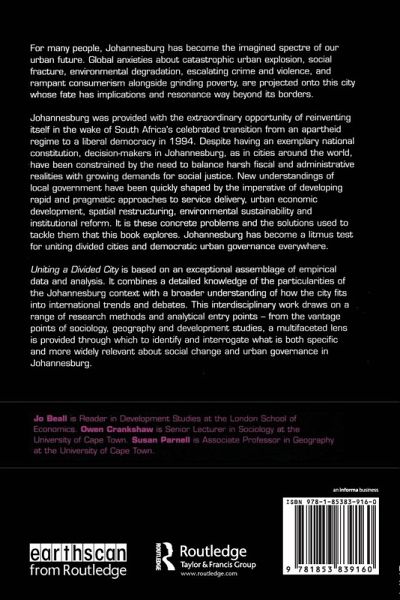
For many, Johannesburg resembles the imagined spectre of the urban future. Global anxieties about catastrophic urban explosion, social fracture, environmental degradation, escalating crime and violence, and rampant consumerism alongside grinding poverty, are projected onto this city as a microcosm of things to come. Decision-makers in cities worldwide have attempted to balance harsh fiscal and administrative realities with growing demands for political, economic and social justice. This book investigates pragmatic approaches to urban economic development, service delivery, spatial…mehr
For many, Johannesburg resembles the imagined spectre of the urban future. Global anxieties about catastrophic urban explosion, social fracture, environmental degradation, escalating crime and violence, and rampant consumerism alongside grinding poverty, are projected onto this city as a microcosm of things to come. Decision-makers in cities worldwide have attempted to balance harsh fiscal and administrative realities with growing demands for political, economic and social justice. This book investigates pragmatic approaches to urban economic development, service delivery, spatial restructuring, environmental sustainability and institutional reform in Johannesburg. It explores the conditions and processes that are determining the city's transformation into a cosmopolitan metropole and magnet for the continent.
Jo Beall studied English Literature and Economic History in South Africa before completing a PhD at the London School of Economics. She taught international development at the LSE, was Deputy Vice Chancellor at the University of Cape Town and was Global Director of Education and Cultural Engagement at the British Council.Meadowlands Dawn is Jo's debut novel, a work inspired by her own experience as an activist and political prisoner under Apartheid, in South Africa.
Inhaltsangabe
Part 1: Ways of Understanding Divided Cities - Introduction to a Divided City Reverberations from a Divided City Part 2: The Changing Spatial Structure of the City - Beyond Racial Fordism: Changing Patterns of Social Inequality Post-Fordist Polarization: The Changing Spatial Order of the City Part 3: Institutional Responses to Urban Change - Decentralization by Stealth: Democratization or Disempowerment through Developmental Local Government? the Politics of Fiscal Austerity in Creating Equitable City Government Part 4: Living in a Divided City - the Inner-city Challenge: Locating Partners for Urban Regeneration Participatory Planning and Informal Settlement Upgrading in Diepsloot Housing and Service Consumption in Soweto the People Behind the Walls: Insecurity, Identity and gated Communities Conclusion: Lessons from a Uniting City Notes References Index
Es gelten unsere Allgemeinen Geschäftsbedingungen: www.buecher.de/agb
Impressum
www.buecher.de ist ein Internetauftritt der buecher.de internetstores GmbH
Geschäftsführung: Monica Sawhney | Roland Kölbl | Günter Hilger
Sitz der Gesellschaft: Batheyer Straße 115 - 117, 58099 Hagen
Postanschrift: Bürgermeister-Wegele-Str. 12, 86167 Augsburg
Amtsgericht Hagen HRB 13257
Steuernummer: 321/5800/1497
USt-IdNr: DE450055826