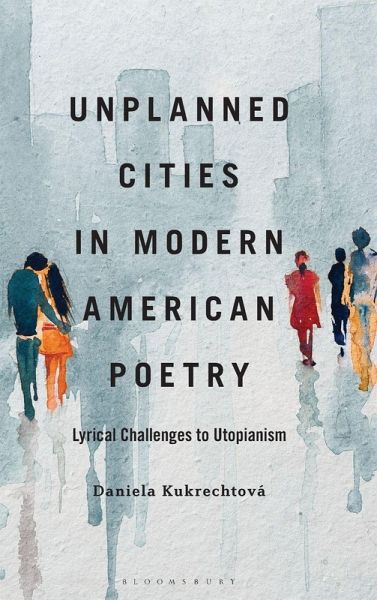
Reveals how five modern American poets challenged prevailing discourses about urbanization through lyrical representations of cities and the diverse people who lived in them. In early 20th-century America, industrialization and the influx of immigrants and rural migrants into urban centers fostered a certain representation of and distaste for cities and their inhabitants. The dominant discourse was one of containment through utopian planning and violent reshaping, often reflected in both policy-making and writings about cities during this time. Yet as Daniela Kukrechtová identifies, urban…mehr
Reveals how five modern American poets challenged prevailing discourses about urbanization through lyrical representations of cities and the diverse people who lived in them. In early 20th-century America, industrialization and the influx of immigrants and rural migrants into urban centers fostered a certain representation of and distaste for cities and their inhabitants. The dominant discourse was one of containment through utopian planning and violent reshaping, often reflected in both policy-making and writings about cities during this time. Yet as Daniela Kukrechtová identifies, urban literature also reveals voices that challenged that narrative. Unplanned Cities in Modern American Poetry shows how the formally innovative works of five poets - Jean Toomer, William Carlos Williams, Hart Crane, Frank O'Hara, and Gwendolyn Brooks - worked against anti-urban discourse. Their works displayed a love for disorderly cityscapes and the actual urbanites who inhabit them, promoting the radical idea that cities were for people while revealing the extreme dystopian/utopian discourses that helped create and maintain divisions and disparities. Kukrechtová argues that, besides offering a radical critique, these poets also used their poetry to imagine the mental and emotional attitudes of urban dwellers toward their environment. She therefore offers the urban ecocritical approach often missing in literary analyses of modern American poetry. Simultaneously, the lyrical and socially-engaged imagination in these works - that is, the human implications of various plans, designs, and policies that helped create the modern American city - represent a voice often unheard in urban studies and its history.
Daniela Kukrechtováis a Visiting Assistant Professor at College of the Holy Cross, USA. She has taught literature and poetry at Brandeis University, Emerson College, and College of the Holy Cross, and her research interests focus on modern and contemporary American poetry, urban ecology and ecocriticism, African American literature, and the literature of exile. She has published in African American Review, the CEA Critic, Soundings: An Interdisciplinary Journal,and The Worcester Review.Her creative work (poetry, translations, and nonfiction) has appeared in The Sunlight Press, Circumference: Poetry in Translation, Persephone's Daughters, Indiana Reviewand Nowhere Magazine.
Inhaltsangabe
List of Figures Acknowledgments Introduction: A Case for a Contra-Symbolic City in Modern American Poetry 1. "Remove the [red] tape" of Respectability: Jazzy Transformations in Jean Toomer's Washington, D.C. 2. "Who are these people": William Carlos Williams Walks with the Crowd in Paterson, NJ 3. "Tilting . momently" Between the Perfect City and the Embodied Urban Experience: Subversive Wordplay in Hart Crane's The Bridge 4. Remembering "You" in the City: Toponyms and Ludic Spaces in Frank O'Hara's Kinesthetic Poetry 5. The Death and Life of a Chicago Edifice: Gwendolyn Brooks's "In the Mecca" Notes Bibliography Index
List of Figures Acknowledgments Introduction: A Case for a Contra-Symbolic City in Modern American Poetry 1. "Remove the [red] tape" of Respectability: Jazzy Transformations in Jean Toomer's Washington, D.C. 2. "Who are these people": William Carlos Williams Walks with the Crowd in Paterson, NJ 3. "Tilting . momently" Between the Perfect City and the Embodied Urban Experience: Subversive Wordplay in Hart Crane's The Bridge 4. Remembering "You" in the City: Toponyms and Ludic Spaces in Frank O'Hara's Kinesthetic Poetry 5. The Death and Life of a Chicago Edifice: Gwendolyn Brooks's "In the Mecca" Notes Bibliography Index
Es gelten unsere Allgemeinen Geschäftsbedingungen: www.buecher.de/agb
Impressum
www.buecher.de ist ein Internetauftritt der buecher.de internetstores GmbH
Geschäftsführung: Monica Sawhney | Roland Kölbl | Günter Hilger
Sitz der Gesellschaft: Batheyer Straße 115 - 117, 58099 Hagen
Postanschrift: Bürgermeister-Wegele-Str. 12, 86167 Augsburg
Amtsgericht Hagen HRB 13257
Steuernummer: 321/5800/1497
USt-IdNr: DE450055826