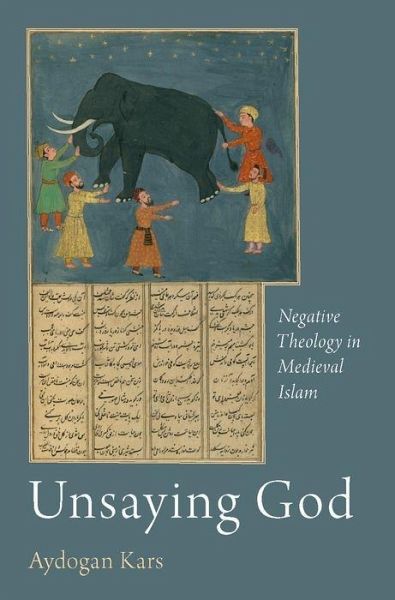
What cannot be said about God, and how can we speak about God by negating what we say? Traveling across prominent negators, denialists, ineffectualists, paradoxographers, naysayers, ignorance-pretenders, unknowers, I-don't-knowers, and taciturns, Unsaying God: Negative Theology in Medieval Islam delves into the negative theological movements that flourished in the first seven centuries of Islam. Aydogan Kars argues that there were multiple, and often competing, strategies for self-negating speech in the vast field of theology. By focusing on Arabic and Persian textual sources, the book defines…mehr
What cannot be said about God, and how can we speak about God by negating what we say? Traveling across prominent negators, denialists, ineffectualists, paradoxographers, naysayers, ignorance-pretenders, unknowers, I-don't-knowers, and taciturns, Unsaying God: Negative Theology in Medieval Islam delves into the negative theological movements that flourished in the first seven centuries of Islam. Aydogan Kars argues that there were multiple, and often competing, strategies for self-negating speech in the vast field of theology. By focusing on Arabic and Persian textual sources, the book defines four distinct yet interconnected paths of negative speech formations on the nature of God that circulated in medieval Islamic world. Expanding its scope to Jewish intellectuals, Unsaying God also demonstrates that religious boundaries were easily transgressed as scholars from diverse sectarian or religious backgrounds could adopt similar paths of negative speech on God. This is the first book-length study of negative theology in Islam. It encompasses many fields of scholarship, and diverse intellectual schools and figures. Throughout, Kars demonstrates how seemingly different genres should be read in a more connected way in light of the cultural and intellectual history of Islam rather than as different opposing sets of orthodoxies and heterodoxies.
Aydogan Kars earned his Ph.D. in Religion at Vanderbilt University. His primary research field is medieval intellectual history with a focus on Sufism and theology. He has been serving as a Lecturer in the Centre for Religious Studies and the Coordinator of the Islamic Studies Program at Monash University.
Inhaltsangabe
* INTRODUCTION * Why Sufism, and Why the Thirteenth Century? * A Guide to Negative Theology: Are the Mu'tazilites Negative Theologians? * Can We Still Speak of Negative Theology Tout Court? * Moving Forward * Coming to Terms: "Apophasis", "Performance", and God's Gender * Compass * PATH ONE. DOUBLE NEGATION: ISMAILI APOPHATICISM * The Background: "Radicals of All Radicals" * Thingness of God? * Double Negation: the Repetitive Form * Permutations and Performances * Disseminations: Ismaili Apophaticism beyond Ismailis * Later Developments * Tusi: Sufi Paths of Ismaili Apophaticism * Dimension of Apophatic Theology in Later Sufi and Ismailli Connections * Summary * PATH TWO. NECESSARILY DISSIMILAR: PHILOSOPHICAL APOPHATICISM * Beginnings: the End-less * The Kindian Dilemma in the Tenth Century * Discursive Thought and Non-Discursive Intellection * Protectors of the Divine Oneness: al-Tawhidi's Circle in Baghdad * Philosophical Apophaticism in Andalusia: Ibn Masarra * Twelfth-Century Andalusia: From Philosophy to Sufism * Aristotle in Andalusia: al-Batalyawsi, Maimonides, and Ibn Sab'in * Jewish Mysticism and Arabic Philosophical Apophaticism: Eyn Sof and Lam Yazal * Sufis and Genies: Philosophical Apophaticism within Sufi Epistemology * Summary * PATH THREE. "YES AND NO": PARADOXICAL APOPHATICISM AND DIALECTICAL LOGIC * Paradox in Literature and Sufism: an Overview * Paradox of Human Apotheosis: from Sufism to Philosophy? * Paradoxes of Late Antiquity in Philosophy * Paradox in Theological Questions * The Divine Paradox: When Incomparability and Immanence are Balanced * Symmetrical Approach to Language, and Dialectical Logic * Logic and Nomenclature in Paradoxical Apophaticism * Healing with Opposites: Performativity in Paradoxical Apophaticism * Summary * PATH FOUR. AGAINST DISCOURSE: AMODAL APOPHATICISM * The Background: "Bila Kayfa" as a Theological Concept * Divine Nature Uninterpreted: Between Anthropomorphism and Apophaticism * Bila Kayfa Apophaticism and Early Hanafism * Early Ash'arism: From Anti-Interpretivism to Anti-Anthropomorphism * Anti-Interpretivism among Early Sufis? * Anti-Interpretivism during the Formalization of Sufism * Interpretivism in Persian Sufism * Hanbali Sufism and the Qadiriyya * The Emergence of the Rifa'iyya * Suhrawardiyya and the State-Sponsored "Sunni Bila Kayfa" Project * Kubrawi Interpretivism * Bila Kayfa Mysticism in Andalusia: the Background * Sufism and Bila Kayfa in the Thirteenth-Century Muslim West * Summary * CONCLUSION * BIBLIOGRAPHY
Es gelten unsere Allgemeinen Geschäftsbedingungen: www.buecher.de/agb
Impressum
www.buecher.de ist ein Internetauftritt der buecher.de internetstores GmbH
Geschäftsführung: Monica Sawhney | Roland Kölbl | Günter Hilger
Sitz der Gesellschaft: Batheyer Straße 115 - 117, 58099 Hagen
Postanschrift: Bürgermeister-Wegele-Str. 12, 86167 Augsburg
Amtsgericht Hagen HRB 13257
Steuernummer: 321/5800/1497
USt-IdNr: DE450055826