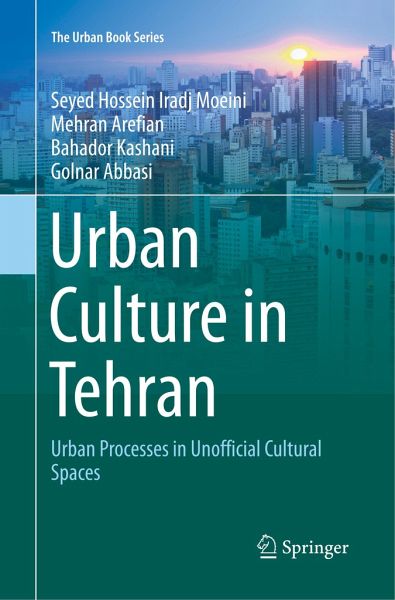
This book studies the production of urban culture in Tehran after 1979. It analyzes urban resistance and urban processes in underground cultural spaces: bookshops, cafes and art galleries. The intended audience is architects and urban planners interested in socio-political aspects of bottom-up space formation, but also those in humanities and particularly cultural studies. The idea of the book reflects architectural criticism and bottom-up processes of space formation. It analyzes alternative, non-official ways of forming cultural spaces in Tehran and the way they resist formally endorsed…mehr
This book studies the production of urban culture in Tehran after 1979. It analyzes urban resistance and urban processes in underground cultural spaces: bookshops, cafes and art galleries. The intended audience is architects and urban planners interested in socio-political aspects of bottom-up space formation, but also those in humanities and particularly cultural studies. The idea of the book reflects architectural criticism and bottom-up processes of space formation. It analyzes alternative, non-official ways of forming cultural spaces in Tehran and the way they resist formally endorsed culture.
Cafés, bookshops and galleries, each take various and different sets of strategies to constitute their territory and their communities within the city. From temporarily occupying street corners (booksellers) to constitution of an underground network of unfixed meeting points, to using the modern paradigms of ownership and the idea of private property, primarily as apolitical tool for management, to claim a safe alternative sphere of art, and finally to semiotic spatial codifications of spaces to make them as a safe gathering places taking food as a means. All these three cultural spaces deal with various conditions to form specific forms of resistance practices, throughout processes that leave their spatial traces on the city.
Nastaran Sedehi holds a Master of Architecture degree, practised architecture for three years, and is currently a graduate student and researcher at the School of Architecture and Landscape Architecture, the University of British Columbia. She is passionate about activist-oriented interdisciplinary practice in architecture and its potential for problem-solving in underprivileged and marginalised communities. In the capacity of a student researcher, she contributed to the 'Not for Sale' exhibition organised by the Architects Against Housing Alienation Collective, which represented Canada at the 18th Venice Architecture Biennale. The exhibition showcased projects at the intersection of research, design, activism, and advocacy, offering innovative responses to the escalating housing crisis in Canada. She enjoys skateboarding, cycling, painting, and watching live music. Iradj Moeini is a senior lecturer in architecture in Shahid Beheshti University (SBU), Tehran-where he has obtained his MArch-and a practising architect in London. Having obtained his PhD from the Bartlett School of Graduate Studies, UCL, on contemporary architecture theory and criticism, he is the author and co-author of numerous papers and four books, has also taught in Yazd, Tehran Azad, and Shariati universities, and worked in a range of Iranian and British practices in a professional capacity. A member of the Royal Institute of British Architects (RIBA), he is also an amateur photographer and musician.
Inhaltsangabe
I: Introduction.- II: 'The Quiet Encroachment of the Ordinary'.- Resistance in the city and theories of civil resistance.- City as a ground for plays of power.- Tehran: Power and resistance in the city.- The everyday practice of resistance in the city.- The use of space: Cultural resistance and its allegories in Tehran.- Possibilities and platforms of cultural resistance in Tehran.- III: The Types.- III.1. Alternative Bookshops.- Introduction.- Historiography.- Genealogy of the independent and alternative bookshops in Tehran.- Conflict of capitalism and culture.- Official and alternative bookshops: State-run, Independent, Unofficial and alternative (second-hand) and street.- Underground bookshops (second-hand and street booksellers) as a space of resistance.- Bookshop as a cultural platform for events and actions.- The community of independent underground bookshops.- A map of alternative bookshops in Tehran.- Spatial arrangements of alternative bookshops.- List of Case studies.- III.2. Alternative Cafés.- Introduction.- Historiography of the café in the modernised Tehran.- Genealogy of café as a space of resistance.- Alternative Café, and Coffee Shop.- A map of alternative cafés in Tehran.- Social coordinates of alternative café.- Café as a space of resistance.- Semiotics of architectural elements in café.- Endurance and instability of alternative cafés.- List of Case studies.- III.3. Domestic Art Gallery.- Introduction.- housing the alternative art gallery.- A map of galleries in Tehran.- List of case studies.- Notes.- Bibliography.-Image Credits.
I: Introduction.- II: 'The Quiet Encroachment of the Ordinary'.- Resistance in the city and theories of civil resistance.- City as a ground for plays of power.- Tehran: Power and resistance in the city.- The everyday practice of resistance in the city.- The use of space: Cultural resistance and its allegories in Tehran.- Possibilities and platforms of cultural resistance in Tehran.- III: The Types.- III.1. Alternative Bookshops.- Introduction.- Historiography.- Genealogy of the independent and alternative bookshops in Tehran.- Conflict of capitalism and culture.- Official and alternative bookshops: State-run, Independent, Unofficial and alternative (second-hand) and street.- Underground bookshops (second-hand and street booksellers) as a space of resistance.- Bookshop as a cultural platform for events and actions.- The community of independent underground bookshops.- A map of alternative bookshops in Tehran.- Spatial arrangements of alternative bookshops.- List of Case studies.- III.2. Alternative Cafés.- Introduction.- Historiography of the café in the modernised Tehran.- Genealogy of café as a space of resistance.- Alternative Café, and Coffee Shop.- A map of alternative cafés in Tehran.- Social coordinates of alternative café.- Café as a space of resistance.- Semiotics of architectural elements in café.- Endurance and instability of alternative cafés.- List of Case studies.- III.3. Domestic Art Gallery.- Introduction.- housing the alternative art gallery.- A map of galleries in Tehran.- List of case studies.- Notes.- Bibliography.-Image Credits.
Es gelten unsere Allgemeinen Geschäftsbedingungen: www.buecher.de/agb
Impressum
www.buecher.de ist ein Internetauftritt der buecher.de internetstores GmbH
Geschäftsführung: Monica Sawhney | Roland Kölbl | Günter Hilger
Sitz der Gesellschaft: Batheyer Straße 115 - 117, 58099 Hagen
Postanschrift: Bürgermeister-Wegele-Str. 12, 86167 Augsburg
Amtsgericht Hagen HRB 13257
Steuernummer: 321/5800/1497
USt-IdNr: DE450055826