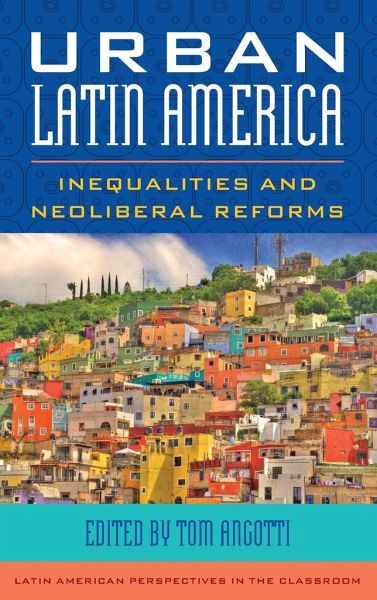
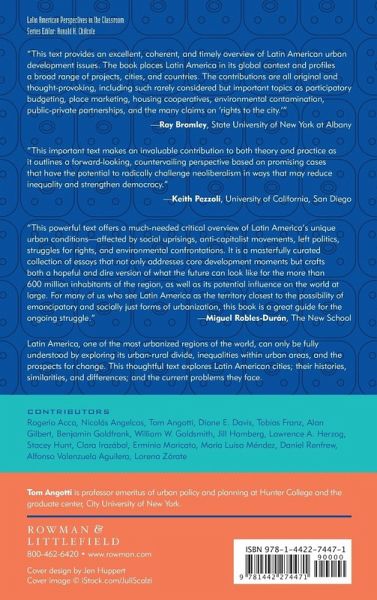
Latin America, one of the most urbanized regions of the world, can only be fully understood by exploring its urban-rural divide, inequalities within urban areas, and the prospects for change. This thoughtful text explores Latin American cities; their history, similarities, and differences; and the current problems they face.
Latin America, one of the most urbanized regions of the world, can only be fully understood by exploring its urban-rural divide, inequalities within urban areas, and the prospects for change. This thoughtful text explores Latin American cities; their history, similarities, and differences; and the current problems they face.
Tom Angotti is professor emeritus of urban policy and planning at Hunter College and the graduate center, City University of New York.
Inhaltsangabe
Part I: Poverty, Informality, and Peripheral Cities Chapter 1: Urban Latin America: Periphery, Informality, and Inequality Tom Angotti Chapter 2: Poverty, Inequality, and Informality in the Latin American City Alan Gilbert Chapter 3: They Are Not Informal Settlements: They Are Habitats Made by People Lorena Zárate Chapter 4: The Future of Global Peripheral Cities Erminia Maricato Part II: The Metropolis in Latin America: São Paulo and Mexico City Chapter 5: São Paulo: City of Industry, Misery, and Resistance William W. Goldsmith and Rogerio Acca Chapter 6: Globalization, Governance, and the Collision of Forces in Mexico City's Historic Center Diane E. Davis Part III: Urban Policies, Neoliberal Reforms, and Best Practices Chapter 7: Failed Markets: The Crisis in the Private Production of Social Housing in Mexico Alfonso Valenzuela Aguilera Chapter 8: Participatory Budgeting in Latin American Cities Benjamin Goldfrank Chapter 9: Urban Governance and Economic Development in Medellín: An "Urban Miracle"? Tobias Franz Chapter 10: Conflict and Convergence between Experts and Citizens: Bogotá's TransMilenio Stacey Hunt Chapter 11: Barra da Tijuca: The Political Economy of a Global Suburb in Rio de Janeiro, Brazil Lawrence A. Herzog Part IV: Exceptions to the Rules Chapter 12: Housing and Urban Development in the Cuban Revolution Jill Hamberg Chapter 13: Uruguay's Housing Cooperatives: Alternative to the Private Market Tom Angotti Part V: Urban Struggles, Citizenship, and Public Space Chapter 14: Citizenship, Democracy, and Public Space in Latin America Clara Irazábal Chapter 15: Struggles against Territorial Disqualification: Mobilization for Dignified Housing and Defense of Heritage in Santiago Nicolás Angelcos and María Luisa Méndez Chapter 16: "We Are Not Marginals": The Cultural Politics of Lead Poisoning in Montevideo, Uruguay Daniel Renfrew References
Part I: Poverty, Informality, and Peripheral Cities Chapter 1: Urban Latin America: Periphery, Informality, and Inequality Tom Angotti Chapter 2: Poverty, Inequality, and Informality in the Latin American City Alan Gilbert Chapter 3: They Are Not Informal Settlements: They Are Habitats Made by People Lorena Zárate Chapter 4: The Future of Global Peripheral Cities Erminia Maricato Part II: The Metropolis in Latin America: São Paulo and Mexico City Chapter 5: São Paulo: City of Industry, Misery, and Resistance William W. Goldsmith and Rogerio Acca Chapter 6: Globalization, Governance, and the Collision of Forces in Mexico City's Historic Center Diane E. Davis Part III: Urban Policies, Neoliberal Reforms, and Best Practices Chapter 7: Failed Markets: The Crisis in the Private Production of Social Housing in Mexico Alfonso Valenzuela Aguilera Chapter 8: Participatory Budgeting in Latin American Cities Benjamin Goldfrank Chapter 9: Urban Governance and Economic Development in Medellín: An "Urban Miracle"? Tobias Franz Chapter 10: Conflict and Convergence between Experts and Citizens: Bogotá's TransMilenio Stacey Hunt Chapter 11: Barra da Tijuca: The Political Economy of a Global Suburb in Rio de Janeiro, Brazil Lawrence A. Herzog Part IV: Exceptions to the Rules Chapter 12: Housing and Urban Development in the Cuban Revolution Jill Hamberg Chapter 13: Uruguay's Housing Cooperatives: Alternative to the Private Market Tom Angotti Part V: Urban Struggles, Citizenship, and Public Space Chapter 14: Citizenship, Democracy, and Public Space in Latin America Clara Irazábal Chapter 15: Struggles against Territorial Disqualification: Mobilization for Dignified Housing and Defense of Heritage in Santiago Nicolás Angelcos and María Luisa Méndez Chapter 16: "We Are Not Marginals": The Cultural Politics of Lead Poisoning in Montevideo, Uruguay Daniel Renfrew References
Es gelten unsere Allgemeinen Geschäftsbedingungen: www.buecher.de/agb
Impressum
www.buecher.de ist ein Internetauftritt der buecher.de internetstores GmbH
Geschäftsführung: Monica Sawhney | Roland Kölbl | Günter Hilger
Sitz der Gesellschaft: Batheyer Straße 115 - 117, 58099 Hagen
Postanschrift: Bürgermeister-Wegele-Str. 12, 86167 Augsburg
Amtsgericht Hagen HRB 13257
Steuernummer: 321/5800/1497
USt-IdNr: DE450055826