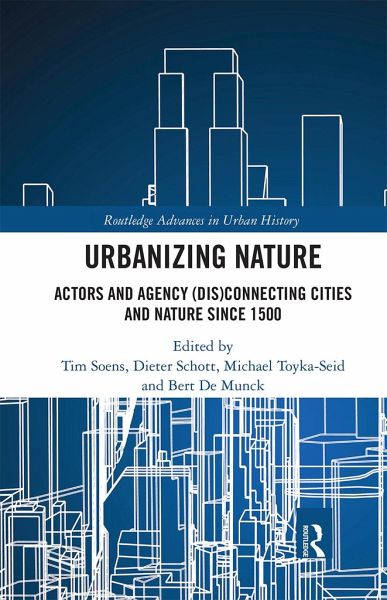
The more people are living in cities, the more nature is said to be "urbanizing": turned into a resource or commodity and mobilized over long distances. Urbanizing Nature aims to counter teleological perspectives on the birth of modern "urban nature", unravelling actors and processes urbanizing nature from 1500 till today.
The more people are living in cities, the more nature is said to be "urbanizing": turned into a resource or commodity and mobilized over long distances. Urbanizing Nature aims to counter teleological perspectives on the birth of modern "urban nature", unravelling actors and processes urbanizing nature from 1500 till today.
Tim Soens is Professor of Medieval and Environmental History at the University of Antwerp, Belgium. Dieter Schott is Professor for Modern History at the Technical University of Darmstadt, Germany. Michael Toyka-Seid is research associate at the Technical University of Darmstadt, Germany. Bert De Munck is professor at the History Department of the University of Antwerp, Belgium.
Inhaltsangabe
Part I: Introduction Introduction: Did Cities Change Nature? A Long-Term Perspective Part II: Nature into Urban Hinterlands 1. Long-Term Transitions, Urban Imprint and the Construction of Hinterlands 2. Concepts of Urban Agency and the Transformation of Urban Hinterlands: The Case of Berlin, Eighteenth to Twentieth Centuries 3. A Place in Its Own Right: The Rural-Urban Fringe of Helsinki from the Early Nineteenth Century to the Present Part III: Nature as Urban Resource 4. Urbanizing Water: Looking Beyond the Transition to Water Modernity in the Cities of the Southern Low Countries, Thirteenth to Nineteenth Centuries 5. Cities Hiding the Forests: Wood Supply, Hinterlands and Urban Agency in the Southern Low Countries, Thirteenth to Eighteenth Centuries 6. Energizing European Cities: From Wood Provision to Solar Panels - Providing Energy for Urban Demand, 1800-2000 7. Re-Use and Recycling in Western European Cities Part IV: Nature as Urban Challenge 8. Hydraulic Experts and the Challenges of Water in Early Modern Times: European Colonial Cities Compared 9. Stockholm's Changing Waterscape: A Long-term Perspective on a City and Its Flowing Water 10. Air Pollution as Urban Problem in France, from the Mid-Nineteenth Century to the 1970s Part V: Visions of Urban Nature 11. Urban Fringes: Conquering Riversides and Lakeshores in the Nineteenth Century - Examples from Austrian and Swiss Medium-Sized Cities 12. Twentieth Century Wastescapes: Cities, Consumers, and Their Dumping Grounds 13. The Roots of the Sustainable City: The Visible Waters of the City in Modern Mainz and Wiesbaden Part VI: Concluding Essay 14. Beyond Cities, Beyond Nature: Building a European Urban Stratum
Part I: Introduction Introduction: Did Cities Change Nature? A Long-Term Perspective Part II: Nature into Urban Hinterlands 1. Long-Term Transitions, Urban Imprint and the Construction of Hinterlands 2. Concepts of Urban Agency and the Transformation of Urban Hinterlands: The Case of Berlin, Eighteenth to Twentieth Centuries 3. A Place in Its Own Right: The Rural-Urban Fringe of Helsinki from the Early Nineteenth Century to the Present Part III: Nature as Urban Resource 4. Urbanizing Water: Looking Beyond the Transition to Water Modernity in the Cities of the Southern Low Countries, Thirteenth to Nineteenth Centuries 5. Cities Hiding the Forests: Wood Supply, Hinterlands and Urban Agency in the Southern Low Countries, Thirteenth to Eighteenth Centuries 6. Energizing European Cities: From Wood Provision to Solar Panels - Providing Energy for Urban Demand, 1800-2000 7. Re-Use and Recycling in Western European Cities Part IV: Nature as Urban Challenge 8. Hydraulic Experts and the Challenges of Water in Early Modern Times: European Colonial Cities Compared 9. Stockholm's Changing Waterscape: A Long-term Perspective on a City and Its Flowing Water 10. Air Pollution as Urban Problem in France, from the Mid-Nineteenth Century to the 1970s Part V: Visions of Urban Nature 11. Urban Fringes: Conquering Riversides and Lakeshores in the Nineteenth Century - Examples from Austrian and Swiss Medium-Sized Cities 12. Twentieth Century Wastescapes: Cities, Consumers, and Their Dumping Grounds 13. The Roots of the Sustainable City: The Visible Waters of the City in Modern Mainz and Wiesbaden Part VI: Concluding Essay 14. Beyond Cities, Beyond Nature: Building a European Urban Stratum
Es gelten unsere Allgemeinen Geschäftsbedingungen: www.buecher.de/agb
Impressum
www.buecher.de ist ein Internetauftritt der buecher.de internetstores GmbH
Geschäftsführung: Monica Sawhney | Roland Kölbl | Günter Hilger
Sitz der Gesellschaft: Batheyer Straße 115 - 117, 58099 Hagen
Postanschrift: Bürgermeister-Wegele-Str. 12, 86167 Augsburg
Amtsgericht Hagen HRB 13257
Steuernummer: 321/5800/1497
USt-IdNr: DE450055826