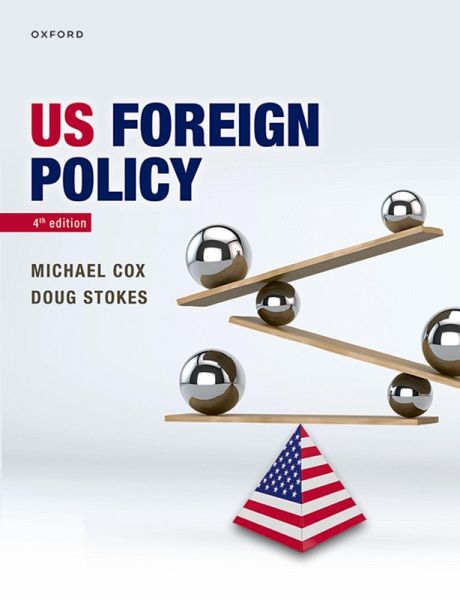
Description Critical and connected: brings together diverse perspectives from many of the world's leading foreign policy experts. US Foreign Policy gives students the tools to critically evaluate America's role in a fast-changing and increasingly contested international system. The return of Donald Trump to the White House, the ongoing strategic competition with China, the war in Ukraine, and conflicts in the Middle East all feature prominently in updated chapters. Key features · 24 chapters tackle a range of topics, including the historical rise of the US through to the long march from the…mehr
Description Critical and connected: brings together diverse perspectives from many of the world's leading foreign policy experts. US Foreign Policy gives students the tools to critically evaluate America's role in a fast-changing and increasingly contested international system. The return of Donald Trump to the White House, the ongoing strategic competition with China, the war in Ukraine, and conflicts in the Middle East all feature prominently in updated chapters. Key features · 24 chapters tackle a range of topics, including the historical rise of the US through to the long march from the end of the Cold War to the new era of geopolitics; domestic factors shaping US foreign policy; the sources of American power; climate change; the role of gender in shaping foreign policy; regional challenges; and America's military role in the world. · The 4th edition sees the return of some of the most important voices in the debate on US foreign policy while at the same time introducing students to a number of new contributors. · Provides readers with the historical context, theoretical frameworks, and empirical analyses needed to understand the complex forces shaping America's role in the world. · Offers insights into the enduring patterns and emerging trends in US foreign policy, examining its institutional foundations, regional dimensions and key issue areas. New to this edition · Builds on the strengths of previous editions while reflecting on the significant changes in US foreign policy since 2018. · Updated to cover the Biden presidency and the start of the second Trump administration, helping students to understand the dynamics of contemporary US foreign policy. ·All chapters have been completely revised, and ten new chapters cover climate change; internal divisions affecting America's global influence; the current state of US democracy and its implications for foreign policy; the dollar's role in sustaining US power; America's approach to military conflict; the US' relationship with Europe, India, Latin America and the Caribbean; and how America's soft power has evolved in recent years. The 4th edition is available for students and institutions to purchase in a variety of formats: the e-book and Politics Trove offer a mobile experience and convenient access along with PowerPoint slides for lecturers, navigation features and links that offer extra learning support for students. For more information about e-books, please visit www.oxfordtextbooks.co.uk/ebooks
Michael Cox is Professor Emeritus of International Relations at the London School of Economics (LSE). He was one of the founding directors of LSE's foreign policy think tank LSE IDEAS, and he also holds a visiting professorship at the Catholic University of Milan. The author, editor and co-editor of over 30 books, his most recent include Agonies of Empire: American Power from Clinton to Biden (Bristol University Press, 2022); Afghanistan: Long War - Forgotten Peace (LSE Press, 2022); and Ukraine: Russia's War and the Future of the Global Order (LSE Press, 2023). Doug Stokes is Professor in International Relations, Modul University, Vienna. He was previously Director of Exeter University's Strategy and Security Institute, and Senior Research Fellow at the Royal United Services Institute (RUSI). His major research focus is on the durability of the US-led liberal international order and the ways in which great powers can use military power to shape international relations. His books include Against Decolonisation: The Campus Culture Wars and the Decline of the West (Polity, 2023) and Global Energy Security and American Hegemony (Johns Hopkins University Press, 2010).
Inhaltsangabe
* Section 1: Framing US foreign policy * 1: Michael Cox and Doug Stokes: Introduction: US foreign policy: past, present, and future * 2: Brian C. Schmidt: Rethinking America * Section 2: The past as present * 3: Walter LaFeber: The US rise to world power: 1776-1945 * 4: Michael Cox: The rise and fall of the American century: From Truman to Trump, 1945-2025 * Section 3: Home front * 5: Brian Klaas: US democracy in crisis * 6: Peter Trubowitz: Regional polarization and US foreign policy * 7: Inderjeet Parmar and Valentina Aronica: Elites and US foreign policy * Section 4: American power * 8: Timothy J. Lynch: Fragmented superpower? * 9: Carla Norrlöf: Dollar hegemony * 10: Hendrik W. Ohnesorge: Soft power and US foreign policy: A post-liberal turn? * Section 5: The United States and war * 11: Michael J. Williams: The American way of war * 12: Caroline Kennedy-Pipe and Wooyun Jo: Military power * Section 6: New security issues * 13: Sylvia Bashevkin: Gender * 14: Guri Bang and Robyn Eckersley: Climate change * Section 7: The return of geopolitics * 15: Jeffrey W. Taliaferro: The return of great power competition * 16: Peter Rutland: Russia in the age of Putin * Section 8: Asian dilemmas * 17: Feng Zhang: America in an Asian century * 18: Tanvi Madan: The future of Indian-US Relations * Section 9: Regional challenges * 19: Toby Dodge: US foreign policy in a changing Middle East * 20: Jussi M. Hanhimäki: Pax Transatlantica: NATO from the Cold War to the war in Ukraine * 21: Alvaro Mendez and Chris Alden: Latin America and the Caribbean: The Monroe Doctrine and beyond * Section 10: Contending futures * 22: Stephen G. Brooks and William C. Wohlforth: The myths of American decline * 23: Christopher Layne: The end of Pax Americana * 24: G. John Ikenberry: Why the liberal order will survive * 25: Anatol Lieven: Trump and the future of US foreign policy
* Section 1: Framing US foreign policy * 1: Michael Cox and Doug Stokes: Introduction: US foreign policy: past, present, and future * 2: Brian C. Schmidt: Rethinking America * Section 2: The past as present * 3: Walter LaFeber: The US rise to world power: 1776-1945 * 4: Michael Cox: The rise and fall of the American century: From Truman to Trump, 1945-2025 * Section 3: Home front * 5: Brian Klaas: US democracy in crisis * 6: Peter Trubowitz: Regional polarization and US foreign policy * 7: Inderjeet Parmar and Valentina Aronica: Elites and US foreign policy * Section 4: American power * 8: Timothy J. Lynch: Fragmented superpower? * 9: Carla Norrlöf: Dollar hegemony * 10: Hendrik W. Ohnesorge: Soft power and US foreign policy: A post-liberal turn? * Section 5: The United States and war * 11: Michael J. Williams: The American way of war * 12: Caroline Kennedy-Pipe and Wooyun Jo: Military power * Section 6: New security issues * 13: Sylvia Bashevkin: Gender * 14: Guri Bang and Robyn Eckersley: Climate change * Section 7: The return of geopolitics * 15: Jeffrey W. Taliaferro: The return of great power competition * 16: Peter Rutland: Russia in the age of Putin * Section 8: Asian dilemmas * 17: Feng Zhang: America in an Asian century * 18: Tanvi Madan: The future of Indian-US Relations * Section 9: Regional challenges * 19: Toby Dodge: US foreign policy in a changing Middle East * 20: Jussi M. Hanhimäki: Pax Transatlantica: NATO from the Cold War to the war in Ukraine * 21: Alvaro Mendez and Chris Alden: Latin America and the Caribbean: The Monroe Doctrine and beyond * Section 10: Contending futures * 22: Stephen G. Brooks and William C. Wohlforth: The myths of American decline * 23: Christopher Layne: The end of Pax Americana * 24: G. John Ikenberry: Why the liberal order will survive * 25: Anatol Lieven: Trump and the future of US foreign policy
Es gelten unsere Allgemeinen Geschäftsbedingungen: www.buecher.de/agb
Impressum
www.buecher.de ist ein Internetauftritt der buecher.de internetstores GmbH
Geschäftsführung: Monica Sawhney | Roland Kölbl | Günter Hilger
Sitz der Gesellschaft: Batheyer Straße 115 - 117, 58099 Hagen
Postanschrift: Bürgermeister-Wegele-Str. 12, 86167 Augsburg
Amtsgericht Hagen HRB 13257
Steuernummer: 321/5800/1497
USt-IdNr: DE450055826