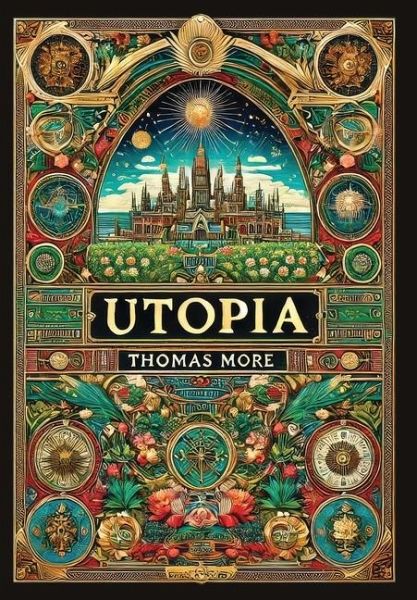
Collector's Edition Laminated Hardback with Jacket What if there was a hidden island where everyone lived in perfect equality, untouched by the greed and corruption of the outside world? Raphael Hythloday, a wanderer with astonishing tales, reveals the secrets of Utopia-a society where wealth is shared, private property is abolished, and reason guides every decision. As he paints a picture of this remarkable civilization, his story dares you to question the flaws of your own society. With each detail, the boundaries between imagination and possibility blur, leaving you wondering: could such a…mehr
Collector's Edition Laminated Hardback with Jacket What if there was a hidden island where everyone lived in perfect equality, untouched by the greed and corruption of the outside world? Raphael Hythloday, a wanderer with astonishing tales, reveals the secrets of Utopia-a society where wealth is shared, private property is abolished, and reason guides every decision. As he paints a picture of this remarkable civilization, his story dares you to question the flaws of your own society. With each detail, the boundaries between imagination and possibility blur, leaving you wondering: could such a place ever exist? Written in 1516, Utopia by Sir Thomas More revolutionized how people imagined society by introducing the concept of an ideal world shaped by reason and equality. It sparked debates across Europe about governance, justice, and the flaws of contemporary systems, influencing political thought for centuries. More's blending of fiction and philosophy made it a cornerstone of Renaissance humanism, inspiring countless reformers and thinkers. Even today, its ideas challenge us to question societal norms and envision a better, more equitable future.
Born on February 7, 1478, in London, Sir Thomas More was an English lawyer, social philosopher, author, and statesman. He studied at the University of Oxford and later pursued legal training at Lincoln's Inn, establishing a reputation for his intellect and integrity. More's humanist ideals and devout Catholic faith profoundly influenced his life's work.In 1516, More published Utopia, a seminal work that depicted an idealized society on a fictional island, critiquing contemporary European politics and social structures. His literary contributions and sharp mind led to his appointment as Lord Chancellor under King Henry VIII in 1529. During his tenure, More staunchly opposed the Protestant Reformation, engaging in debates against figures like Martin Luther and William Tyndale.More's refusal to endorse Henry VIII's separation from the Catholic Church and the annulment of the king's marriage to Catherine of Aragon led to his resignation in 1532. His steadfast principles resulted in charges of treason, culminating in his execution on July 6, 1535. Canonized by the Catholic Church in 1935, Sir Thomas More remains a symbol of moral integrity and conviction.
Es gelten unsere Allgemeinen Geschäftsbedingungen: www.buecher.de/agb
Impressum
www.buecher.de ist ein Internetauftritt der buecher.de internetstores GmbH
Geschäftsführung: Monica Sawhney | Roland Kölbl | Günter Hilger
Sitz der Gesellschaft: Batheyer Straße 115 - 117, 58099 Hagen
Postanschrift: Bürgermeister-Wegele-Str. 12, 86167 Augsburg
Amtsgericht Hagen HRB 13257
Steuernummer: 321/5800/1497
USt-IdNr: DE450055826