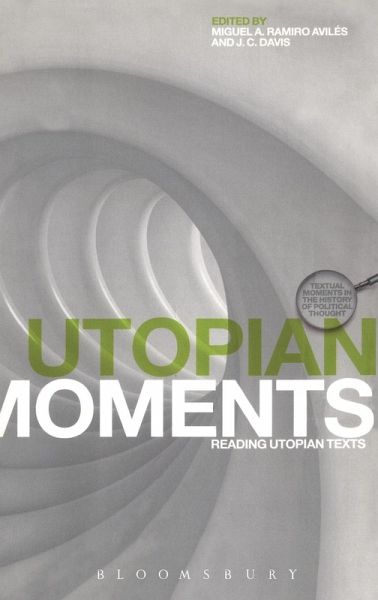
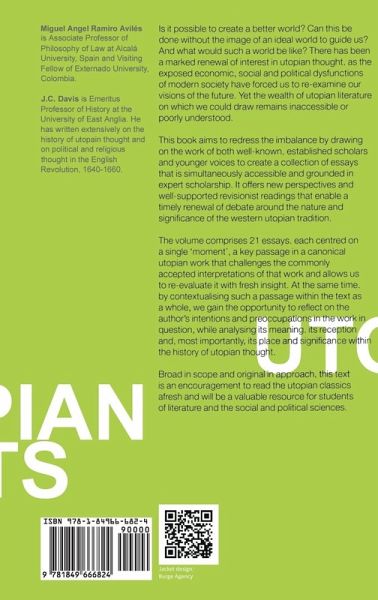
This book is available as open access through the Bloomsbury Open Access programme and is available on www.bloomsburycollections.com. Is it possible to create a better world? Can this be done without the image of an ideal world to guide us? What would such a world be like? There has been a marked renewal of interest in utopian thought, as the exposed economic, social and political dysfunctions of modern society have forced us to re-examine our visions of the future. Yet the wealth of utopian literature on which we could draw remains inaccessible or poorly understood. This book readdresses this…mehr
This book is available as open access through the Bloomsbury Open Access programme and is available on www.bloomsburycollections.com. Is it possible to create a better world? Can this be done without the image of an ideal world to guide us? What would such a world be like? There has been a marked renewal of interest in utopian thought, as the exposed economic, social and political dysfunctions of modern society have forced us to re-examine our visions of the future. Yet the wealth of utopian literature on which we could draw remains inaccessible or poorly understood. This book readdresses this imbalance, with a collection of essays, each centred on a key passage in a canonical utopian work that challenges the commonly accepted interpretation of that work and allows us to examine it with fresh insight. At the same time, by contextualising each passage within the text as a whole, readers are enabled to reflect on the meaning and reception of the work and on its significance in the history of utopian thought. Broad in scope and original in approach, this textbook is an encouragement to students and scholars alike to read the utopian classics afresh.
J.C. Davis is Emeritus Professor of History at the University of East Anglia. He has written extensively on the history of utopian thought and on political and religious thought in the English Revolution 1640-1660. He is the author of Utopia and the Ideal Society (1981), and numerous other writings on Utopian thought which are benchmarks in the field. Described as a 'brilliant and provocative iconoclast', he taught at a number of universities in the UK and abroad and set up the School of History at the University of East Anglia. Miguel Angel Ramiro Avilés is Assistant Professor of Philosophy of Law at Alcalá University and Visiting Fellow of Externado University (Bogotá, Colombia). He is member of the Monitoring Boby of the National Human Rights Action Plan. He was previously Senior Lecturer at Carlos III de Madrid University, where he was Deputy Director of the "Bartolomé de las Casas" Human Rights Institute and Director of the Human Rights Master Program.
Inhaltsangabe
J.C. Davis and Miguel A. Ramiro Avilés, Introduction George M. Logan, Thomas More's "Utopia" (tbc) Susan Bruce, Colonialists, Refugees and the Nature of Sufficiency J.C. Davis, Reading "Utopia" Bronwen Price, 'A dark light': Spectacle and Secrecy in Francis Bacon's "New Atlantis" Maurizio Cambi, Tommaso Campanella, the "City of Sun" and the guardian stars. Edward Thompson, Johann Valentin's "Christianopolis" (tbc) Nadia Minerva, So Close, So Far: the Puzzle of "Antangil" Miguel Angel Ramiro Avilés, "Sinapia", a Political Journey to the Antipodes of Spain John Christian Laursen and Cyrus Masroori, The Persian Moment in Denis Veiras's "History of the Sevarambians" John Gurney, Gerrard Winstanley's "The Law of Freedom": Context and Continuity J.C. Davis, 'de te Fabula narratur': "Oceana" and James Harrington's Narrative Constitutionalism Gaby Mahlberg, An island with potential: Henry Neville's "The Isle of Pines" K. Steven Vincent, Marie Jean Antoine Nicolas Caritat, marquis de Condorcet (1743-1794) (tbc) Claudio de Boni, Nature and Utopia in Morelly's "Code De La Nature" David Leopold, The Utopian Organization of Work in Icaria Gregory Claeys, A Tale of Two Cities: Robert Owen and the Search for Utopia, 1815-1817 Jonathan Beecher, Women's Rights and Women's Liberation and the 'Riddle' of Charles Fourier's "Theory of the Four Movements" Neil McWilliam, How to Change the World: Claude-Henri de Rouvroy, comte de Saint-Simon Matthew Beaumont, The Horror of Strangeness: Bellamy's Psychology of the Utopian Imagination in "Looking Backward" Richard Nate, The incompatibility I could not resolve: Ambivalence in H.G. Wells's "A Modern Utopia" Laurence Davis and Peter G. Stillman, Utopian Journeying: Ursula K. Le Guin's "The Dispossessed" Lyman Tower Sargent, Conclusion
J.C. Davis and Miguel A. Ramiro Avilés, Introduction George M. Logan, Thomas More's "Utopia" (tbc) Susan Bruce, Colonialists, Refugees and the Nature of Sufficiency J.C. Davis, Reading "Utopia" Bronwen Price, 'A dark light': Spectacle and Secrecy in Francis Bacon's "New Atlantis" Maurizio Cambi, Tommaso Campanella, the "City of Sun" and the guardian stars. Edward Thompson, Johann Valentin's "Christianopolis" (tbc) Nadia Minerva, So Close, So Far: the Puzzle of "Antangil" Miguel Angel Ramiro Avilés, "Sinapia", a Political Journey to the Antipodes of Spain John Christian Laursen and Cyrus Masroori, The Persian Moment in Denis Veiras's "History of the Sevarambians" John Gurney, Gerrard Winstanley's "The Law of Freedom": Context and Continuity J.C. Davis, 'de te Fabula narratur': "Oceana" and James Harrington's Narrative Constitutionalism Gaby Mahlberg, An island with potential: Henry Neville's "The Isle of Pines" K. Steven Vincent, Marie Jean Antoine Nicolas Caritat, marquis de Condorcet (1743-1794) (tbc) Claudio de Boni, Nature and Utopia in Morelly's "Code De La Nature" David Leopold, The Utopian Organization of Work in Icaria Gregory Claeys, A Tale of Two Cities: Robert Owen and the Search for Utopia, 1815-1817 Jonathan Beecher, Women's Rights and Women's Liberation and the 'Riddle' of Charles Fourier's "Theory of the Four Movements" Neil McWilliam, How to Change the World: Claude-Henri de Rouvroy, comte de Saint-Simon Matthew Beaumont, The Horror of Strangeness: Bellamy's Psychology of the Utopian Imagination in "Looking Backward" Richard Nate, The incompatibility I could not resolve: Ambivalence in H.G. Wells's "A Modern Utopia" Laurence Davis and Peter G. Stillman, Utopian Journeying: Ursula K. Le Guin's "The Dispossessed" Lyman Tower Sargent, Conclusion
Es gelten unsere Allgemeinen Geschäftsbedingungen: www.buecher.de/agb
Impressum
www.buecher.de ist ein Internetauftritt der buecher.de internetstores GmbH
Geschäftsführung: Monica Sawhney | Roland Kölbl | Günter Hilger
Sitz der Gesellschaft: Batheyer Straße 115 - 117, 58099 Hagen
Postanschrift: Bürgermeister-Wegele-Str. 12, 86167 Augsburg
Amtsgericht Hagen HRB 13257
Steuernummer: 321/5800/1497
USt-IdNr: DE450055826