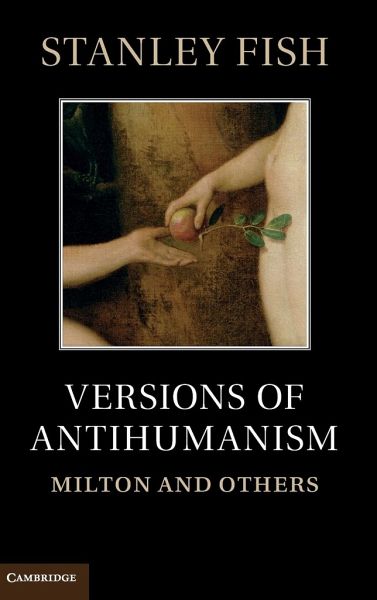
Stanley Fish, one of the foremost critics of literature working today, has spent much of his career writing and thinking about Milton. This book brings together his finest published work with brand new material on Milton and on other authors and topics in early modern literature. In his analyses of Renaissance texts, he meditates on the interpretive problems that confront readers and offers a sustained critique of historicist methods of interpretation. Intention, he argues, is key to understanding which pieces of historical data are relevant to literary criticism. Lucid, provocative, direct…mehr
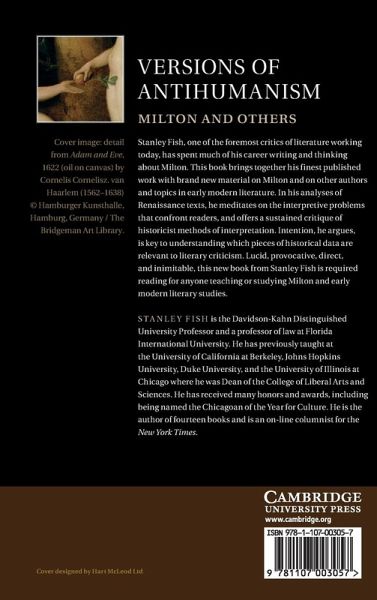
Stanley Fish, one of the foremost critics of literature working today, has spent much of his career writing and thinking about Milton. This book brings together his finest published work with brand new material on Milton and on other authors and topics in early modern literature. In his analyses of Renaissance texts, he meditates on the interpretive problems that confront readers and offers a sustained critique of historicist methods of interpretation. Intention, he argues, is key to understanding which pieces of historical data are relevant to literary criticism. Lucid, provocative, direct and inimitable, this new book from Stanley Fish is required reading for anyone teaching or studying Milton and early modern literary studies.
Stanley Fish is the Davidson-Kahn Distinguished University Professor and a Professor of Law at Florida International University. He has previously taught at the University of California, Berkeley, Johns Hopkins University, Duke University and the University of Illinois, Chicago where he was Dean of the College of Liberal Arts and Sciences. He has received many honors and awards, including being named the Chicagoan of the Year for Culture. He is the author of fourteen books and is a weekly columnist for The New York Times.
Inhaltsangabe
Introduction Part I. Milton: 1. The Brenzel lectures 2. To the pure all things are pure: law, faith and interpretation in the prose and poetry of John Milton 3. 'There is nothing he cannot ask': Milton, liberalism, and terrorism 4. Why Milton matters, or against historicism 5. Milton in popular culture 6. How the reviews work 7. The New Milton criticism Part II. Early Modern Literature: 8. Void of storie: the struggle for insincerity in Herbert's prose and poetry 9. Authors-readers: Jonson's community of the same 10. Marvell and the art of disappearance 11. Masculine persuasive force: Donne and verbal power 12. How Hobbes works Index.
Es gelten unsere Allgemeinen Geschäftsbedingungen: www.buecher.de/agb
Impressum
www.buecher.de ist ein Internetauftritt der buecher.de internetstores GmbH
Geschäftsführung: Monica Sawhney | Roland Kölbl | Günter Hilger
Sitz der Gesellschaft: Batheyer Straße 115 - 117, 58099 Hagen
Postanschrift: Bürgermeister-Wegele-Str. 12, 86167 Augsburg
Amtsgericht Hagen HRB 13257
Steuernummer: 321/5800/1497
USt-IdNr: DE450055826