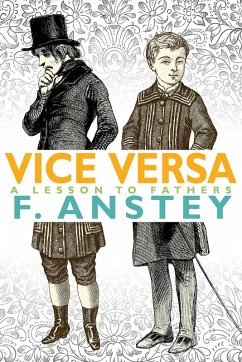
Set in Victorian times, VICE VERSA concerns business man Paul Bultitude and his son Dick. Dick is about to leave home for a boarding school which is ruled by the cane wielding headmaster Dr. Grimstone. Bultitude, seeing his son's fear of going to the school, foolishly says that schooldays are the best years of a boy's life, and how he wished that he was the one so doing. At this point, thanks to a handy magic stone brought by an uncle from India which grants the possessor one wish, they are now on even terms. Dick, now holding the stone, is ordered by his father to turn him back into his own…mehr
Set in Victorian times, VICE VERSA concerns business man Paul Bultitude and his son Dick. Dick is about to leave home for a boarding school which is ruled by the cane wielding headmaster Dr. Grimstone. Bultitude, seeing his son's fear of going to the school, foolishly says that schooldays are the best years of a boy's life, and how he wished that he was the one so doing. At this point, thanks to a handy magic stone brought by an uncle from India which grants the possessor one wish, they are now on even terms. Dick, now holding the stone, is ordered by his father to turn him back into his own body, but Dick refuses, and decides instead to become his father, and so the fun begins.
Thomas Anstey Guthrie (writing as F. Anstey or FT Anstey), was an English writer best known for his humorous novel Vice Versa, about a boarding school child and his father who switch identities. The Tinted Venus, as well as other funny parodies in Punch magazine, reinforced his reputation. He was born in Kensington, London, to organist and composer Augusta Amherst Austen and Thomas Anstey Guthrie. He was educated at King's College School and Trinity Hall, Cambridge, and admitted to the bar in 1880. Guthrie's younger brother, Leonard Guthrie (1858-1918), was a physician. The widespread success of his story Vice Versa (1882), with its topsy-turvy replacement of a father for his schoolboy son, established him as an innovative comedian. In 1883, he wrote a serious book, The Giant's Robe, which George Gissing called'very poor stuff'. Anstey learned (again in 1889 with The Pariah) that the public preferred to consider him as a comic rather than a serious author. As a result, his fame was reinforced by The Black Poodle (1884), The Tinted Venus (1885), A Fallen Idol (1886), and other masterpieces.
Es gelten unsere Allgemeinen Geschäftsbedingungen: www.buecher.de/agb
Impressum
www.buecher.de ist ein Internetauftritt der buecher.de internetstores GmbH
Geschäftsführung: Monica Sawhney | Roland Kölbl | Günter Hilger
Sitz der Gesellschaft: Batheyer Straße 115 - 117, 58099 Hagen
Postanschrift: Bürgermeister-Wegele-Str. 12, 86167 Augsburg
Amtsgericht Hagen HRB 13257
Steuernummer: 321/5800/1497
USt-IdNr: DE450055826